


Quick Summary:
- Match the seat label to your child’s weight, height, and age range.
- Check harness or belt routing sits correctly, with no twists.
- Do a tightness test, the seat should move under one inch.
- If it’s wrong, request a swap immediately, before leaving the lot.
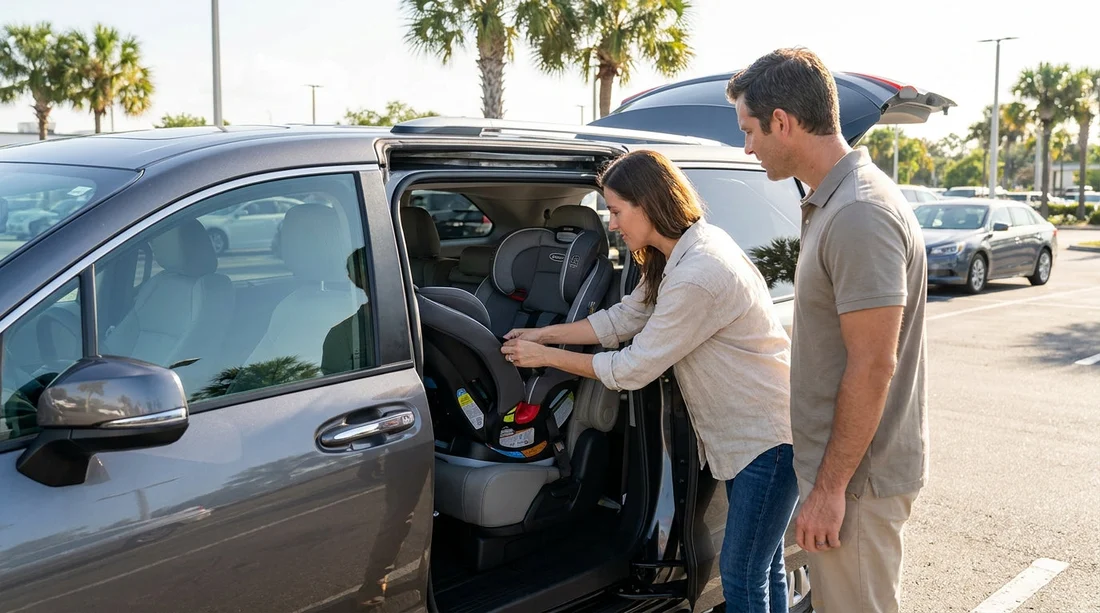
Picking up a rental car after a flight into Orlando is rarely the moment you want surprises, especially when you have a child seat add-on. Child seats supplied with car hire can vary by brand, model, and condition, so it is worth doing a short, systematic check at the counter or in the collection area before you drive away.
This guide explains what the common seat group labels mean, how to check the seat is the right size for your child, and what to do if it is not suitable. It focuses on practical steps you can complete in a few minutes at pick-up in Orlando, including quick fit checks for both rear-facing and forward-facing seats, and booster seats.
If you are collecting around the airport, it helps to plan a little extra time into your arrival day, particularly at https://holacarrentals.com/pages/car-rental-airport-orlando-mco locations where the handover area can be busy and you may need to ask staff for an alternative seat.
1) Start with the label, not the guess
The fastest way to verify size is to find the manufacturer label on the side or back of the seat. Look for weight and height ranges, and sometimes an age guideline. Do not rely on “infant”, “toddler”, or “booster” alone, those words can be used loosely.
In general, you may see these categories:
Infant (rear-facing), commonly suitable for smaller babies, with a lower weight range and a reclined position. Some are “infant carrier” style with a handle, others are compact convertible seats set to rear-facing.
Toddler (convertible or forward-facing), used rear-facing for younger toddlers or forward-facing once the child meets the seat’s forward-facing minimums. The key is the label’s rear-facing and forward-facing ranges, which can differ.
Booster, used when a child is too big for a harnessed seat but not yet ready for an adult seat belt alone. Boosters are either high-back or backless, and both require the car’s seat belt to fit correctly.
If you booked “child seat” with your car hire, confirm at the desk what type was reserved and whether your child’s approximate weight and height fit that type. If you are using a service at https://holacarrentals.com/pages/car-rental-orlando-mco, it is sensible to keep your child’s latest weight and height in your phone notes so you can compare quickly.
2) Know the minimum checks by seat type
Once the label matches your child, do a quick physical fit check. You do not need perfection at the kerb, but you do need safety basics: correct orientation, correct harness or belt routing, and a tight install.
Rear-facing infant or convertible seat checks
Recline and head position: the seat should be reclined enough to keep the child’s head from flopping forward. Many seats have a level line or bubble indicator. If the indicator shows “too upright” for a small baby, request guidance or a different model.
Harness height: rear-facing harness straps generally need to come from at or below the child’s shoulders. If the lowest harness slot is already above your child’s shoulders, the seat is not the right size.
Harness snugness: pinch the webbing at the collarbone area, if you can pinch a fold, it is too loose. The chest clip should sit armpit level.
Forward-facing toddler seat checks
Harness height: forward-facing straps should generally come from at or above the shoulders. If the top slot is still below the shoulders, the seat is too small.
Top tether awareness: many forward-facing seats use a top tether strap to reduce head movement. Ask where the tether anchor is in your rental vehicle and whether the seat is designed to use it. If staff fit the seat for you, confirm the tether is not left loose.
Head support: ensure the child’s ears are within the shell or supported by the headrest, depending on seat design. If the head is above the top of the seat back, it is likely outgrown.
Booster seat checks
Seat belt fit: the lap belt should sit low on the hips and upper thighs, not on the stomach. The shoulder belt should cross the middle of the shoulder and chest, not the neck and not slipping off the shoulder.
Booster height: with a high-back booster, the belt guide should be at or just above the child’s shoulder level. With a backless booster, make sure the vehicle’s headrest supports the child’s head adequately.
Because Florida travel often includes longer drives and theme park traffic, families choosing larger vehicles sometimes consider people carriers. If that is your plan, vehicle space can make correct belt routing easier, especially with multiple children. See options like https://holacarrentals.com/en-gb/pages/minivan-hire-disney-orlando-mco if you are comparing layouts for boosters and harnessed seats across a second row and third row.
3) Do the “one inch” install test before leaving
Even the right size seat is not safe if it is loose. Whether the seat is installed with LATCH (lower anchors) or with the car’s seat belt, do this quick check:
Grip the seat at the belt path, the point where the strap runs through the seat. Pull side-to-side and front-to-back firmly. If it moves more than about one inch (2.5 cm) at the belt path, it needs tightening or refitting.
Press down while tightening: use your body weight to compress the vehicle cushion as you tighten the strap or belt.
Check for twists: a twisted strap can look tight but will not hold properly. Flatten the webbing before you lock it down.
If your rental company staff install the seat, still do the one inch test yourself. It is your final check before you drive out of the collection area, and it takes seconds.
4) What to do if the seat is not suitable
If the seat does not fit your child’s size range, is missing parts, fails the tightness test, or appears expired or damaged, deal with it immediately, before you leave the pick-up area.
Ask for a swap, not an adjustment: if the label range does not match your child, no amount of strap tightening fixes it. Request the correct category, for example rear-facing infant seat instead of forward-facing toddler seat, or a high-back booster instead of backless if belt fit is poor.
Request assistance fitting it: many locations will help demonstrate installation. Ask them to show you the belt path they are using, and then repeat the one inch test yourself.
Consider vehicle choice: if you have three seats across, a narrow back seat can make a correct install difficult. If the seat is correct but the car layout is the issue, discuss alternatives that have more rear width or easier anchor access. Larger options are covered at https://holacarrentals.com/en-gb/pages/van-hire-orlando-mco.
Document the issue: take clear photos of the label and the problem (missing parts, damage, expiry date). Keep it calm and factual. This helps if there is any disagreement about availability or fees.
If you are arriving on a UK flight and picking up under a UK-facing rental page, note that terminology can differ, so keep your checks label-based rather than language-based. The Orlando airport page at https://holacarrentals.com/en-gb/pages/car-hire-orlando-mco is a helpful reference point for organising the rest of your car hire details so you can focus on the seat at handover.
FAQ
How do I know whether I need an infant seat, toddler seat, or booster?
Use your child’s current weight and height, then match them to the seat label ranges. “Infant” usually means rear-facing, “toddler” usually means a harnessed seat, and “booster” uses the car’s seat belt, but the label is the deciding factor.
What is the quickest safety check at car hire pick-up?
After confirming the label fits your child, do the one inch movement test at the belt path. If the seat moves more than about one inch, it needs refitting or tightening before you drive.
If the seat looks worn but not broken, should I still accept it?
Light cosmetic scuffs are common, but avoid seats with frayed straps, a sticky buckle, missing labels, cracks, or an expired use-by date. If you are unsure, ask for another seat.
Can a booster be unsafe even if my child meets the weight minimum?
Yes. Boosters depend on correct belt fit. If the shoulder belt sits on the neck, slips off the shoulder, or the lap belt rides on the stomach, ask for a different booster style or adjust seating position.
What should I do if the correct seat type is unavailable?
Raise it immediately at the pick-up point and ask what suitable alternatives exist, including a different seat model or vehicle with better belt geometry. If no safe option is available, do not drive until the issue is resolved.































































































