


Quick Summary:
- Check whether your rental uses a transponder plan or toll-by-plate billing.
- Expect tolls to post later, and some suppliers add admin fees.
- Write down the number plate and rental agreement number before leaving.
- Ask how disputes work if a toll charge appears after return.
New York has moved many bridge and tunnel crossings to cashless tolling, meaning there is no staffed booth where you can hand over coins or a card. For drivers using car hire, the practical question is simple: if you pass under a gantry, how does the toll reach you, and what extra fees might be added by the rental company?
In most cases, cashless tolls on a New York rental car are billed through either an in-car transponder (often linked to E-ZPass systems) or via toll-by-plate using the vehicle registration. The rental company then charges your card on file after the toll data is received. Because toll transactions can arrive days or even weeks later, the charge may appear after you have returned the car.
If you are collecting at or near the New York metro airports, it is common to pick up in New Jersey and drive straight into New York City crossings. Hola Car Rentals frequently helps travellers compare options around Newark, so it is worth reviewing pick-up details for your trip, for example car hire at Newark Airport (EWR) or car hire in Newark (EWR), because toll policies often vary by supplier even at the same location.
Why New York tolls feel different to visitors
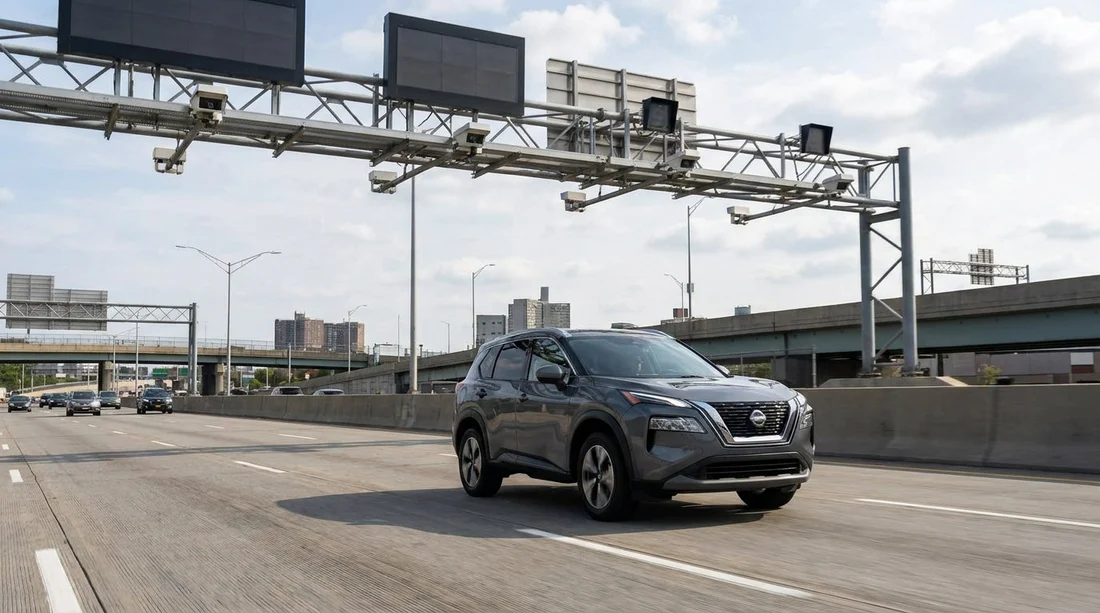
Many bridges and tunnels in and around New York City use overhead readers and cameras. If your vehicle has a transponder, the system attempts to read it as you pass. If not, cameras capture the number plate and the toll is billed to the vehicle owner, which for a rental is the rental company. Either way, you rarely have a chance to pay on the day at the roadside.
This is why cashless tolling and car hire can be confusing. You are driving a vehicle registered to someone else, and you may not know in advance whether a transponder is installed, active, or tied to a daily toll plan. The key is confirming the billing method and fee structure before you drive off the forecourt.
The two common billing methods on New York rental cars
1) Transponder-based charging (E-ZPass style)
Many rental fleets have a transponder fitted to the windscreen area. If it is active and associated with your rental agreement, tolls are captured electronically. Rental companies may offer an opt-in toll programme where you pay a daily fee for the days the device is used, plus the tolls themselves. Some programmes charge a daily fee for every day of the rental once activated, others charge only on days when you pass a toll point.
2) Toll-by-plate charging
If there is no active transponder, or if the system does not read it, toll agencies bill by the vehicle’s number plate. The invoice goes to the registered owner, which is the rental company. The rental company then matches the toll to your rental agreement and charges your payment card, typically adding an administrative fee to cover processing.
In practice, both methods can occur on the same trip if a transponder fails to read at a particular gantry. This is one reason to ask how your supplier handles mixed transactions, and whether a toll-by-plate event triggers extra fees even if you opted into a transponder plan.
What you may be charged, beyond the toll itself
Cashless toll costs on a rental car usually fall into three buckets.
The toll amount set by the toll agency, which can vary by crossing, vehicle class, and whether the system treated the car as transponder or plate-billed.
A toll programme fee from the rental company, often a daily fee when the toll programme is in use. The exact rules matter: daily when used can be very different from daily for the rental once used. Clarify which applies to your agreement.
An administrative or processing fee, commonly applied when the rental company receives a toll-by-plate notice and has to allocate it to your rental. Some companies cap admin fees per toll event or per billing period, while others do not. Because these are supplier-specific terms, the best protection is to read the toll policy section on your agreement and ask for a plain-language summary at the counter.
If you are comparing suppliers around Newark for driving into New York, pages such as Hertz at Newark (EWR), Alamo in New Jersey (EWR), and Dollar at New Jersey (EWR) can help you narrow down a provider, then you can focus your questions about tolls on that supplier’s policy at pick-up.
What to confirm at the counter before you drive off
To avoid surprises, treat tolling as a checklist item alongside fuel and insurance.
Ask whether the vehicle has a transponder and whether it is already enabled. If it is present but disabled unless you opt in, you need to know how to enable it properly, and some systems activate automatically when you pass through a toll point.
Ask what happens if you do nothing. With cashless tolling, doing nothing typically means toll-by-plate and later billing, which may carry higher toll rates and admin fees. Understanding the default path helps you decide whether a toll programme is worth it for your route.
Confirm the fee structure in writing. Specifically, ask whether any daily fee is charged only on toll days, or on all rental days after first use. Also ask whether admin fees apply per toll, per day, or per statement.
Confirm the billing timeline. Ask how long after return tolls can still be charged. It is normal for tolls to post later, but you should know the rough window so you can recognise legitimate charges on your card statement.
Record identifiers. Note the number plate, rental agreement number, and the time you picked up and returned the vehicle. If a toll is misallocated, these details make it far easier to investigate.
FAQ
Do I pay New York bridge and tunnel tolls at the booth in a rental car? No, many crossings are cashless, so tolls are captured electronically by transponder or number plate and billed later.
Will toll charges show up immediately on my card? Not usually. Tolls can post days or weeks after your rental ends, because the toll authority and rental company process transactions in batches.
What is the difference between a transponder plan and toll-by-plate? A transponder plan bills tolls electronically, often with a daily programme fee. Toll-by-plate bills the vehicle owner by the plate, then the rental company recharges you, often with admin fees.
Can I use my own E-ZPass in a rental car? Sometimes, but you must ensure the rental’s transponder is not active to avoid double billing, and you may need to add the rental plate to your account. Confirm the correct method at pick-up.
What should I do if I think a toll charge is wrong? Contact the rental company first with your agreement number and dates. Ask for a breakdown of tolls versus fees, and request a review if the transaction does not match your travel.































































































