


Quick Summary:
- Expect ‘compact’ to fit two cabin bags, not four large suitcases.
- ‘Midsize’ usually suits two large cases plus two small, with care.
- Choose an SUV mainly for taller items, not automatically more litres.
- For five adults with luggage, consider minivan size to avoid compromises.
US rental car categories look clear on paper, but luggage space varies far more than most travellers expect. When arranging car hire in Miami, the difference between “compact”, “midsize”, and “full size” can be the difference between a stress free airport pickup and a boot that will not shut. The goal is to translate the labels into practical expectations, based on typical boot shapes, opening sizes, and the kinds of suitcases people actually bring.
Two important notes before diving in. First, you are reserving a class, not a specific model, so luggage capacity is a range. Second, US class names are not always aligned to UK terms, especially around “intermediate”, “standard”, and “full size”. If you collect near the airport area or Coral Gables, see car hire airport Coral Gables for local pickup context, then use the guidance below to pick a class that matches your bags, not just your passengers.
How to think about luggage, not just “number of bags”
Counting suitcases is a start, but the shape matters more than the label. A large suitcase might be 75 to 80 cm tall, and two “medium” cases can be bulkier than one large when trying to fit around a boot hinge. Also consider:
Boot opening height: Some saloons have good volume but a narrow opening, making hard shell cases awkward.
Depth behind the rear seats: Hatchbacks can be short in depth, so cases must be stacked, which can block rear visibility.
Carry on items: Backpacks, cooler bags, and prams create “dead space” unless you have a square boot.
Miami reality: If you are parking in tighter areas such as Brickell or Downtown, upsizing solely for luggage can create a different headache. Location matters, and so does where you will drive. For city focused stays, you may compare options on car hire Downtown Miami or Avis car hire Brickell and weigh parking convenience against boot needs.
US size classes translated into realistic boot expectations
Below are typical luggage expectations for common US categories. Use them as a planning baseline, then add one class if you dislike “Tetris packing” or have rigid suitcases.
Economy and Compact
Typical cars: small saloons and hatchbacks. You often see models such as Nissan Versa or similar in this bracket, but it varies.
Realistic luggage: 1 large suitcase plus 1 small suitcase, or 2 cabin bags and a couple of soft backpacks.
What surprises people: A compact may seat 4 to 5, but that assumes minimal luggage. With four adults, the boot usually forces at least one suitcase into the back seat. If you are planning a beach and shopping heavy trip, compact can feel tight quickly.
Intermediate and Midsize
Typical cars: slightly longer saloons with better boot depth, sometimes a hatchback.
Realistic luggage: 2 large suitcases plus 1 to 2 small cases, depending on shell shape. A common “works for most” mix is 2 large, 2 cabin bags, and a couple of soft items.
Best for: Two adults plus children, or three adults with normal luggage. This is often the sweet spot for Miami trips where you will drive to the Keys or Orlando and want comfort without stepping up to a larger footprint.
Standard
Typical cars: larger saloons, sometimes with wider boots.
Realistic luggage: 3 large suitcases if they are not oversized, or 2 large plus several smaller items with less stacking stress.
Watch out for: Boot opening still matters. Some standard saloons swallow volume but make it hard to angle a rigid case through the opening. If you bring tall, boxy suitcases, an SUV or a hatch style can be easier even at similar litres.
Full Size
Typical cars: larger saloons with more rear legroom and better boot depth.
Realistic luggage: 3 large suitcases plus 1 small case, or 2 large plus multiple carry ons with room to spare.
When it makes sense: Four adults with airport luggage, especially if you want nothing on laps and do not want to fold a seat down. For many travellers, “full size” is the first category where luggage stops dictating every packing choice.
Premium and Luxury
Typical cars: higher spec saloons or convertibles, depending on what is available.
Realistic luggage: Similar to standard or full size saloons, but varies widely. Convertibles can have notably smaller boots because of the roof mechanism.
Key point: Do not assume “premium” equals bigger boot. You are paying for comfort and features, not guaranteed cargo volume. If luggage is the priority, pick the class based on boot expectations first, then choose comfort level.
SUVs, crossovers, and “midsize SUV”
Typical cars: compact and midsize crossovers with a taller cargo area.
Realistic luggage: Often 2 to 3 large suitcases plus a couple of smaller bags, with easier loading thanks to the hatch opening.
Common misunderstanding: An SUV’s height helps bulky items and prams, but the floor can be higher and the cargo length behind the rear seats can be similar to a saloon. SUVs shine when you have tall items, odd shapes, or you want to stack without scraping the roof liner.
Minivans and people carriers
Typical cars: 7 to 8 seat vans with sliding doors.
Realistic luggage: With all seats in use, luggage space ranges from modest to good, and improves significantly if you can keep one row partially folded. With four to five passengers, you can often take several large cases comfortably.
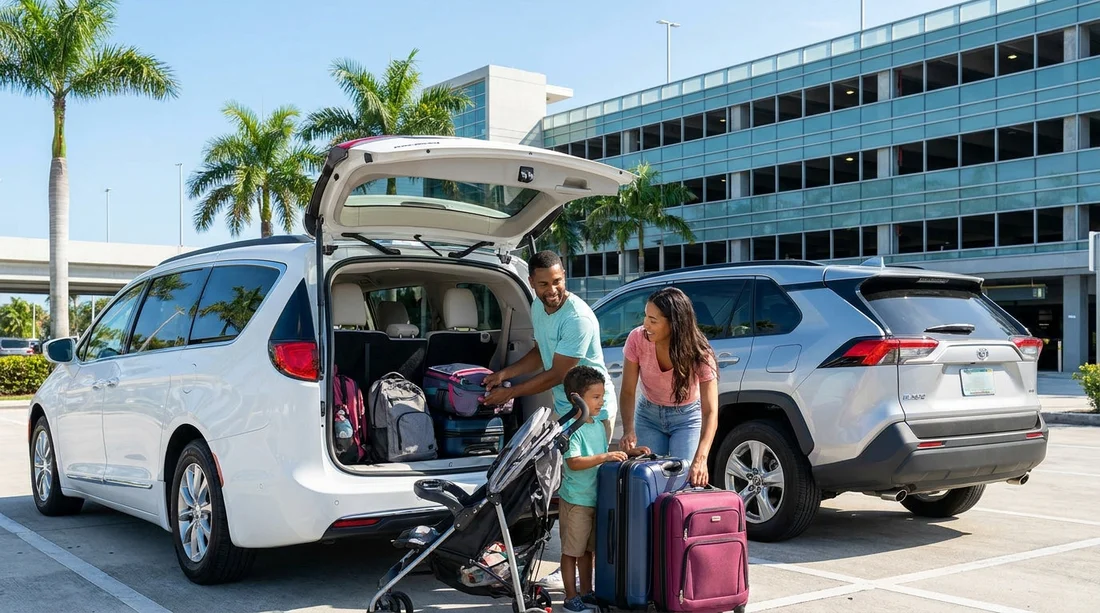
When you should consider it: Five adults with luggage, families with pushchairs, or anyone moving sports gear. If Doral suits your route, minivan hire Doral is a helpful reference point for choosing this type without guessing.
Miami specific scenarios, and what to choose
Two people, one week, mixed plans: Midsize is usually enough for 1 to 2 large suitcases plus day bags, while still being easy to park.
Three adults, all with checked luggage: Standard or full size reduces compromise, especially if you will drive longer distances on Florida highways.
Four adults, airport pickup, hotel drop, shopping: Full size or a midsize SUV prevents luggage riding in the cabin.
Families with pram, beach kit, and extra bags: An SUV can work, but a minivan is the most forgiving if you expect bulky items daily.
Staying in Miami Beach and prioritising parking: Consider whether a larger class will create hassle in tight garages. For provider options in that area, you might compare Avis car rental Miami Beach with your preferred size class and luggage needs in mind.
Practical tips to avoid luggage surprises at pickup
Assume “5 passengers” does not mean “5 suitcases”: Most classes quote seating capacity, not comfortable luggage capacity.
Hard shell cases need more real space: Soft duffels and backpacks fill gaps better, especially in compact and midsize boots.
Consider splitting luggage between passengers: Two medium cases can sometimes fit where one extra large will not.
Plan for day two, not just arrival: Coolers, outlet shopping, and beach chairs quickly consume boot space.
If you want less variability, size up one class: Because models vary within each class, moving up often protects you against a “smaller than expected” vehicle on the day.
FAQ
Q: Does “midsize” in the US mean the same as “medium” in the UK?
A: Not exactly. US midsize often aligns with a UK family saloon, but the boot can still vary a lot by model and whether it is a saloon or hatch.
Q: Can I rely on suitcase icons shown on booking sites?
A: Use them as a rough guide only. They rarely reflect oversized cases, hard shells, or the boot opening shape, which can be the real limiting factor.
Q: Is an SUV always better for luggage on a Miami trip?
A: Not always. SUVs load more easily and suit bulky items, but some have similar cargo length to saloons. Choose an SUV when you need height or flexible stacking.
Q: We are four adults with four large suitcases, what class should we consider?
A: Full size is the safest starting point, and a midsize SUV can also work. If you want guaranteed breathing room, consider a minivan style class.
Q: What if the car in my reserved class has a smaller boot than expected?
A: Because you reserve a class, models can differ. If luggage fit is critical, selecting a higher class reduces risk, and you can discuss alternatives at the counter if available.





























































































