


Quick Summary:
- Many Miami pumps request a US ZIP code, which foreign cards lack.
- Expect a temporary pre-authorisation hold, often $75 to $200.
- Pay inside to bypass ZIP prompts and reduce repeated declines.
- Keep receipts and allow time for holds to settle.
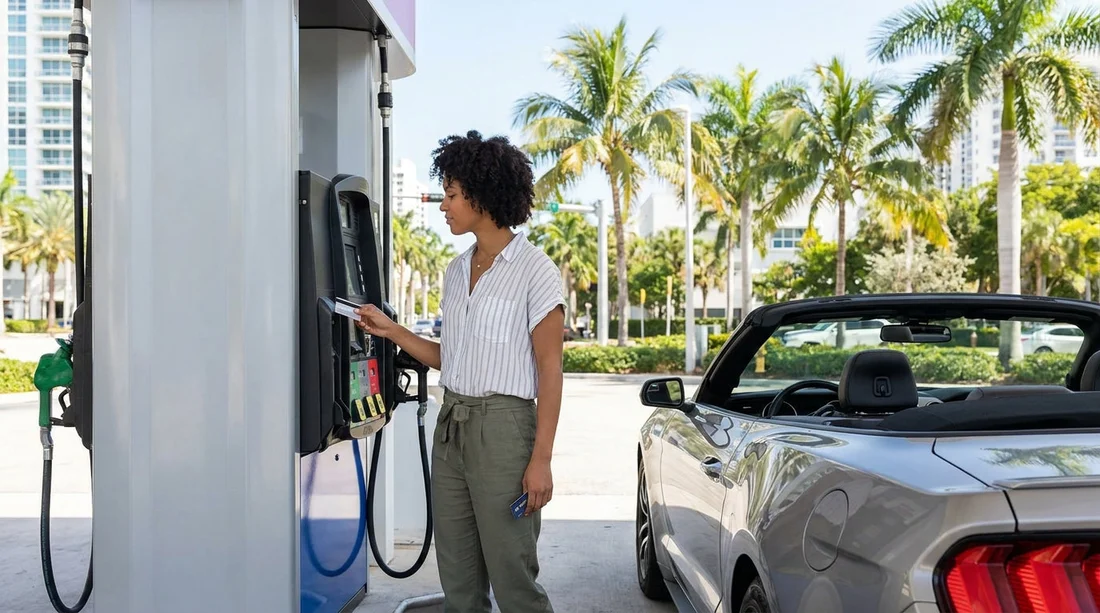
Arriving in Miami and taking the wheel on day one is usually straightforward, until you hit your first petrol station and the pump asks for a ZIP code. If you are using a foreign credit card with your car hire, pay-at-pump can work perfectly well, but it follows US rules that are unfamiliar to many visitors. The good news is that the common problems, such as ZIP prompts and large temporary card holds, have simple, practical fixes.
This guide explains what is happening when a Miami pump requests a ZIP code, why your bank may show a bigger amount than you actually spent, and how to refuel without delays. It is written for travellers using a rental car in Miami, whether you are driving around Brickell, Downtown, Doral, or heading out of the city.
Why Miami fuel pumps ask for a ZIP code
At many US petrol stations, the pump uses a ZIP code prompt as an extra fraud check when you insert or tap a card. The system is typically designed around US-issued cards, where the billing address includes a five-digit ZIP code that the card network can verify. With many foreign cards, that ZIP match is not available, so the pump cannot confirm the address and may decline the transaction or keep looping back to the ZIP screen.
Sometimes the pump will accept alternative inputs. Some terminals accept the ZIP from the address on file with your card, others accept a portion of your postal code converted to numbers, and many accept nothing at all. Because the behaviour varies by station brand and by terminal, it is worth knowing the workarounds before you are low on fuel.
Understanding pre-authorisations and why the amount looks “wrong”
US fuel pumps often place a pre-authorisation hold before dispensing fuel. This is a temporary reservation of funds that confirms the card is valid and has enough available credit. In Miami, holds commonly appear as $75, $100, $150, or $200, even if you only put $42 of fuel into the tank. The final charge should later settle for the exact amount dispensed, and the hold should drop off.
For car hire customers, this can be confusing because it looks like you have been overcharged. In practice, it is usually just the hold. The time for the hold to disappear depends on the station, card network, and your bank. It can be same day, but it can also take several days, particularly on debit cards. If you are travelling with a tighter budget, these holds can reduce your available funds while they are pending.
A practical approach is to use a credit card rather than a debit card for fuel, and to stick to one card for pump transactions so you do not end up with multiple overlapping holds across several cards.
What to do when the pump declines your foreign card
If pay-at-pump fails, it does not necessarily mean your card is blocked. It is usually one of these issues: the ZIP code verification failed, the pump is temporarily offline, the station is restricting certain card types, or your bank is declining an unexpected US transaction.
Try these fixes in order:
1) Switch from pay-at-pump to Pay Inside. Walk into the shop, tell the cashier the pump number, and ask to put a specific amount on your card. This route often bypasses the ZIP prompt entirely because the card is verified at the till, not at the pump.
2) Ask the cashier to authorise the pump. Some stations can start the pump for you after checking ID or processing a smaller authorisation.
3) Use tap-to-pay or chip instead of swipe. Some terminals handle contactless or chip transactions differently than swipe, especially where older pump hardware struggles with foreign cards.
4) Reduce the authorised amount. If you are paying inside, choose an amount closer to what you need, for example $30 or $50, to limit large pending holds.
5) Try another station brand nearby. Terminal settings vary widely. In a busy area like Miami, the next station is usually close.
Choosing the easiest refuelling plan for day one
For most visitors, the smoothest plan is to assume your first stop may require paying inside, then treat pay-at-pump as a convenience when it works. If you are collecting a vehicle near the airport or central neighbourhoods, pick a station with good lighting and a staffed shop, since cashier assistance is part of the workaround.
If you are comparing car hire options and pickup areas, knowing where you will be driving first can help you plan refuelling. Vehicles collected near Miami, Florida car rental locations often head straight onto fast roads where stations are plentiful, but it can still be handy to identify one easy station close to your accommodation for the final top-up.
Neighbourhoods like Brickell can be busy at peak times, so factor in a little extra time for paying inside if you need it. If you are driving an SUV, you may also choose larger stations with easier access and turning space, especially in dense areas near SUV hire in Brickell routes.
If you are based in Doral, you may find a wide choice of modern stations with newer payment terminals, which can be friendlier to foreign cards. This is useful if you are picking up from, or staying near, car rental in Doral areas and want a dependable first refuel.
How fuel charges and receipts help with rental returns
Many rental agreements expect you to return the car with the same fuel level as at pickup, often full to full. That means your last refuel matters. Keep the receipt, even if the pump printed nothing and you had to ask inside. Receipts show the date, time, gallons, and total, which can be useful if there is any question about when you filled up.
Give yourself a buffer before return time. Miami traffic can be unpredictable, and the last thing you want is to arrive late because you had to queue to pay inside. If you are returning around Downtown, build time for a short detour, particularly if you are using services around Downtown Miami car hire corridors where congestion is common.
Also remember that pre-authorisation holds can still be pending when you return the vehicle. That is normal and separate from any car hire deposit. If your bank app shows a high pending amount from the petrol station, check again after settlement, and keep your receipt until the final posted amount matches what you pumped.
FAQ
Why is the petrol station showing a $150 charge when I only bought $40? It is usually a pre-authorisation hold used by pay-at-pump systems. The final posted charge should later change to the amount you actually pumped.
What ZIP code should I enter with a foreign card at a Miami pump? There is no universal ZIP that works. The most reliable solution is to pay inside, where the cashier can process your card without the pump ZIP verification.
Is it better to use a debit card or credit card for pay-at-pump? A credit card is usually easier because holds do not reduce your cash balance, and releases can be faster and more consistent than with debit cards.
Can I prepay inside and still fill the tank completely? Yes. Tell the cashier the pump number and an amount. If you do not use the full amount, the unused portion is not charged, or it is adjusted to the actual dispensed total.
How can I avoid problems on the day I return my rental car? Refuel with time to spare, keep the receipt, and expect any pump hold to remain pending for a short period even after you return the vehicle.

























































































