


Quick Summary:
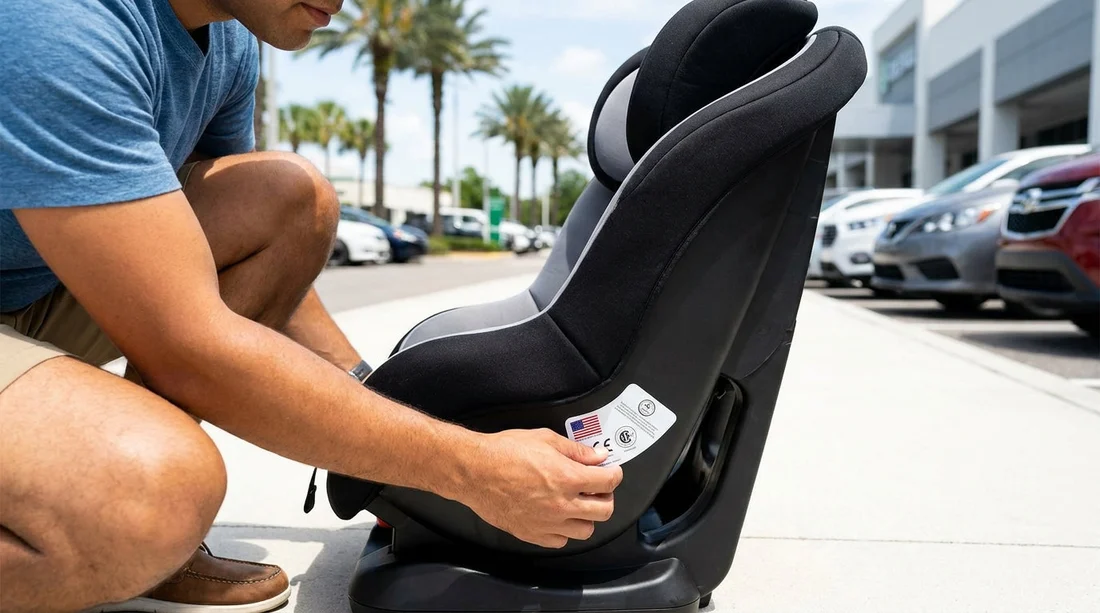
- Find the FMVSS 213 label stating the seat meets US standards.
- Match your child’s weight and height to the seat’s stated limits.
- Inspect shell, harness, and buckle for cracks, frays, or stiffness.
- Test a tight install in your hired vehicle before leaving.
Collecting a prebooked child seat at a car hire counter in Orlando can feel hurried, especially after a flight. The safest approach is a quick inspection, confirming the seat is legal for use in the US, suitable for your child, and in acceptable condition.
If you are collecting from Orlando International Airport, you may find it helpful to review pick-up expectations on car rental airport Orlando MCO and car rental Orlando MCO. Those pages outline where handovers typically happen, which helps you plan time for checks.
1) Confirm the US safety compliance label (FMVSS 213)
The key item is the US compliance statement for child restraints. On most seats it is a white sticker on the side or back of the shell, sometimes under a fabric flap. It should say the restraint conforms to applicable Federal motor vehicle safety standards and reference FMVSS 213.
Locate the compliance sticker: check both sides of the shell, the rear, and near the base. For convertible seats, check around the belt path area.
Read it, do not assume: you want clear wording that it meets US federal standards. If the label is missing, heavily worn, or unreadable, treat that as a fail.
Check the manufacturer and model details: the same label often includes the brand name, model number, and date of manufacture. Note these on your phone so you can reference them if you need a swap.
Why this matters: in the US, child seats used in cars should meet federal standards. A missing compliance label is a strong signal the seat is not suitable or its history is unclear.
2) Verify the seat fits your child’s current size and stage
Even when you have prebooked a child seat, the category provided can vary. Some counters use broad terms such as infant seat or toddler seat, but what you need is the correct fit for your child’s weight, height, and maturity.
Weight range: confirm your child’s current weight sits inside the stated limits. If your child is near the top of the range, ask to switch to the next stage to avoid a poor harness fit.
Rear-facing versus forward-facing: if your child should be rear-facing, confirm the seat allows rear-facing at your child’s weight, and that the recline positions support it.
Harness versus booster: if your child still needs a harnessed seat, do not accept a booster instead.
If you are hiring a larger vehicle for family luggage and easier access, you can compare options on minivan rental Disney Orlando MCO or minivan hire Disney Orlando MCO. A roomier cabin can also make it easier to achieve the correct recline and a tight installation.
3) Check the seat’s condition and completeness
Car hire child seats get heavy use. Focus on safety-critical wear, not cosmetic perfection, and check the seat in good light.
Shell and base: look for cracks, stress whitening, deep scratches, or warped parts. Check the underside too. A cracked shell is an automatic reject.
Harness webbing: pull the straps out and look for fraying, cuts, or melted-looking sections. The webbing should feel strong and smooth, not stiff or fuzzy.
Buckle and chest clip: click the buckle together and release it several times. It should latch positively and release with normal pressure. If it sticks or jams, request a different seat.
All parts present: if the seat needs an insert, a top tether strap, or a detachable base, ensure it is provided. Missing parts can make correct use impossible.
4) Do a tight installation test in the actual vehicle before you leave
The most important practical step is confirming you can install the seat securely in the vehicle you have been assigned. A seat can be compliant and undamaged, but still a poor match for the car’s belt geometry or available anchors.
Identify the attachment method: you may use LATCH anchors within the seat’s permitted weight limits, or the vehicle seat belt. Use only one method unless the seat instructions explicitly say otherwise.
Check belt routing: confirm you are using the correct belt path for rear-facing or forward-facing. Many convertible seats have separate paths.
Tightness at the belt path: once installed, grip the seat at the belt path and try to move it side-to-side and front-to-back. You want minimal movement, typically no more than about one inch at the belt path.
If you cannot achieve a secure install quickly, ask the lot staff whether another vehicle is available, or request a different child seat model.
When to refuse the seat and request a replacement
Request another child seat before leaving the car hire centre in Orlando if the FMVSS 213 compliance label is missing or unreadable, the seat is outside your child’s limits, there are cracks in the shell, key parts are missing, or you cannot get a tight installation.
It can help to be specific and calm, refer to the exact label or issue you found, and ask for a like-for-like replacement or a different model that matches your child’s measurements.
FAQ
Q: What exact US label should I look for on a hired child seat?
A: Look for a statement that the restraint conforms to applicable Federal motor vehicle safety standards, typically referencing FMVSS 213, plus the manufacturer and model details.
Q: If the seat has a compliance label, is it definitely safe to use?
A: It is a key requirement, but you still need to check size limits, missing parts, and that you can install it tightly in your hired vehicle.
Q: Where are the labels usually located on infant and convertible seats?
A: Common places are the side of the shell, the back of the seat, near the belt path, or under a fabric edge near the base.
Q: What should I do if I cannot get the seat tight enough before leaving?
A: Ask staff for help, try a different seating position, or request a different seat model or vehicle, because a loose installation reduces protection significantly.
Q: Can I accept a booster seat instead of a harnessed seat if that is all they have?
A: Only if it matches your child’s age, size, and ability to sit correctly for the whole trip. If your child still needs a harness, request the correct seat type.





























































































