


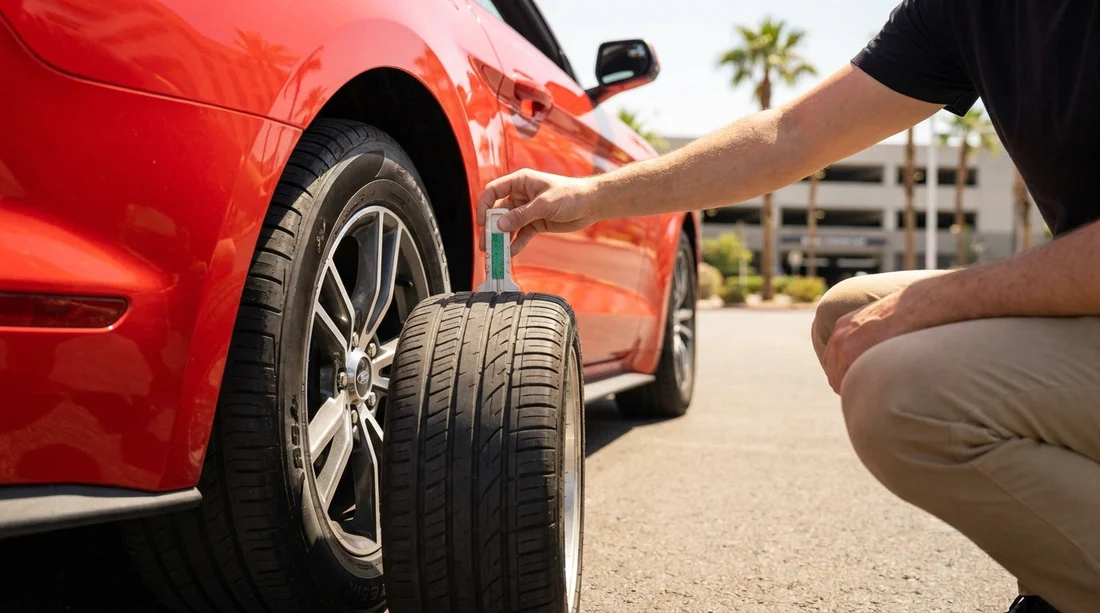
Quick Summary:
- Check each tyre has at least 2 mm tread across main grooves.
- Use a coin or tread gauge, inspect inner, centre, outer edges.
- Refuse tyres showing cords, bulges, cracks, or severe uneven wear patterns.
- Ask staff to note concerns, swap vehicles, and document condition report.
When you pick up a car hire in Las Vegas, a 60 second tyre tread check can prevent a stressful trip later. Tyres are your only contact with the road, and Las Vegas driving often includes high temperatures, long straight motorway miles, and sudden braking around busy junctions. Even if the car looks clean and well presented, the tyres deserve a close look before you leave the car park.
In the US, tyre tread is typically measured in 32nds of an inch, and the legal minimum in many states is 2/32 inch. That is about 1.6 mm. For simple pick-up checks, aim higher than the bare legal minimum. A practical, easy threshold is 2 mm or more across the main grooves, and ideally closer to 3 mm if you plan longer drives or expect rain. Your goal is not to become a mechanic at the counter, it is to spot obviously unsafe tread depth or damage and request a swap before you drive away.
If you are collecting from the airport, build this check into your handover routine. The main benefit is catching issues while staff are nearby and alternative vehicles are available. For airport collections, see information related to Las Vegas airport car rental so you know what to expect at pick-up.
What tread depth should you look for on a Las Vegas rental?
For a rental, you are not trying to achieve a perfect number, you are trying to avoid tyres that are near the end of their life. Use these simple benchmarks:
Minimum acceptable at pick-up: about 2 mm remaining tread depth in the main grooves, and it should be consistent across each tyre. If you see one tyre that is much lower than the others, treat that as a red flag.
Preferred for peace of mind: around 3 mm or more, particularly if you will drive outside Las Vegas, head into higher elevations, or travel during seasons where rain is possible. More tread helps reduce the risk of hydroplaning and improves braking on wet roads.
Immediate no-go: any tyre at or near wear bars, with tread that looks flush with the indicators, or where you can see fabric or metal cords.
Do not worry if the numbers are not exact. What matters is whether the tyre has clearly usable tread and whether wear is even.
A quick, practical tyre check you can do in under two minutes
Park the car where you can safely walk around it, then follow this sequence. It is simple enough to do discreetly, but thorough enough to catch common issues.
1) Check the main grooves, not the tiny sipes. You are looking at the deeper channels that run around the tyre. Tread depth is measured in these grooves, not at the shoulder where small cuts and patterns appear.
2) Inspect three points on each tyre. Look at the inner edge, centre, and outer edge. You do not need to remove a wheel or crawl under the car. Turning the steering wheel full lock left and right helps you see the front tyre inner edges more easily.
3) Use a quick measuring method. A small tread depth gauge is ideal, but a coin works as a rough check. Insert it into the main groove. If the groove looks shallow and the wear bars seem close to the surface, treat it as borderline. If you brought a gauge, note the lowest reading you find, because the lowest point is what matters for safety.
4) Look for uneven wear patterns. Even if the tread seems deep enough, uneven wear can signal alignment or suspension issues that could cause poor handling.
5) Check sidewalls for damage. Tread depth is not the only safety factor. Scan the sidewalls for bulges, cuts, cracking, or a chunk missing. A bulge is an immediate reason to request a different car, as it can indicate internal damage.
6) Compare tyres across the vehicle. The two tyres on the same axle should look broadly similar. If one looks much newer than the other, ask why. Mismatched tyres are not always unsafe, but big differences can affect handling, especially in wet conditions.
Why this matters for Las Vegas driving
Las Vegas roads are generally well maintained, but the environment can be hard on tyres. Summer heat can increase tyre pressure, and long motorway stretches can expose vibration or balance issues that a short city drive might not. Sudden downpours also happen, and low tread increases stopping distances on wet surfaces.
If you are choosing a larger vehicle for comfort on longer routes, it is still worth doing the same tyre check. For example, drivers comparing options like SUV rental in Las Vegas should still inspect tread depth and sidewall condition, because heavier vehicles rely on tyres in good shape for stable braking and steering.
How to request a swap if tread looks unsafe
If anything looks questionable, handle it before you exit the lot. A calm, specific request is usually the fastest way to resolve it.
Step 1: Take clear photos. Photograph the tyre tread close up, including any wear bars, bald patches, or damage. Also take one wider photo showing the tyre on the vehicle, plus the number plate if visible. Photos help if questions arise later.
Step 2: Return to the desk or the exit gate staff. State the issue clearly, for example, “The front right tyre has very low tread on the inner edge,” or “There is a bulge on the sidewall.” Avoid vague complaints, and stick to observable facts.
Step 3: Ask for an alternative vehicle or tyre replacement. In most cases, swapping the vehicle is simplest. If they propose replacing a tyre, ask how long it will take and whether you can wait on-site. If you are on a tight schedule, a vehicle swap is often quicker.
Step 4: Ensure the condition report is updated. If you take the car after a discussion, make sure the paperwork or electronic record notes the tyre condition and any photos you provided. If you swap vehicles, repeat a quick tyre check on the replacement before leaving.
Step 5: Do not feel pressured to accept unsafe tyres. You are responsible for driving the vehicle, so it is reasonable to request a different option if tread is at the limit or wear is uneven in a way that could affect control.
If you are arranging car hire in Las Vegas through a brand partner page, it can help to know where to find pick-up details and policies in advance. For example, these pages provide relevant local context: car rental in Las Vegas, Hertz car rental in Las Vegas, and Enterprise car rental in Las Vegas.
FAQ
What is the minimum tyre tread depth I should accept on a rental car? A practical minimum at pick-up is about 2 mm in the main grooves, evenly across the tyre. If it is near wear bars, or much lower on one edge, request a swap.
How can I check tread depth without tools? Use a coin as a rough guide and focus on whether the main grooves look clearly deep and not close to the wear indicators. Also compare inner, centre, and outer edges for uneven wear.
What tyre damage means I should not drive away? Do not accept tyres with visible cords, sidewall bulges, deep cuts, or cracking that looks severe. Any one of these is a valid reason to ask for another vehicle.
Should I check all four tyres or just the front ones? Check all four. Rear tyres can be more worn than you expect, and uneven wear on any corner can affect braking and stability, especially on wet roads.
What should I say at the counter if the tread looks unsafe? Be specific, show photos, and ask for a vehicle swap or tyre replacement before leaving. Ask staff to record the issue in the condition report so it is documented.































































































