


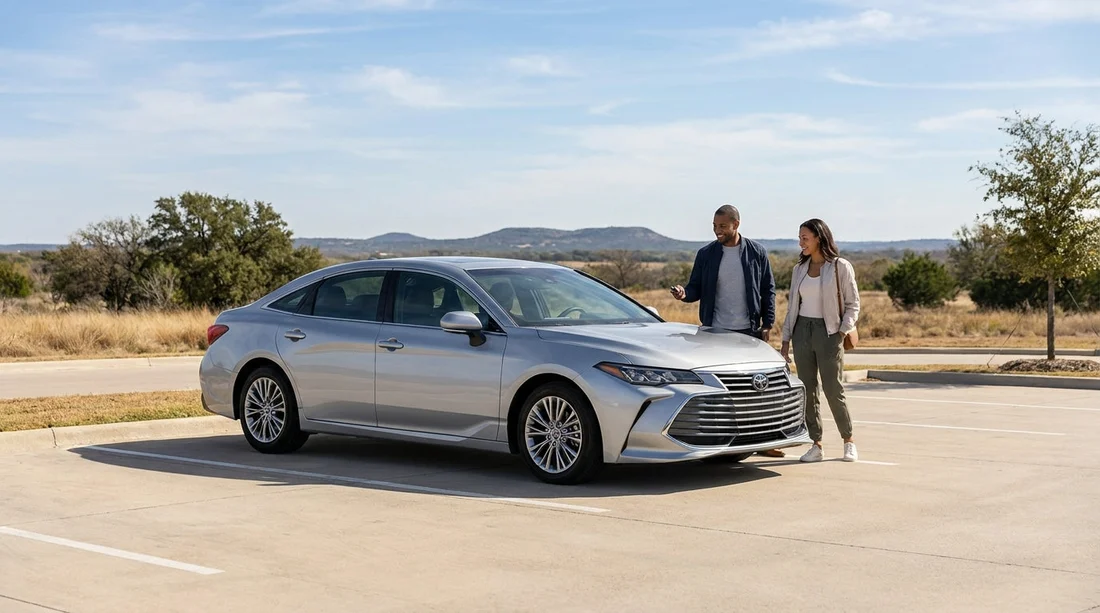
Quick Summary:
- Full-size usually fits five adults comfortably, with noticeably better rear legroom.
- Expect a boot that suits two large suitcases and smaller bags.
- Common examples include Toyota Camry, Nissan Altima, and Chevrolet Malibu.
- “Or similar” means the class is guaranteed, not the exact model.
When you see “Full-size” on a US rental car listing, it can feel reassuring, until you notice the phrase “or similar” and realise the exact car is not promised. For car hire in Texas, understanding what the class generally includes helps you choose the right size for long interstate drives, airport pick-ups, and the very real luggage needs of family trips.
This guide explains what “full-size” typically means in the US rental market, what you can normally expect for cabin and boot space, which cars often appear in the category, and how “or similar” changes the reality at the counter.
What “full-size” generally means in US rental classes
In the US, rental categories are usually based on size and comfort rather than a single manufacturer model. “Full-size” sits above “mid-size” and below “premium” or “luxury” in most fleets. It is commonly a roomy, five-seat saloon (sedan), though some suppliers may include similar-sized vehicles that still meet the class requirements.
If you are collecting at a major airport, selection can be broader and class definitions more consistent. For example, when comparing options around Dallas, listings at Dallas DFW often show full-size as a separate class with multiple possible models behind the scenes.
Typical cabin space: what passengers can expect
Most full-size cars are designed for five occupants with an emphasis on adult comfort in both rows. In practical terms, “five seats” in the US means three seatbelts in the back, but the middle seat is still the least comfortable on long drives. Where full-size makes a difference is the shoulder room and rear legroom compared with smaller classes.
Front seats: wider seats, more adjustment range, and a less cramped driving position, especially for taller drivers.
Rear seats: generally suitable for two adults for long journeys, with more knee clearance and easier entry and exit than compact cars.
Child seats: easier installation space, especially if you need two child seats side-by-side, although three across can still be tight depending on seat width.
If you are arriving via Houston, you can also compare class availability at Texas IAH, where full-size sedans are frequently offered alongside SUVs.
Typical boot space: luggage guidance that actually helps
Boot capacity is one of the biggest reasons people choose full-size. While litre figures vary by model, a standard full-size sedan generally handles airport luggage well.
As a realistic rule of thumb for car hire in Texas, a full-size sedan boot often fits two large suitcases plus two smaller cabin bags, or a similar combination of medium suitcases and soft bags.
If you are travelling with a pram, foldable wheelchair, large cooler, or sports gear, a sedan boot may feel limiting. In those cases, you may want to compare with a larger vehicle category, such as options highlighted on SUV rental in Texas, where the cargo opening and vertical space are often more forgiving.
Common examples of “full-size” cars in the US
Suppliers rotate fleets, but full-size in the US commonly includes mainstream, comfortable sedans. In Texas, typical examples you might see listed include the Toyota Camry, Nissan Altima, Chevrolet Malibu, Kia K5, or occasionally a Honda Accord depending on how a supplier groups its fleet.
Do not treat the example list as a promise. A listing might show one model name for illustration, but it is the class that matters, especially when “or similar” appears.
What “or similar” means at pick-up, and why it matters
“Toyota Camry or similar” does not mean you will receive a Camry. It means the supplier will provide a vehicle that meets the same class standards, usually relating to passenger capacity, doors, transmission, air conditioning, and the general size band.
In practice, “or similar” can play out in a few ways. You may receive a different model but equivalent size, you may get a comparable car with a different boot opening, or you may be offered an upgrade or alternative if full-size sedans are limited.
Full-size vs mid-size vs premium, quick comparisons
Renters often ask whether full-size is “worth it” over mid-size. Mid-size is often fine for two to four people with moderate luggage, while full-size is better for rear comfort and longer highway miles. Premium may mean higher trim or more power, but it can overlap with full-size in passenger count.
If you are collecting at a high-volume airport and want the most predictable class separation, it can help to compare supplier pages tied to specific terminals. For instance, San Antonio SAT listings can differ from Dallas or Houston in which models are most common on a given week.
FAQ
Is a full-size rental car in Texas always a sedan? Usually, yes. Full-size most commonly refers to a roomy four-door sedan, but the exact body style can vary by supplier and fleet availability.
How many suitcases fit in a full-size rental car boot? Typically two large suitcases plus a couple of smaller bags. Exact fit depends on the model’s boot shape and your luggage dimensions.
Will I definitely get the model shown, like a Toyota Camry? No. “Or similar” means you receive a vehicle within the same class, not a guaranteed make or model.
Is full-size better than mid-size for Texas road trips? Often, yes. Full-size usually provides better rear-seat comfort and a larger boot, which helps on longer interstate drives.
When should I choose an SUV instead of full-size? Choose an SUV if you have bulky luggage, need flexible cargo space, or want easier loading, even if passenger count is the same.































































































