


Quick Summary:
- Pack a 12V USB‑C charger plus USB‑A and USB‑C cables.
- Most rentals still have USB‑A, while USB‑C availability varies widely.
- Check for charge-only ports, wireless pads, and a working 12V socket.
- Test charging at pickup before leaving the car park.
If your phone, camera, sat nav device, or power bank now charges via USB‑C, it is sensible to bring a USB‑C adapter for charging in a rental car before car hire in Florida. The reason is simple, charging options vary widely by vehicle class, model year, and trim. Some cars offer USB‑C ports, others stick to USB‑A, and many still rely on a 12V socket. Planning for the most common scenarios means you avoid arriving at the hotel with a flat phone after a long flight and drive.
Florida trips often include heavy navigation use, hotspot tethering, and day-long outings to beaches, theme parks, and shopping outlets. All of that drains batteries quickly, especially in bright sunlight. A small charging kit takes almost no luggage space, but can make your car hire experience smoother.
What charging ports do rental cars in Florida usually have?
There is no single standard across rental fleets. In Florida, you may pick up anything from a compact city car to an SUV or minivan, and the charging setup can differ even within the same category. In general, you are likely to see one or more of the following:
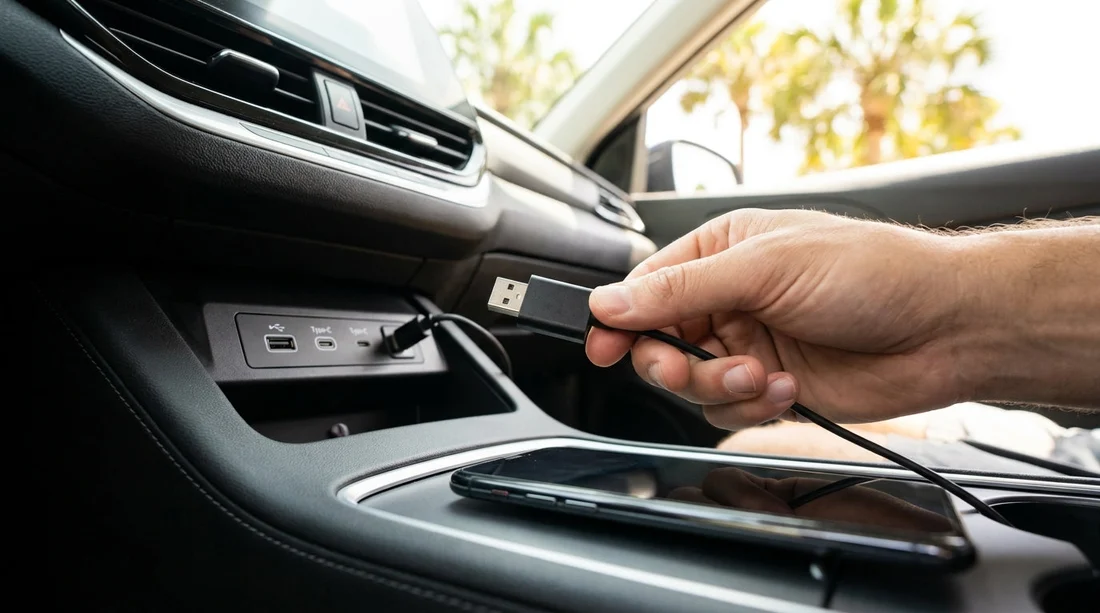
USB‑A ports are still the most common. They are familiar rectangular ports and work with older cables, but they may charge slowly with modern phones if the port output is low.
USB‑C ports are increasingly common on newer models, especially mid-size sedans, premium trims, and newer SUVs. They often provide faster charging, but not always, output varies.
12V socket (cigarette lighter style) is still widespread. This is important because a dedicated 12V USB charger can outperform built-in ports and gives you predictable charging across different cars.
Wireless charging pad appears in some newer cars, but pad size and placement can be fiddly, and cases or camera bumps can prevent reliable charging.
If you are collecting near Miami or Fort Lauderdale, you may be choosing between multiple vehicle types in busy pickup locations, so it helps to plan for variation rather than hope for a specific port type. For example, if you are comparing pickup options like Miami Beach car rental versus Fort Lauderdale car rental, you could still end up in a similar class car with very different charging ports.
Do you actually need a USB‑C adapter, or just the right cable?
Think in terms of three pieces: the port in the car, the cable you brought, and the port on your device. USB‑C adds confusion because it can describe the connector shape, not the charging speed.
If your device is USB‑C and the car has USB‑C, you only need a USB‑C to USB‑C cable. If your device is USB‑C but the car only has USB‑A, you need a USB‑A to USB‑C cable. If you bring only USB‑C to USB‑C, you might be stuck unless the car also has USB‑C.
A “USB‑C adapter” can mean a small plug that converts USB‑A to USB‑C, or it can mean a 12V charger with USB‑C outputs. For reliability in car hire, the most useful option is a compact 12V charger that includes at least one USB‑C port, ideally alongside USB‑A too. That way, you can charge modern and older devices even if the built-in ports are missing, occupied, or weak.
The simplest charging kit for Florida car hire
For most travellers, the goal is not to bring a bag of cables, it is to cover the likely scenarios with minimal fuss. Consider packing:
1) A 12V car charger with USB‑C and USB‑A, this turns the 12V socket into your dependable power source.
2) A USB‑C to USB‑C cable for fast charging when USB‑C is available.
3) A USB‑A to USB‑C cable for older USB‑A ports in the dashboard or centre console.
4) Optional: a short cable for rear passengers if you are travelling with family and relying on back-seat ports.
This matters even more if you are collecting a larger vehicle for group travel, where multiple people want to charge at once. Fleets used for family holidays, such as minivan hire in Coral Gables, may have rear-seat ports, but not necessarily USB‑C, and output can be shared between seats.
What to check at the counter and in the car park
You do not need to interrogate staff, but a quick, practical check can save hassle. When you pick up your car hire in Florida, confirm:
Where the ports are located, some are hidden inside the centre console, armrest storage, or under the infotainment panel.
How many ports are available, especially if you have passengers who will charge during drives.
Whether the ports are charge-only or data-capable, some USB ports are meant for media playback and may not supply strong charging current.
That the 12V socket is present and working, this is your fallback for a reliable charger.
Before leaving the car park, plug in and confirm your phone indicates charging. Also check that plugging in does not interrupt wireless CarPlay or Android Auto if the car supports it, some systems behave differently depending on the port used.
If you are picking up after a flight into Orlando, you may be tired and focused on getting moving. Still, spending 30 seconds checking the ports at Orlando Airport car hire can prevent frustration later when you need navigation most.
USB‑C charging speed in cars, what to expect
Even with USB‑C, charging speed is not guaranteed. Some vehicles provide higher-wattage USB‑C outputs suitable for fast charging, but others provide modest power that only maintains battery level during heavy use. Things that can reduce charging performance include:
Low-power USB ports intended for basic accessory charging.
Cheap or damaged cables that limit current.
Multiple devices on shared circuits, common with rear-seat ports.
Heat, phones may slow charging when they get hot, which is more likely in Florida.
If you need reliable fast charging for long drives, a quality 12V charger is often the best solution, because it bypasses the vehicle’s low-output USB ports. Keep your phone out of direct sun and, if possible, route air conditioning towards it to avoid thermal throttling.
Special cases: SUVs, vans, and lots of passengers
Vehicle type influences how charging is set up. In some SUVs, front ports are USB‑A while rear ports are USB‑C, or vice versa. Some vehicles include a rear 12V outlet, which is useful for a second charger. If you are choosing a bigger car for beach gear, shopping, or family luggage, you may also care about keeping everyone’s devices topped up.
For example, with SUV rental in Coral Gables, you might have more seating rows and more potential charging points, but it is still worth packing a charger that fits the 12V socket so you can add ports where needed.
So, should you bring a USB‑C adapter for charging?
Yes, bringing a USB‑C charging solution is a smart move before car hire in Florida, because USB‑C availability is inconsistent and charging demands are high. The best approach is to pack a 12V charger with USB‑C, plus both USB‑C to USB‑C and USB‑A to USB‑C cables. That combination covers nearly every rental car setup you are likely to encounter, and it helps you avoid slow charging when you are using navigation all day.
FAQ
Q: Will my Florida car hire definitely have USB‑C ports?
A: No. Some newer models do, but many rentals still provide USB‑A only, plus a 12V socket. Plan for mixed port types.
Q: Is a 12V USB‑C car charger better than the built-in USB ports?
A: Often yes. A good 12V charger can provide more consistent power than low-output built-in ports, especially when running maps and music.
Q: Should I bring both USB‑A to USB‑C and USB‑C to USB‑C cables?
A: Yes. It is the easiest way to stay compatible with whichever ports your rental car has, without relying on adapters that can be misplaced.
Q: Can I rely on wireless charging pads in rental cars?
A: Treat them as a bonus. Wireless pads can charge slowly, may not fit larger phones well, and can cause overheating in warm conditions.
Q: What should I check at pickup to avoid charging problems later?
A: Locate the USB ports and 12V socket, plug in to confirm charging, and check how many ports are available for passengers.































































































