


Quick Summary:
- Confirm if the deal is Full to Full, Prepaid, or Same to Same.
- Match voucher fuel terms to the counter agreement before you sign.
- Photograph the fuel gauge, receipt, and odometer at pick-up and return.
- Refuel within a few miles of return, then keep the itemised receipt.
Refuelling charges are among the most common surprises people face with car hire in Texas. The good news is that most of the risk disappears when you know which fuel policy you have, how it is described on your voucher, and what to confirm at the counter before you sign anything.
If you are collecting from a major airport location, you will typically see these fuel policy types across the state, including at Fort Worth DFW and other hubs. The exact wording can vary by supplier and channel, so treat your voucher as the master reference, then ensure the counter agreement matches it.
Understand the common US fuel policies
Full to Full means you collect the car with a full tank and return it full. It is often the fairest option because you pay pump prices, but it requires good timing near return. In practice, “full” is usually interpreted as the gauge showing full, not necessarily a brimmed tank, but some suppliers can still charge if it reads slightly below full when checked.
Prepaid fuel (sometimes called “Full to Empty” or “Prepay”) means you pay upfront for a full tank and are allowed to return it empty. This can work if you will drive a lot and can plan to use nearly all the fuel, but it can be poor value if you return with fuel left. Many prepaid options are non-refundable, so you effectively donate unused fuel back to the supplier.
Same to Same means you return it with the same level as pick-up, for example 7/8. This is rare in the US compared with Europe, but it does appear. It can be tricky because replicating a partial level is harder than filling to full, so you should document the gauge carefully at pick-up.
Supplier refuel on return is the worst case for price certainty. Some contracts state that if you do not refuel, the supplier will refuel and charge a premium rate plus a service fee. Even with Full to Full, this is the mechanism that applies if you return short.
What to check on your voucher before you travel
Start with the voucher because it usually spells out the intended fuel policy for your booking. Look for a dedicated line that mentions “Fuel policy” or “Fuel arrangement”. If it is not obvious, search the voucher text for words like “Full”, “Prepaid”, “Return”, “Refuelling”, and “Service fee”.
Next, look for any note about refuel charges. Many vouchers explain that if the vehicle is returned with less fuel than required, you will be charged for missing fuel at a higher rate. If a service fee is mentioned, note it.
Also check whether the voucher mentions a requirement to provide a fuel receipt. Some suppliers ask for a receipt dated the day of return, typically from a station near the return location. If you know you are flying out of Houston, you might collect at Houston IAH, then plan a refuel stop in the final 10 to 20 miles and keep the itemised receipt.
What to verify at the counter before you sign
Counter paperwork can override what you thought you booked if you sign without checking. Before you accept the keys, ask the agent to point to the fuel section on the rental agreement. You are checking for two things: the fuel policy itself and any pre-authorised fuel purchase or refuelling option you did not intend to accept.
Match the wording to your voucher. If your voucher says Full to Full, the agreement should not say “prepaid fuel” or include a fuel purchase line. If there is a mismatch, stop and ask for clarification before signing.
Look for add-ons that change the fuel arrangement. Some desks offer a “fuel service option” that lets you return without refuelling. If you accept it, you are usually paying supplier fuel rates, plus you may still lose value on unused fuel. If you do not want it, ask for it to be removed and then re-check the totals.
Confirm the car is actually full. With Full to Full, do not assume the gauge is full. If it is below full at pick-up, ask for it to be corrected in writing on the agreement, or ask to swap vehicles.
Ask how they define “nearby” fuel receipt. This matters at large airports. If you are returning to Dallas, rules can differ by supplier, including locations such as Enterprise at Dallas DFW. Knowing the expectation helps you choose a sensible fuel stop and avoid debating later.
How to refuel smartly in Texas and avoid fees
Refuel closer than you think you need to. In Texas metro areas, traffic can burn more fuel than expected. Aim for the final 5 to 10 miles where possible, without stressing yourself.
Use the right fuel grade. Most rental cars take regular unleaded, and many have a label on the fuel door. Putting premium in is usually unnecessary, and diesel in a petrol vehicle can be disastrous. The supplier will not waive refuelling charges because you used a higher grade.
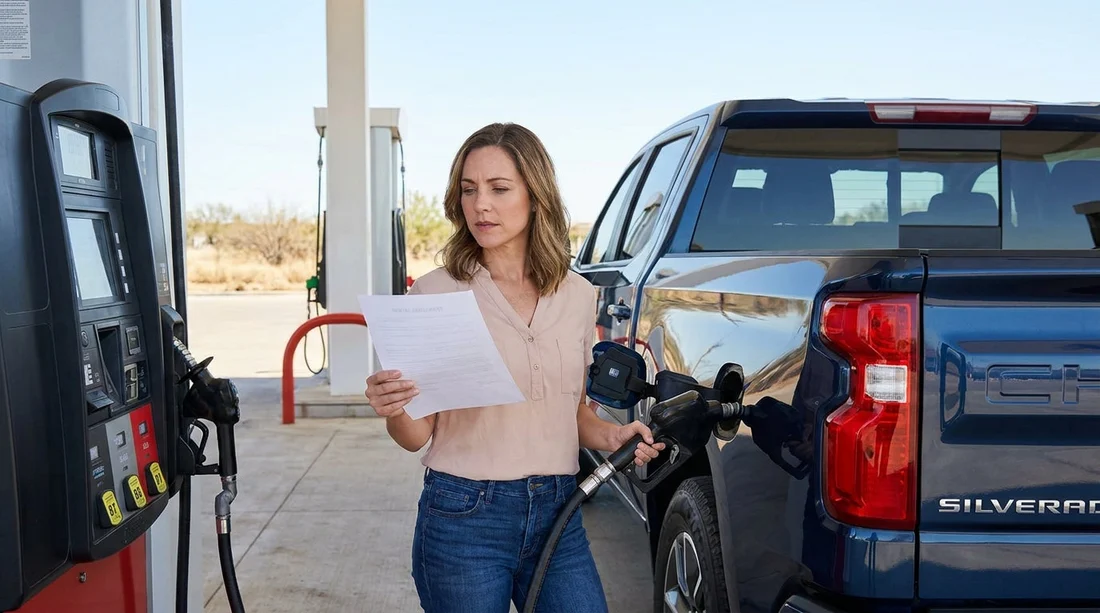
Keep the itemised receipt. You want the date, time, address, and gallons. If you pay at the pump, take the printed receipt. If the pump says “see cashier”, go inside.
Take photos at pick-up and return. Photograph the fuel gauge and odometer at pick-up, then again at return, ideally with the car parked in the return lane. If you used a key drop, take the photos before you walk away.
Allow time for a staffed check-in. If you can, return during staffed hours so an agent can close the rental in front of you. If you are hiring a larger vehicle for a group, the extra fuel cost can be higher, so it is worth being cautious, including for van hire at Houston IAH.
Special situations that cause surprise refuelling charges
Partial fuel at pick-up. If you start at 7/8 and your policy is “return same level”, you need that number on the agreement. If your policy is Full to Full but you start under full, insist on a correction or different car.
Long queues at airport returns. Idling in return lanes can move the gauge needle. That is one reason to refuel nearby and not cut it too fine.
After-hours drop-off. If nobody checks the car in with you, the fuel reading may be taken later. Photos and a nearby receipt become your best protection.
Checklist to run before you leave the counter
Before you drive off, quickly confirm you have: the correct fuel policy printed on the agreement, a note if the tank is not actually full, clarity on whether a receipt is required, and an understanding of what happens if you return slightly under. This one-minute check is often the difference between a predictable trip and a post-holiday dispute.
If your trip is going through West Texas, policies and charges are still the same, including at locations such as National in El Paso ELP, so the same proof-first approach applies statewide.
FAQ
Q: What fuel policy is best for car hire in Texas?
A: Full to Full is usually best value and simplest, as you pay local pump prices. Prepaid fuel can work only if you will use almost the entire tank.
Q: If I return the car one bar under full, will I be charged?
A: Potentially yes. Many suppliers treat anything under “full” as missing fuel, then charge a premium rate plus a service fee. Refuel close to return and keep the receipt.
Q: Do I need to show a fuel receipt at the return desk?
A: Not always, but it is smart to keep one. Some suppliers request a same-day receipt from a nearby station, especially if the gauge reading is borderline.
Q: What should I do if the car is not full when I pick it up?
A: Ask the agent to note the exact gauge level on the agreement, or request another vehicle. Take a clear photo of the dashboard before leaving the lot.
Q: I used the key drop, how can I dispute a refuelling charge later?
A: Use time-stamped photos of the gauge at return, plus an itemised fuel receipt from nearby. Those two pieces of evidence usually support a review of the charge.































































































