


Quick Summary:
- Keep children rear-facing until they reach the seat’s stated limits.
- Switch to a forward-facing harness only after rear-facing limits are exceeded.
- Use a booster until the adult belt sits correctly on hips.
- Do the five-step belt test before stopping booster use.
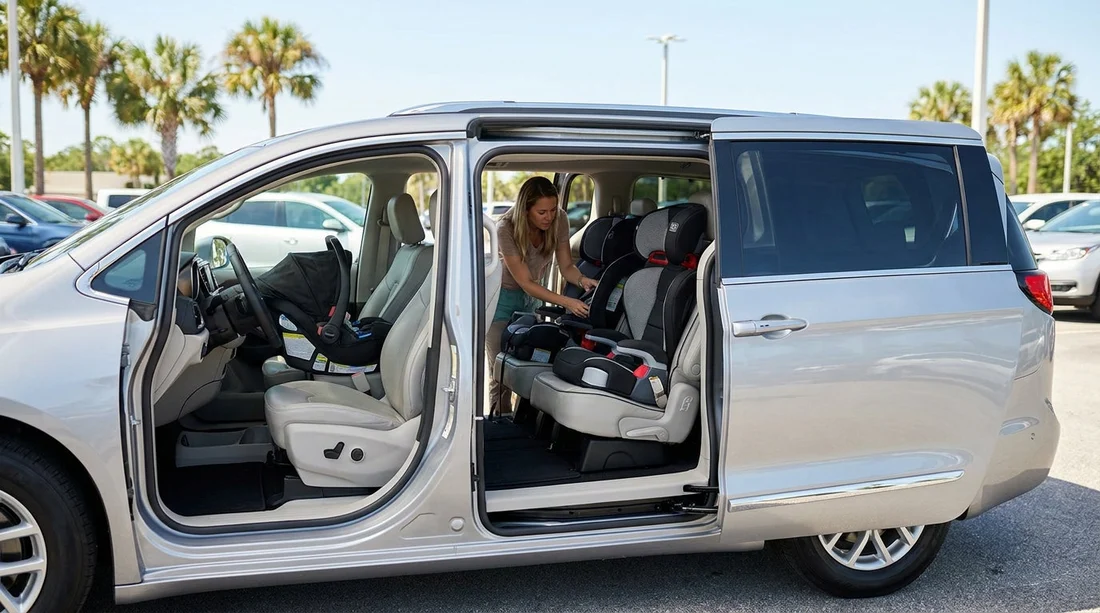
When arranging car hire in Florida with children, the key question is not just age, it is whether your child fits the safety seat correctly. Florida follows widely used US best practice: start rear-facing, move to forward-facing with a harness when your child outgrows rear-facing limits, then use a booster until the vehicle seat belt fits properly.
This guide explains which child seat to use by age and size, what “fits” actually means in a rental car, and how to avoid common mistakes that can make journeys less safe or simply uncomfortable.
Child seat stages: what matters more than age
Age-based milestones are helpful, but manufacturers set specific height and weight limits for each seat, and those limits are what determine whether your child still fits the seat safely. For car hire, you will often be selecting from categories (infant seat, toddler seat, booster) rather than a specific model, so it helps to know the key indicators that your child is ready to move up.
Use these three checks when deciding.
1) Weight and height limits, printed on the seat label or product manual. If your child is at or above the maximum for the current seat mode, it is time to change.
2) Harness fit. For harnessed seats, the straps should sit snugly with no slack, and the chest clip should be at armpit level.
3) Belt fit. For boosters and adult belts, the lap belt should sit low on the hips, and the shoulder belt should cross the middle of the shoulder, not the neck.
Rear-facing: best for babies and younger toddlers
Typical age range: birth to about 2 years, often longer depending on the seat.
Typical size range: commonly up to 22 to 40 lb, depending on the seat’s rear-facing limit.
Rear-facing provides the best protection for the head, neck and spine because it supports the whole back in a crash. In Florida, you will commonly see rear-facing recommended until at least age two, and longer if your seat allows it.
Signs your child should remain rear-facing: they are under the rear-facing maximum weight and height, and their head is still at least an inch below the top of the seat shell (rule varies by model). In a rental car, rear-facing seats often take up more front-to-back space, so allow extra time at pickup to adjust the front passenger seat for safe clearance.
If your Florida trip includes longer drives, choosing a vehicle with more rear-seat space can make rear-facing easier. See options such as minivan hire near Disney Orlando for extra room behind the front seats.
Forward-facing with a harness: for toddlers and preschoolers
Typical age range: about 2 to 5 years.
Typical size range: usually from the rear-facing maximum up to around 40 to 65 lb, depending on the seat.
Move to a forward-facing harness only once your child has outgrown rear-facing limits. In this stage, your priority is a harness that fits securely and a tether (top strap) that can be anchored correctly, as the tether reduces forward head movement in a crash.
Fit checks: the harness straps should be at or above the shoulders when forward-facing, the chest clip stays at armpit level, and you should not be able to pinch slack in the straps at the collarbone.
Rental-car tip: ask at the counter whether the seat offered is a harnessed seat and whether it includes the top tether strap. Many US vehicles have tether anchors, but the location varies, sometimes behind the seatback or in the cargo area. When you collect your vehicle, locate the tether anchor before tightening everything down, because it is awkward to redo later.
Picking up at a major airport can be convenient for families, as you can fit the seat once and keep moving. If you are collecting on the Gulf Coast, you may find it helpful to review location details for car hire at Tampa Airport so you can plan time for installation and checks.
Booster seat: for school-age children until the belt fits
Typical age range: about 5 to 10 years.
Typical size range: often from about 40 lb upwards until adult belt fit, frequently around 4ft 9in (145 cm).
A booster positions your child so the vehicle’s lap and shoulder belt sit on strong bones rather than the soft abdomen or neck. This is the stage that is most commonly misunderstood, because children may look “big enough” but still do not sit correctly with an adult belt.
High-back vs backless booster: high-back boosters help position the shoulder belt and provide head support if the vehicle seat has a low headrest. Backless boosters can work well when the vehicle has a supportive headrest and good belt geometry.
Fit checks in your rental: have your child sit back fully with knees bending naturally at the seat edge. If they have to slouch to bend their knees, the lap belt will ride up. The shoulder belt should not touch the neck or slip off the shoulder.
For families planning coastal drives from South Florida, make sure the booster works with the back-seat headrests and belt path in your chosen car category. If you are travelling around the Miami area, car hire in Miami Beach can be a good base for short trips, and correct booster positioning is still important even on quick journeys.
Adult seat belt: when is a child truly ready?
Typical age range: often 10 to 12 years, but varies.
Typical size marker: around 4ft 9in (145 cm), with a good belt fit.
Graduating to the vehicle seat belt is not about confidence, it is about fit. Use the “five-step test” to decide whether a child can ride without a booster.
1) Back against the vehicle seat.
2) Knees bend at the seat edge without slouching.
3) Lap belt stays low on the hips, touching the upper thighs.
4) Shoulder belt crosses the centre of the shoulder and chest.
5) Child can maintain this position for the whole trip.
If any step fails, keep the booster. In practice, many children need a booster for longer in some vehicles than others, because seat cushions and belt anchor points vary by model. That variability is common with car hire, where you may not know the exact make and model until pickup.
Florida-specific practicalities when using child seats in a rental
Plan for installation time. Whether you fit the seat with the vehicle belt or with lower anchors (often called LATCH in the US), allow 10 to 20 minutes at pickup, more if you have two seats. Do not assume the staff will install the seat for you.
Bring key measurements. Before travel, note your child’s current height and weight, plus their age. Those three details let you choose the right seat category quickly and confidently.
Choose a suitable vehicle class. Small saloons can work fine for one child seat, but two seats, or a rear-facing seat plus luggage, can get tight. For airport arrivals with lots of bags, a larger vehicle can reduce stress, especially if you are also managing buggies and carry-ons.
Do a belt-path check every time. If you move the seat to access the third row or fold seats for luggage, re-check tightness. The seat should not move more than one inch side-to-side at the belt path.
If you are comparing pick-up points or fleet types for future US trips, explore pages such as Budget car hire in San Jose and car hire in Salt Lake City to see how vehicle availability can vary by destination.
FAQ
What child seat should I choose for a 1-year-old in Florida? Most 1-year-olds should still ride rear-facing, provided they are within the seat’s rear-facing height and weight limits. Rear-facing offers the best protection for the head and spine.
My child is 3, can they use a booster seat? Usually not. Most 3-year-olds fit best in a forward-facing seat with a harness. A booster relies on the child sitting correctly every time, which is difficult for many toddlers.
How do I know if the booster fits properly in a rental car? The lap belt must sit low on the hips and upper thighs, and the shoulder belt should cross the middle of the shoulder. If the belt touches the neck, slips off the shoulder, or the child slouches, the fit is not right.
Is age or weight more important when selecting a child seat? The seat’s height and weight limits are more important than age. Age is a guideline, but the correct seat is the one your child fits within, with proper harness or belt positioning.
Can I rely on the minimum legal requirement in Florida? Minimum rules are a baseline, not necessarily best practice. For the safest travel, keep children rear-facing and then in boosters for as long as they fit the seat’s limits and until the adult belt fits correctly.






























































































