


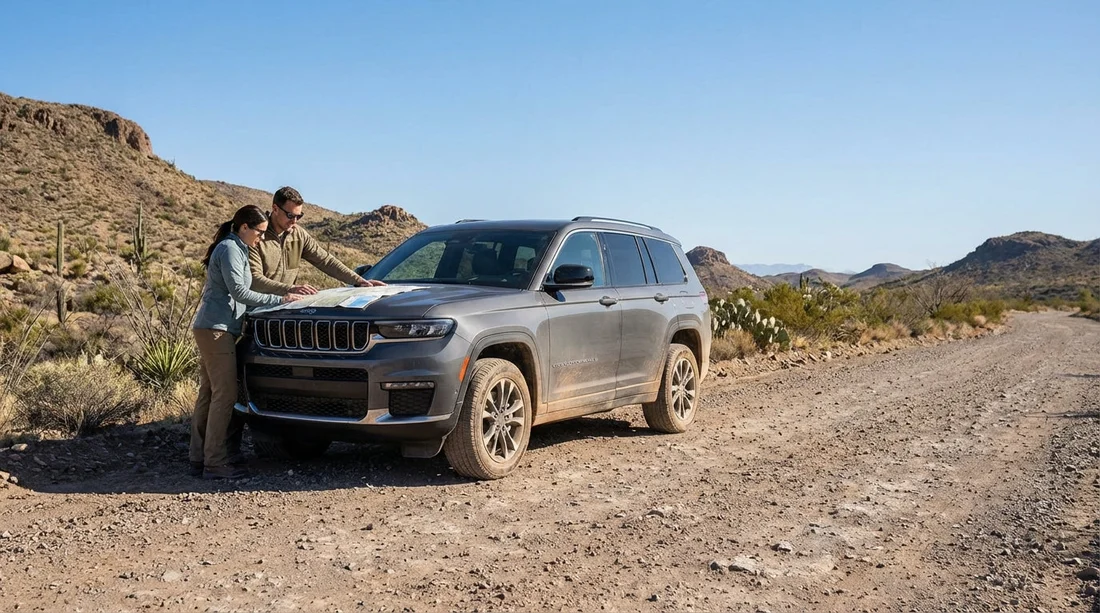
Quick Summary:
- Most Texas car hire terms exclude damage on unpaved or unmaintained roads.
- Plan routes using paved highways to Panther Junction, avoiding backcountry tracks.
- If gravel is unavoidable, photograph signs, surface conditions, and your route.
- Ask for written confirmation of any permitted short unpaved access roads.
Big Bend is one of Texas’s great road trip rewards, huge skies, long distances, and a landscape that changes mile by mile. It is also the sort of destination where a satnav can quietly nudge you off smooth tarmac and onto rough caliche or graded dirt, especially if you aim for trailheads, river access points, or remote viewpoints. If you are travelling with car hire in Texas, that matters, because many rental agreements treat unpaved roads as a red line that can affect what you are covered for.
This guide explains the typical restrictions you will see, how to plan a route to Big Bend that avoids risky sections, and what evidence to gather if you must use a short unpaved stretch, for example, to reach a hotel driveway, a campsite entrance, or a clearly maintained access road.
Why unpaved roads are a bigger deal for car hire than drivers expect
On your own vehicle, a bit of gravel might feel like an everyday inconvenience. With car hire, the issue is contractual. Many providers define “off-road” broadly, not just dramatic 4x4 tracks, but also gravel, dirt, sand, riverbeds, washboard, and any route that is not publicly maintained or not “paved and surfaced.” If a contract says you must not drive on such roads, any damage that arises while you are on them, or as a result of being on them, can fall outside the protection you assumed you had.
Big Bend National Park and the surrounding region include both fully paved highways and long unpaved routes. The park’s main visitor corridors are reachable on paved roads, but some iconic areas, and many backcountry routes, are unpaved and can be rough, remote, and tyre-unfriendly.
Typical Texas car hire restrictions on gravel and unpaved roads
Terms vary by supplier and vehicle class, so you must read the rental agreement and any local conditions for Texas. Still, restrictions tend to fall into a few patterns:
1) Prohibited surfaces: Damage occurring on unpaved, unsealed, or “off-road” surfaces may be excluded. This can include graded park roads, ranch roads, oilfield access roads, and desert tracks.
2) Prohibited areas: Some agreements restrict travel to certain regions, or to public roads only. Even if Big Bend itself is not named, the wording can still catch you if you leave maintained paved routes.
3) Special exclusions for underbody and tyres: Even where general damage cover applies, contracts commonly exclude tyres, wheels, glass, roof, and underbody. Those are exactly the components most likely to be damaged by sharp stones, washboard vibrations, hidden ruts, or debris.
4) Recovery and towing limitations: If you get stuck on sand or a rough track, recovery can be costly. Many products exclude towing or recovery from unpaved roads, or only cover it when a mechanical breakdown occurs on a paved public road.
5) “Negligence” and “misuse” clauses: If signage warns against certain vehicles, if the road is clearly unsuitable, or if weather makes conditions unsafe, the provider may argue misuse, which can affect liability even beyond the gravel question.
If you are collecting your vehicle near a major hub, it can help to review location information in advance so you have time to compare options and ask questions. Hola Car Rentals has Texas landing pages for common pickup points such as car hire Austin AUS, car hire San Antonio SAT, and car hire at Fort Worth DFW.
Big Bend route planning, how to avoid risky unpaved sections
The safest way to protect your car hire cover is to plan a route that stays on paved, numbered highways and paved park roads. In general, you can reach Big Bend National Park’s main services and viewpoints without leaving tarmac, but you need to be deliberate about your destinations.
Use paved approaches into the region: Most visitors drive in via major highways to Marathon, Alpine, Fort Stockton, or Terlingua, then continue on paved state and US routes. Mobile coverage can be limited, so download offline maps and confirm road types before you depart.
Prioritise paved park access: The road to Panther Junction Visitor Center is paved. The Chisos Basin road is paved as well, although it is steep and winding and may have length restrictions for very large vehicles. Santa Elena Canyon access is commonly reached on paved roads, but always check current park conditions because repairs and closures do occur.
Avoid “shortcuts” suggested by satnav: Mapping apps may propose faster options that cut across ranch land or use county roads that transition to gravel without a clear warning. Cross-check the route using satellite view where possible, and verify with Texas Department of Transportation updates and official park advisories.
Be realistic about remoteness: Even on paved roads, Big Bend involves long gaps between fuel and services. Plan petrol stops conservatively and avoid driving at night, when wildlife collisions are more likely.
When a short unpaved stretch is unavoidable, what to do
Sometimes you cannot avoid a brief unpaved section, for example, a lodge driveway, a campsite entrance, or a clearly signed access road to a viewpoint outside the main paved network. If you decide to proceed, focus on reducing risk and preserving evidence that you acted reasonably.
1) Stop and assess before you commit
Get out, walk the first part if safe, and look for deep ruts, sharp rocks, soft sand, or standing water. If the surface looks likely to strike the underbody, damage tyres, or require clearance you do not have, turn back.
2) Drive slowly and smoothly
Washboard corrugations can shake components and loosen trim. Keep speed low, avoid sudden braking, and keep to the most even line. Do not straddle ridges that could strike the undercarriage.
3) Avoid weather-related traps
Desert roads can change quickly. A dry dip can become impassable after rain. If rain is forecast, reconsider leaving paved routes, particularly in remote areas where recovery may take hours.
4) Do not follow other vehicles blindly
A local in a high-clearance truck may be fine on a rough section that is unsuitable for a standard saloon or crossover. Your contractual restrictions still apply even if others proceed.
What cover could be voided if you drive on unpaved roads
This is the core concern: if your agreement prohibits unpaved roads, the provider may treat any resulting loss as outside the protection package. The most common impacts are:
Collision Damage Waiver type protection: If the incident is connected to prohibited use, the waiver may not apply and you could be responsible up to the full value of the vehicle, plus fees.
Tyres and wheels: Punctures, sidewall cuts, and wheel damage are common on gravel. Even if other damage is covered, tyres and wheels are frequently excluded unless you purchased a specific add-on and it remains valid under the usage rules.
Underbody damage: Scrapes to the oil pan, exhaust, fuel lines, or suspension can be expensive and are often excluded. Underbody inspections can happen when you return the vehicle.
Glass and lights: Stone chips to windscreens and headlamps are more likely on gravel. Again, glass is commonly excluded or limited.
Recovery and towing: If you get stuck off tarmac, you may have to pay recovery costs, and these can be substantial in the Big Bend area due to distance and limited providers.
Administrative charges and loss-of-use: If damage occurs, suppliers can add admin fees and may claim loss-of-use while the car is repaired, subject to local rules and the rental agreement.
Vehicle choice can reduce, but not eliminate, risk. Higher clearance can help on uneven access roads, and some travellers prefer an SUV for West Texas. If you are comparing options, Hola Car Rentals provides information such as SUV hire in Austin AUS, but you should still treat any unpaved-road restriction as binding regardless of vehicle type.
How to plan proof and documentation before you leave paved roads
If you must use a short unpaved stretch, documentation can help show what happened, where, and under what conditions. It will not magically override a contractual exclusion, but it can be valuable if there is a dispute about whether the road was truly “off-road,” whether signage prohibited access, or whether damage could have happened elsewhere.
Photograph the start of the road: Include the junction from the paved road, any street signs, and any “public road” markers. If there is signage indicating the road is maintained or suitable for passenger cars, capture that too.
Photograph surface and hazards: Take clear pictures of the road surface, ruts, rocks, potholes, and any relevant conditions like flooding or mud. Use wide shots and close-ups.
Record your route: Save a GPS track or timeline on your phone. Screenshots with date and time can help if you later need to explain that the unpaved portion was short and unavoidable.
Take “before” and “after” walkarounds: Do a quick walkaround before entering gravel and again once you return to paved roads. Focus on tyres, wheels, lower bumpers, and underbody areas you can see. Time-stamped photos are useful.
Keep receipts and notes: If you stop for fuel, supplies, or park entry, keep receipts that show times and approximate locations. If a ranger or staff member advises on road conditions, note their name and the date.
Report issues promptly: If you hear a loud impact, notice a warning light, or see a puncture, do not continue driving long distances. Continuing can worsen damage and complicate claims.
Questions to ask at pickup, without slowing down your trip
At the counter, aim for clarity on a few points that matter specifically for Big Bend travel:
Are unpaved or gravel roads prohibited? Ask how they define “off-road” and whether graded gravel access roads are included.
Which parts are excluded? Confirm tyres, wheels, glass, and underbody, and whether any optional protection changes those exclusions.
What about towing and roadside assistance? Ask what happens if you get a puncture or become immobilised far from major towns.
Are there any geographic limitations? Ensure West Texas travel is permitted, and ask how cross-border travel is treated if your wider itinerary includes it.
If you are arriving via Houston and then driving west, you may also want to review pickup options ahead of time, for example Dollar car hire Texas IAH, so you can compare terms and select the best fit for a remote-area road trip.
Practical Big Bend tips that protect your car hire and your holiday
Choose destinations that match your agreement: If unpaved roads are excluded, focus on paved highlights and established visitor areas. You can still have an excellent Big Bend visit without backcountry driving.
Fuel early and often: Keep your tank comfortably above half when possible. Detours are common due to closures or weather.
Carry basics: Water, a torch, a phone charging solution, and a paper map help when signals drop. These are safety items, not off-road gear.
Do not rely on clearance alone: An SUV may sit higher, but it does not change the contract terms. The key is whether the road is permitted and suitable.
Return the vehicle clean enough for inspection: Excess mud can hide damage and raise questions. A quick rinse can make the return smoother, while still avoiding aggressive underbody sprays that could be problematic if damage exists.
FAQ
Can I drive a hired car to Big Bend National Park on paved roads only?
Yes, you can reach the park’s main visitor areas on paved routes, and several popular viewpoints are accessed via tarmac. Plan carefully to avoid satnav shortcuts onto gravel.
Is a graded gravel park road considered “off-road” for car hire?
Often yes. Many agreements treat any unpaved surface as prohibited, even if it is graded. Always rely on the contract wording for your specific rental, not the road’s popularity.
What parts of cover are most likely to be voided on unpaved roads?
Tyres, wheels, glass, and underbody are commonly excluded or limited, and recovery costs can be excluded off tarmac. If unpaved use is prohibited, broader damage protection may also be affected.
What evidence should I collect if I must drive a short unpaved access road?
Photograph signs, the junction from the paved road, and the surface conditions. Save a GPS timeline, and take time-stamped walkaround photos before and after the unpaved section.
Will hiring an SUV guarantee I am allowed on gravel roads?
No. An SUV can reduce the risk of scraping on uneven surfaces, but it does not automatically permit unpaved driving. Permission depends on the rental terms and any local restrictions.






























































































