


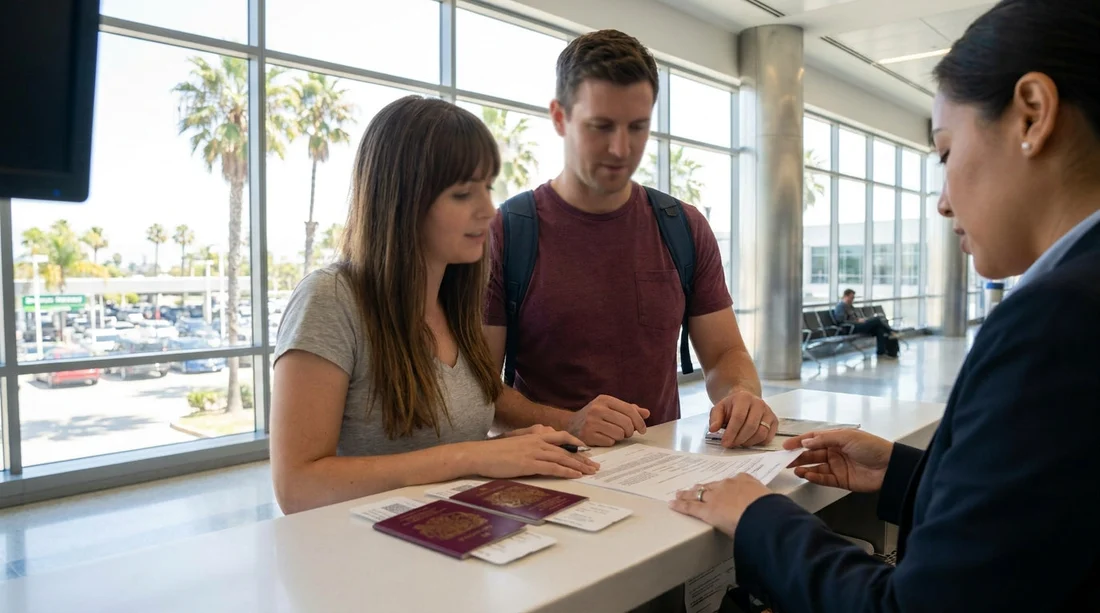
Quick Summary:
- UK travel insurance may cover damage, but rental desks may still require LDW.
- Most insurers reimburse after you pay first, not replace LDW.
- Bring your policy wording showing rental car excess cover, territory, and limits.
- Confirm the desk’s accepted alternatives before pick-up to avoid surprises.
UK travellers arranging car hire in California often assume their travel insurance can take the place of Loss Damage Waiver (LDW) at the counter. The reality is more nuanced. Travel insurance can sometimes cover what LDW covers, but it does not automatically give you the right to decline LDW, and it may not satisfy the rental company’s requirements for releasing the vehicle without their own protection.
This guide explains how LDW works in California, what UK travel insurance typically does, what proof you may be asked for, and how to reduce the chance of a stressful discussion at the desk.
What LDW is, and why it matters in California
LDW, sometimes shown as CDW/LDW, is a waiver offered by the rental company that reduces or removes your financial responsibility if the rental car is damaged or stolen. It is not the same as third-party liability insurance, which covers injury or property damage to others. California requires rental companies to provide at least minimum liability protection, but that is separate from LDW.
When you decline LDW, the rental agreement usually makes you responsible for damage to the vehicle up to the vehicle’s value, plus associated costs. Those additional costs can include loss of use, towing, storage, and administration fees. This is where UK travel insurance can help, but acceptance depends on the rental company, the brand, and the exact product you hold.
Can UK travel insurance replace LDW at the counter?
In most cases, UK travel insurance does not “replace” LDW in a way the rental desk treats as equivalent. Instead, it acts as a backstop that reimburses you after you have paid the rental company. That distinction is crucial. Many rental desks do not need to see your travel insurance to let you decline LDW, but they also will not treat it as a waiver issued by them.
There are three common outcomes:
1) You can decline LDW, but you remain liable to the rental company. Your travel insurance may reimburse you later if the claim is valid.
2) The desk requires LDW unless you have an accepted alternative. Some desks only recognise specific products, often standalone car hire excess policies or credit card programmes, and even then they may still hold a large deposit.
3) The desk allows you to decline, but places a higher security deposit hold. This is common in US car hire, and the hold can be substantial on a UK-issued card.
If you are collecting from a major airport location, the desk process can be fast-moving. It helps to know in advance how your chosen brand usually handles deposits and whether they ask for written proof. When comparing providers for California, you can also review location pages such as car hire at Sacramento SMF or National car hire in Santa Ana (SNA) to understand typical pick-up environments and counter procedures.
What UK travel insurance usually covers for rental cars
Many UK travel insurance policies include “car hire excess” or “rental vehicle excess” as a benefit, either included or as an add-on. Typically, this benefit covers the excess amount you would otherwise pay under the rental agreement, plus some related fees. However, the details vary sharply.
Common features and limitations include:
Reimbursement basis: you pay the rental company first, then claim back from the insurer.
Excess-only cover: some policies do not cover the full value of damage, only the excess you agreed with the rental company.
Exclusions: tyres, windscreen, roof, underbody, keys, single-vehicle incidents, and “negligence” exclusions are common, and these are areas where LDW often provides broader comfort.
Duration limits: a policy may cap the number of rental days per trip or per year.
Vehicle type limits: large SUVs, luxury vehicles, and vans may be excluded. If you need a larger vehicle, check terms carefully, especially for people movers and one-way trips. For context on larger vehicles, see van rental in San Diego.
Territory wording: ensure the United States, not just “worldwide excluding USA”, is included. Some UK policies require an extra premium for USA cover.
Proof you may need if you plan to decline LDW
Even when a rental desk does not require proof, you should carry it. If a dispute arises later, documentation helps. For UK travel insurance, useful proof typically includes:
Insurance certificate and policy schedule showing your name, dates of cover, and that the USA is included.
Policy wording section that explicitly mentions rental cars or car hire excess, including limits and what is covered.
Emergency assistance or claims contact details in case the rental company requests confirmation or you need to notify your insurer promptly.
Evidence of payment card used to secure the rental, because the rental company may require a credit card for the deposit, especially if LDW is declined.
If you are relying on insurance, you should also understand what the desk will do if there is damage. In California, the rental company can charge your card for repairs and fees according to the contract. Your insurer may then ask for itemised invoices, damage reports, photos, and a copy of the rental agreement.
Why the rental desk may still recommend LDW
Rental staff are trained to offer protection products, but there are practical reasons LDW remains popular even for insured travellers. First, LDW can reduce the chance you have to pay a large amount upfront. Second, it can simplify the post-incident process. Third, many insurance policies have exclusions that only become obvious when you read the wording.
California driving can also involve risks that trigger exclusions, such as parking damage, kerb strikes, or scraping the underside on steep driveways. Even a small incident can result in a sizeable bill once loss of use and administration fees are added.
If you are collecting from a busy leisure market, the counter conversation can be brief. Knowing your risk tolerance and your policy limits in advance helps you decide calmly. For pick-ups around Orange County and South Coast routes, you can compare provider pages such as Alamo car hire at Santa Ana SNA.
How to decide whether to decline LDW for California car hire
A sensible approach is to evaluate three things: financial exposure, claims friction, and deposit capacity.
Financial exposure: if your insurance only covers the excess, you could still be on the hook for amounts beyond that, depending on the contract and exclusions.
Claims friction: if you would struggle to gather documents while travelling, or if you want to avoid paying large sums first, LDW may be worth considering.
Deposit capacity: declining LDW may mean a much higher hold on your card. Make sure your available credit can handle it alongside hotel deposits and daily spending.
Also consider the type of trip. A short coastal stay with secure parking differs from a long road trip with frequent stops. If you are flying into Northern California for a driving-heavy itinerary, it can help to understand airport pick-up norms and car category availability at places like Sacramento Airport (SMF) car rental.
What to ask your insurer and your rental provider before you travel
Before you fly, ask your insurer to confirm in writing that your policy includes rental car damage cover in the USA, and whether it covers the rental company’s loss-of-use and admin charges. Separately, check your rental terms to see whether declining LDW changes the deposit, or whether any protection is already included in the rate you selected.
It is also worth confirming the correct name of the cover. Some UK policies say “car hire excess”, while rental companies use LDW terminology. Matching those terms in your documents reduces confusion at the counter.
FAQ
Does UK travel insurance mean I can always decline LDW in California? Not always. You can usually decline LDW, but the rental company may still hold you liable for damage and may require a higher deposit.
Will the rental desk accept my travel insurance as proof instead of LDW? Often they will not treat it as a substitute. Travel insurance typically reimburses you later rather than waiving charges at the time.
What documents should I bring to support declining LDW? Bring your insurance certificate, policy schedule, and the policy wording section covering car hire excess, showing USA territory, limits, and exclusions.
If the car is damaged, do I pay first? In many cases, yes. The rental company can charge your card under the agreement, and you then claim reimbursement from your insurer with invoices and reports.
Is a standalone car hire excess policy different from LDW? Yes. It may cover your excess and some fees, but it is still separate from the rental company’s LDW and may not reduce deposit requirements.






























































































