


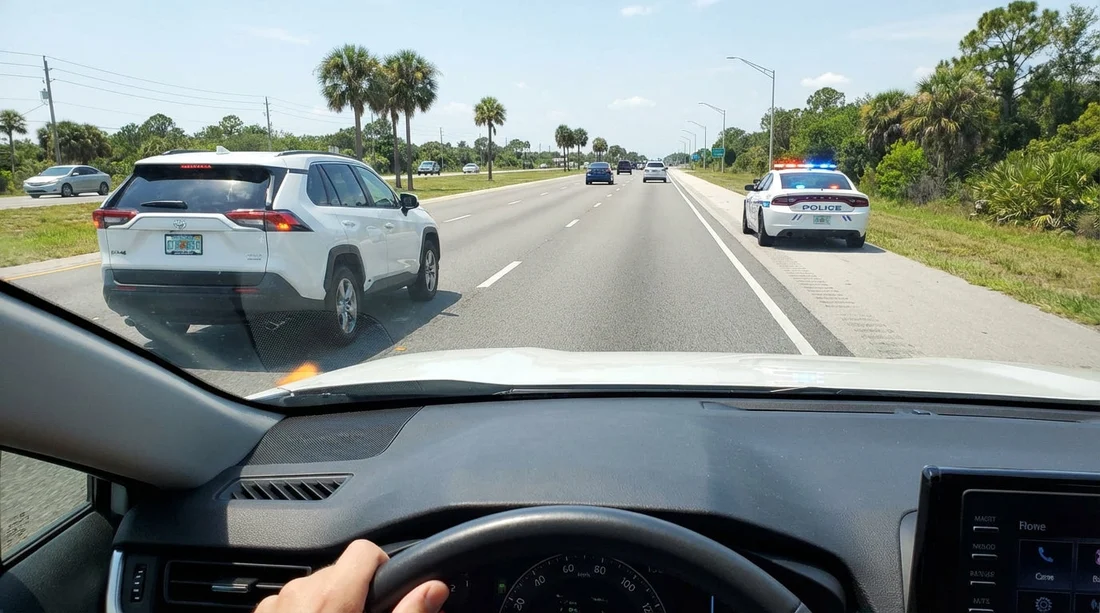
Quick Summary:
- Move over one lane for stopped emergency and service vehicles.
- If you cannot move over safely, reduce speed well below limits.
- On multi-lane roads, anticipate stops early and signal clearly.
- Fines and points apply, especially if a worker is endangered.
If you are driving in Orlando on car hire, Florida’s “Move Over” law is one of the easiest rules to misunderstand and one of the costliest to ignore. It applies when you approach certain vehicles stopped on the roadside with warning lights, for example police cars, ambulances, tow trucks, or highway service vehicles. In plain terms, you must either change lanes away from the stopped vehicle, or if you cannot safely change lanes, you must slow down to a specified reduced speed.
The law exists to protect people working a few feet from fast-moving traffic. Florida interstates around Orlando, such as I-4, SR 417, SR 528, and Florida’s Turnpike, have frequent roadside incidents, and enforcement can be strict. Knowing exactly what to do, and doing it early, is the best way to avoid a roadside-law ticket and keep everyone safe.
Before you set off from the airport, it helps to familiarise yourself with the local driving environment and your vehicle. If you are collecting near MCO, see car hire Orlando MCO for practical trip-planning context. If you are comparing pickup options for airport and resort areas, car hire airport Disney Orlando MCO can also help you understand typical routes where the Move Over law often matters.
What Florida’s Move Over law requires
Florida’s Move Over law tells drivers how to behave when approaching certain authorised vehicles stopped on the roadside displaying warning lights. The requirement depends on the type of road you are on and whether you can safely change lanes.
On roads with two or more lanes travelling in the same direction: you must move over into the next lane away from the stopped vehicle, if you can do so safely. This is the default expectation on motorways and many major Orlando roads.
If you cannot move over safely: you must slow down. Florida sets specific reduced speeds depending on the posted limit. In everyday driving, that means you should come off the accelerator early, increase your following distance, and pass the stopped vehicle at a clearly reduced speed, not simply “a little slower”.
On two-lane roads with one lane each way: you cannot change lanes away from the stopped vehicle, so the key requirement is slowing down to the legally required reduced speed while passing.
In practice, officers look for three things: did you notice the stopped vehicle early, did you attempt to create a safe buffer by moving away, and if you could not move away, did you slow down enough to show real caution.
Which stopped vehicles are covered?
Many visitors assume Move Over only applies to police cars. In Florida, it covers a range of vehicles when stopped and displaying their authorised warning lights. The broad categories commonly encountered around Orlando include:
Emergency vehicles: law enforcement, fire, and ambulances.
Wreckers and roadside recovery: tow trucks and other authorised wrecker services assisting a stranded vehicle.
Roadside and utility service vehicles: vehicles providing infrastructure, maintenance, or service work, typically with amber lights. You might see these near roadworks, broken-down cars, or incident management areas.
Sanitation and certain work vehicles: some specialised stopped work vehicles are covered when properly marked and displaying warning signals.
The safe approach, particularly on unfamiliar roads in a hire car, is to treat any stopped official vehicle with flashing blue, red, or amber lights as a Move Over situation and act early. Even if a particular vehicle type is debated in the moment, the safest behaviour is the same: move away or slow significantly.
Exactly when you must change lanes
You are expected to change lanes when all of the following are true:
1) The road has at least two lanes in your direction. This includes most motorways and many multi-lane arterials in Orlando.
2) The stopped vehicle is on the shoulder or roadside area adjacent to your lane. If it is on the right shoulder and you are in the right lane, you should move to the lane on your left. If it is on the left shoulder, you should move to the lane on your right.
3) It is safe and reasonable to do so. “Safe” means you can complete the lane change without cutting someone off, causing hard braking behind you, or making an abrupt manoeuvre. If traffic is heavy, you may need to signal earlier and wait for a clear gap.
What “safe” looks like in real traffic: check mirrors, signal, check blind spot, move smoothly, then maintain a steady speed while giving the stopped vehicle a wide berth. Avoid last-second swerves. If you miss the opportunity to move over, you should treat it as a “cannot safely move” scenario and slow down instead.
Exactly when you must slow down, and by how much
If you cannot safely change lanes, Florida requires a significant reduction in speed when passing the stopped, lit vehicle.
When the posted speed limit is 25 mph or higher: slow to 20 mph below the posted limit.
When the posted speed limit is 20 mph: slow to 5 mph.
These are not suggestions. On higher-speed roads, 20 mph below the limit can feel dramatic, which is precisely the point, it creates time and space for the people outside their vehicles and reduces the risk from sudden movements.
Practical tip: begin slowing as soon as you see the flashing lights. If you wait until you are alongside the stopped vehicle, you will likely brake sharply, which can create a rear-end risk. Early, progressive braking is both safer and easier to defend if questioned.
Where Orlando drivers most commonly get caught out
Most Move Over violations are not deliberate, they happen because drivers are overloaded with navigation, exits, and fast traffic. Common Orlando scenarios include:
Busy motorway interchanges: approaching an incident on I-4 near a junction, you may be preparing to exit while also needing to move over. If you cannot safely change lanes because of exit-only lanes or dense traffic, slow down decisively instead.
Toll roads and shoulders: on SR 417 or SR 528, broken-down vehicles and service trucks can appear on narrow shoulders. The safest pattern is to move away early, then hold your lane steadily.
Night driving and rain: Florida downpours reduce visibility. Flashing amber lights can blend into reflections on wet roads. Increase following distance so you have time to react, and treat any cluster of lights ahead as a reason to prepare.
Unfamiliar vehicles: visitors may not recognise a roadside assistance vehicle as covered. If it has authorised warning lights and is stopped close to live lanes, use the Move Over approach.
What are the fines and penalties in Florida?
Fines can vary by county and circumstances, and court costs may be added. Florida also uses driver licence points for certain violations. The bigger issue for many visitors using car hire is that a citation can lead to added fees and administrative hassle, plus the distraction of dealing with it during a trip.
In general terms, a Move Over violation may be treated as a moving traffic offence, which can involve:
Monetary fines: a base fine plus additional costs, with higher amounts possible when the offence occurs in specific safety zones or circumstances.
Points on your driving record: points may be assessed, which can matter for insurance and future driving consequences.
More serious outcomes if someone is endangered: if the violation contributes to endangering a person on the roadside, penalties can increase substantially.
If you are unsure of the exact amount on a notice, read the citation carefully and follow the instructions on it. Do not ignore deadlines, and do not assume it will disappear because you are travelling.
Step-by-step: a simple Move Over routine that works
Use this repeatable routine whenever you see flashing lights on the shoulder:
1) Look far ahead. Scan beyond the car in front of you. The earlier you see the lights, the smoother your response.
2) Identify the shoulder side. Decide which direction you would move, left or right, to create space.
3) Check mirrors and blind spot, then signal early. Signalling early gives other drivers time to cooperate.
4) Move over smoothly if a clear gap exists. Avoid rapid steering inputs. Maintain a stable line.
5) If you cannot move over safely, slow down to the legal reduction. Reduce speed progressively, keep your lane, and increase following distance.
6) Do not rubberneck. Looking at the incident instead of the lane is how drivers drift and clip cones or people.
7) Resume normal driving after you are fully past the scene. Accelerate gently back to traffic speed once it is safe and clear.
Extra tips for visitors using car hire around Orlando
Driving a different vehicle and navigating theme-park routes adds cognitive load. A few practical habits reduce the chances of a Move Over mistake:
Set up navigation before moving. If you need to change routes, do it in a car park, not while approaching flashing lights.
Leave a bigger gap than you think you need. A longer following distance lets you move over without sudden braking.
Pick the calmer lane when possible. In unfamiliar areas, staying out of the far-right lane on motorways can reduce conflict with merging traffic and shoulder activity, while still obeying lane discipline for your situation.
Know your vehicle size. If you are in a larger family vehicle, allow more time to change lanes safely. For travellers considering space for luggage and passengers, minivan hire Disney Orlando MCO is a useful reference point for what a bigger vehicle feels like on multi-lane roads.
Understand that tow trucks count. Orlando roads see frequent breakdown support, and tow operators are often very close to traffic. Treat them with the same caution as police stops.
Do not rely on other drivers. You may see some drivers fail to move over. That does not change your obligation. Focus on your own safe manoeuvre and speed reduction.
What to do if you are pulled over near a Move Over stop
If an officer signals for you to stop, indicate, slow down, and pull over safely. Keep your seatbelt on, stay calm, and keep your hands visible. In Florida, you may be asked for your driving licence, vehicle documents, and proof of insurance. With car hire, your rental agreement may also be relevant.
It can help to know where your rental documents are stored before you start driving. If you are arranging a pickup at MCO, car rental Orlando MCO provides a practical starting point for thinking through your collection and paperwork routine.
Do not argue on the roadside. If you believe you complied by moving over or slowing appropriately, you can note details (location, conditions, traffic density) and address the citation through the proper process later.
How this law affects common Orlando routes
On the motorways and toll roads around Orlando, you will often pass stopped vehicles on the right shoulder. The safest strategy is to anticipate that the right lane may need to move left with little notice. If you are travelling to or from theme-park areas, allow extra time so you are not rushing, because rushing makes late lane changes far more likely.
If you prefer to compare providers and policies ahead of time, you can review options such as Hertz car hire Disney Orlando MCO or Avis car hire Disney Orlando MCO in a neutral, planning-focused way. Regardless of vehicle, the Move Over routine is the same: create a buffer by changing lanes or reduce speed substantially when you cannot.
FAQ
Q: Do I have to move over for a tow truck in Florida?
A: Yes, if it is stopped and displaying authorised warning lights, you should move over one lane when safe, or slow down to the required reduced speed if you cannot move over safely.
Q: What if traffic is too heavy to change lanes?
A: If you cannot safely move over, you must slow down, typically 20 mph below the posted limit on roads 25 mph and above, and pass with extra caution.
Q: Does the Move Over law apply on two-lane roads?
A: Yes. When you cannot change lanes because there is only one lane each way, you must slow down to the legally required reduced speed while passing the stopped, lit vehicle.
Q: Is it enough to tap the brakes and keep going?
A: No. The law expects a meaningful speed reduction when you cannot move over, not a minor adjustment. Slow early and clearly so the reduction is obvious and safer.
Q: Can I get points on my licence for a Move Over violation?
A: It may be treated as a moving traffic offence and can involve points as well as fines and court costs, especially if the situation involves increased risk to roadside workers.




























































































