


Quick Summary:
- Look for posted clearance heights and ‘oversize’ boards before turning in.
- Large SUVs, minivans, pickups, and roof boxes often trigger higher rates.
- Compare street rules, municipal lots, and outer-borough garages for short stays.
- Choose a standard car hire class to reduce height and width surprises.
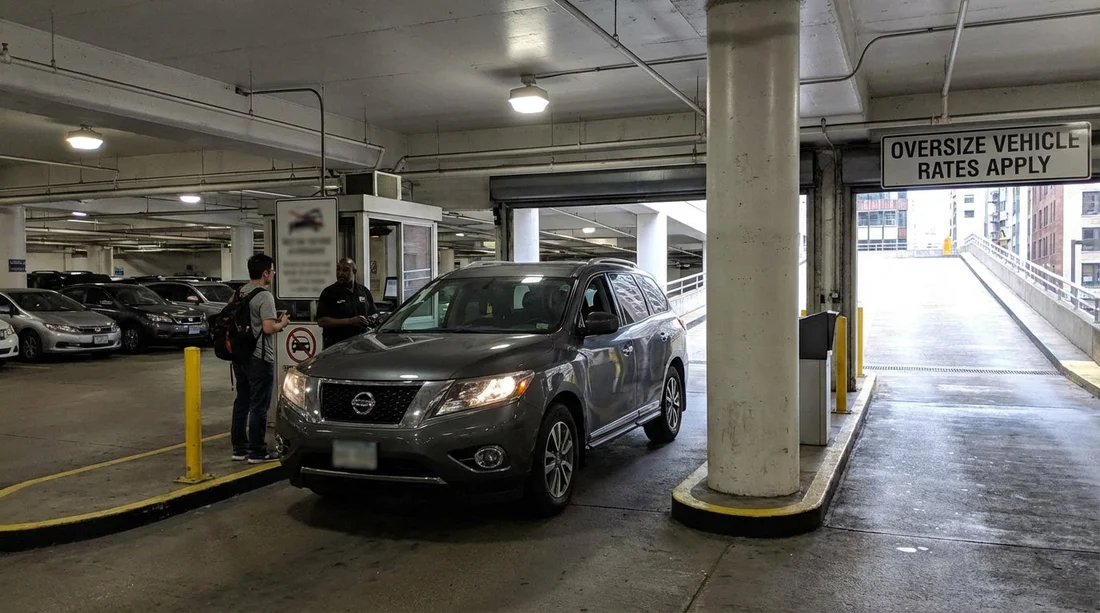
Oversize pricing in New York City parking garages catches plenty of visitors out, especially when you arrive with a taller vehicle than you realised. You might have secured a good-value car hire, planned a quick museum stop, then found a garage quoting a higher “oversize” day rate, or refusing entry due to clearance. Understanding why garages do this, and how to spot the rules before you commit, can save both money and time.
This guide explains what “oversize” usually means in NYC, which vehicle types are most affected, how to read signage and policies before you enter, and smarter alternatives for short stays when Manhattan parking looks punitive.
Why NYC garages charge ‘oversize’ rates
NYC garages operate under intense space constraints. Many facilities are built into older buildings, with tight ramps, narrow aisles, low beams, and lifts designed around smaller passenger cars. An oversize vehicle can reduce the number of cars a garage can safely store, slow down staff manoeuvres, and increase the risk of damage. Charging a higher rate is their way of pricing the extra space and operational friction.
Another factor is labour. Many Manhattan garages are valet-operated. If attendants need extra time to position a tall SUV, avoid scraping a roof rail, or leave extra clearance around a wider vehicle, the garage’s throughput drops. Oversize pricing can compensate for that reduced capacity, particularly during peak periods.
Finally, “oversize” is sometimes a straightforward clearance issue, not just a pricing strategy. If a garage has a 6'0" or 6'2" clearance, a vehicle that would otherwise fit a standard bay may simply not be safe to admit. In those cases, the oversize board can be a shorthand for “taller than our safe clearance” rather than merely “bigger than average”.
What ‘oversize’ usually means, and why it varies
Unlike airline luggage, there is no single, citywide definition for oversize parking. Garages set their own thresholds based on their building layout, insurance, and the types of customers they handle. That is why you might see two garages on the same street with different clearance limits and different surcharges.
Common triggers include height, width, and overall footprint. Height is the most visible, but it is not the only one. A vehicle might clear the entrance sign yet still be considered oversize due to turning radius on ramps, or because it occupies a space that could otherwise hold two smaller vehicles.
In practice, many NYC garages treat anything beyond a standard saloon size as oversize, especially in Midtown and Lower Manhattan. Others use a simple height cut-off. A few apply oversize only to specific categories such as “SUV” or “van”, regardless of exact measurements.
Vehicle types most likely to trigger oversize fees
If you want to avoid surprises, it helps to know which categories most often get flagged by attendants.
Full-size and large SUVs are frequent candidates, particularly models with higher rooflines or chunky tyres. Even some mid-size SUVs can be classed as oversize in garages with narrow ramps or older stack systems.
Minivans and people carriers often sit taller than a typical saloon. Add a rear spoiler or roof rails and the “barely fits” becomes “not allowed”. If your trip genuinely needs seven seats, plan your parking stops more carefully.
Pickups can be problematic due to length and turning radius. Some garages also restrict pickups for operational reasons, regardless of height.
Vehicles with roof extras are an easy way to drift into oversize territory. A roof box, bike rack, ski rack, or even a tall antenna can tip you over the posted clearance. If you are on a road trip, this is the detail most commonly overlooked.
Luxury SUVs and “sport” trims sometimes have wider tyres or body kits. A garage might charge oversize not because of height, but because the vehicle needs a wider space to avoid door dings and pillar scrapes.
How to spot height and oversize policies before you enter
The key is to treat garage entry like a low-bridge situation: decide before you turn in. Once you are in the queue, it is harder to back out, and attendants may assume you accept the terms.
1) Read clearance signage early. Look for a bar or board stating “MAX HEIGHT” or “CLEARANCE”. In NYC it is often shown in feet and inches. Note that the entrance sign may show the lowest point, but inside ramps can be lower due to piping, beams, or signage. If you are close to the limit, do not assume it will be fine.
2) Look for separate “Oversize” boards. Many garages display two rates, a standard daily rate and an oversize daily rate. This might be on a standing sign near the entrance booth, on a wall board, or printed near the payment window. If the oversize rate is present, ask what qualifies before you hand over keys.
3) Confirm whether the garage is self-park or valet. Valet garages can be stricter because attendants are responsible for moving your vehicle around tight corners. If you are self-parking, you can judge fit yourself, but you also accept the risk of scraping in narrow turns.
4) Ask for the exact rule, not just the price. “Is this classed as oversize here?” is a better question than “How much is parking?” because it forces a yes or no based on your vehicle type or height.
5) Keep your vehicle’s height handy. If your car hire paperwork or the model spec lists height, note it in your phone. Even better, if you have a roof box, measure your real height once, as accessories can add several inches.
How car hire choice affects oversize risk in New York
Your parking experience in NYC starts with the vehicle class you choose. A standard or compact car generally gives you the broadest access to garages and tends to avoid oversize pricing. Larger classes increase the odds of both higher parking rates and refusal in older facilities.
Where you pick up can also influence your options. If you are collecting near the airports and driving into Manhattan, it may be worth thinking about the trade-off between luggage space and daily parking hassle. For readers comparing pick-up points, Hola Car Rentals provides location pages that help you plan your trip logistics, such as car hire at New York JFK or car hire at Newark EWR.
If you already know you need a taller vehicle, check typical garage clearances near your accommodation and the places you will stop. If your itinerary is mostly central Manhattan, a big SUV may cost more in parking than you expect. If your itinerary is a longer road trip with limited Manhattan time, a larger vehicle can still make sense, but plan your city segment with alternatives outlined below.
And if you are considering an SUV for winter trips or extra luggage, note that “SUV” is sometimes automatically treated as oversize regardless of exact dimensions. This is especially relevant when comparing classes like SUV hire near New Jersey EWR versus a standard saloon that may slip under most thresholds.
Smarter alternatives for short stays in Manhattan
If you only need the car for a quick stop, you have options beyond the first garage you see.
Use street parking strategically, but follow the rules closely. Street parking can be cheaper, but NYC signage is dense. Pay attention to alternate-side restrictions, metered hours, and “no standing” zones. For a short stay, you can sometimes find a legal metered space, but build extra time for circling and reading signs. Do not assume Sunday rules apply everywhere, and remember that some neighbourhoods have local variations.
Choose municipal or larger public lots where possible. Larger facilities, especially those built more recently or serving retail centres, often have higher clearances and more forgiving layouts. They may still charge more in Manhattan, but are less likely to have the tight lift systems that reject taller vehicles.
Park outside the core and use the subway. For quick visits, it can be cheaper and less stressful to park in an outer borough or New Jersey, then take public transport in. Many drivers find this the most predictable way to avoid oversize surprises. If your trip starts on the New Jersey side, car hire at New Jersey EWR airport can fit neatly into a plan where you keep driving outside Manhattan and only dip in when necessary.
Pick a hotel with included or partner parking. Hotels sometimes have arrangements with garages that can be clearer on vehicle limits and pricing. Even then, confirm whether oversize is extra, and ask for the garage name so you can check clearance on arrival.
When paying oversize might still be worth it
There are situations where it is rational to accept the oversize rate. If you have mobility needs, multiple child seats, or a full boot and want a single close-by garage to avoid unloading on the street, the convenience can outweigh the surcharge. The point is not that oversize pricing is always “wrong”, but that it should be a conscious choice rather than a surprise at the entrance.
Also, remember that NYC parking prices fluctuate by location and time. A garage may have a high oversize day rate in peak hours and a different overnight rate. If your stay is short, compare the total cost of a nearby garage versus the time and effort of parking farther away.
Practical checklist to avoid oversize fees on your next NYC stop
Know your vehicle type and height. If you select a larger class for your car hire, assume parking will be harder until proven otherwise.
Remove roof accessories before entering the city. If a roof box is optional for the NYC segment, taking it off can be the simplest way to fit standard clearances.
Scan for clearance signs before turning in. If you cannot see a clearance figure, slow down and look again, or choose another facility.
Ask “What counts as oversize here?” A clear question avoids the “we told you at the window” moment.
Have a Plan B location. Pick one alternative garage or a neighbourhood where you will search for street parking, so you are not deciding under pressure.
Finally, align your pick-up, vehicle class, and itinerary. If you will spend most of your time in Manhattan, smaller can be smarter. If you are road-tripping and only passing through, consider parking outside the centre for the short visit and keep the larger vehicle for the rest of the journey. If you are comparing providers, you can also review supplier-specific pages such as Avis car rental in New Jersey EWR to help plan where you will start your drive and how quickly you need to reach the city.
FAQ
Why do some NYC garages charge oversize rates even if my vehicle fits? “Oversize” can mean more than height. Garages may charge extra for SUVs, vans, pickups, or wide vehicles because they reduce capacity, require extra manoeuvring, or do not suit stack systems.
What height is considered oversize in New York parking garages? It varies by garage. Some facilities post clearances around 6'0" to 6'6", while others can accommodate higher vehicles. Always rely on the posted clearance at the specific entrance.
Can I avoid oversize fees by choosing a different car hire class? Often, yes. Compact and standard cars are least likely to trigger oversize pricing, while large SUVs and minivans are more commonly surcharged. Vehicle class choice is one of the easiest ways to reduce risk.
Is it safer to park outside Manhattan for a short visit? For many drivers it is more predictable. Parking in outer boroughs or New Jersey can mean larger facilities, fewer clearance issues, and lower prices, then you can use public transport into central areas.
What should I ask a garage attendant before handing over keys? Ask two things: the maximum clearance and what they class as “oversize” at that location. Confirm the total rate for your expected duration before you commit.




























































































