


Quick Summary:
- Most Florida rental counters no longer take manual credit-card imprints today.
- Expect a pre-authorisation hold, not a charge, at pick-up.
- Bring the physical credit card, matching ID, and booking name.
- Using the right card helps avoid deposit issues and verification delays.
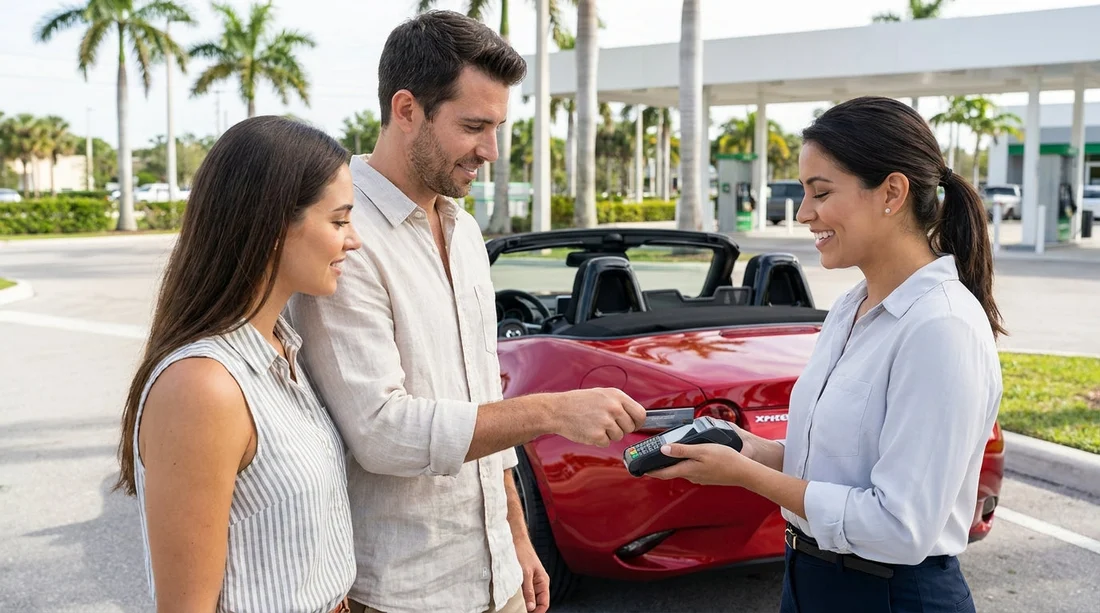
Credit-card imprints feel like something from another era, a metal slider, carbon paper, and a raised-number card. Travellers still ask about them because the phrase pops up in old rental terms, and some people have experienced slow check-ins where the staff “took an imprint” of sorts. In modern Florida car hire, a true manual imprint is rare. What most customers see today is an electronic pre-authorisation, which is faster, traceable, and works with current fraud-prevention rules.
This article explains the difference between a credit-card imprint and a pre-authorisation, what you should expect at Florida rental counters, and why Hola Car Rentals’ credit-card-only approach is designed to reduce pick-up delays and mismatched-payment problems.
What a credit-card imprint actually is
A credit-card imprint is a physical copy of the card details, historically made when the card had raised numbers. The rental desk placed the card in a manual imprinter, slid a carriage across, and the raised characters transferred onto a paper slip. The slip could later be processed if a customer did not return or if there was damage to recover.
Imprints were used when real-time electronic authorisation was unavailable or unreliable. They helped merchants prove the card was present at the time of rental, but they were also slow and prone to errors. In most cases, an imprint alone did not confirm available funds, it simply captured details for later billing.
What a pre-authorisation is, and why it replaced imprints
A pre-authorisation is an electronic hold placed on your credit card by the rental company at pick-up. It is not a payment. Instead, your card issuer temporarily sets aside a specified amount of your available credit to cover the deposit, plus any estimated rental charges depending on the supplier’s rules.
It is a hold, not a charge. You usually will not see money leave your account as a debit, but the available credit reduces by the pre-authorised amount.
It happens in real time. The terminal requests approval from your card issuer, which is why staff can confirm immediately whether the deposit can be secured.
Release timing varies. Once the car is returned and the final amount is settled, the hold is released or adjusted. The release can be quick, but in practice it depends on the bank’s processing time.
Because pre-authorisations validate the card and available credit instantly, most rental desks in Florida have no operational need for a manual imprint. Even when staff say “imprint”, they typically mean they have taken an electronic authorisation and stored the card details according to compliance rules.
Is a credit-card imprint still used for rental car pick-up in Florida?
In most situations, no. The overwhelming norm at airports and major city locations is electronic payment processing with a chip-and-PIN or chip-and-signature transaction, combined with a pre-authorisation hold.
Terminology lag. Rental terms and counter language sometimes keep old words even after processes change.
Additional verification steps. Some desks may photocopy documents or take extra details for security, which can feel like the old approach, but it is not a true imprint.
The practical takeaway is simple, plan for a pre-authorisation and make sure your card and documents meet the rental requirements. If you are flying into Orlando, pick-up processes are typically streamlined, particularly at major airport facilities such as Orlando Airport (MCO) car rental locations where electronic authorisation is standard.
Why pick-up delays happen, even with modern payments
Although imprints are mostly history, pick-up delays can still happen when the deposit cannot be secured smoothly. Common causes include card type mismatch, name mismatches, insufficient available credit, bank security blocks, and multiple holds that have not released yet.
These issues can arise in any Florida location, whether you are collecting near Miami, Tampa, or the theme-park corridor. If you are comparing pick-up experiences, airport sites and larger city branches often have more staffing and faster verification, for example Tampa (TPA) car hire counters that run high volumes tend to rely on consistent electronic checks.
How Hola’s credit-card-only policy helps prevent pick-up delays
Hola Car Rentals focuses on reducing common counter problems by aligning expectations with how Florida suppliers actually process deposits today. The practical benefit of a credit-card-only approach is that it limits the most frequent cause of refused deposits, arriving with a payment method that cannot support a pre-authorisation.
It is also helpful when renting in areas with heavy demand, such as Miami and its surrounding districts. If you are collecting around Doral, providers there commonly use standard pre-authorisation workflows, as seen with options like car hire in Doral (DRL). Having a suitable credit card ready reduces the risk of being redirected to change payment methods or rebook under another driver.
What to bring to a Florida rental counter for a smooth pick-up
Even though credit-card imprints are largely obsolete, you still need to arrive prepared for today’s verification checks. Bring the physical credit card used for the deposit in the main driver’s name, your driving licence, and any requested photo ID, plus your booking confirmation so staff can match the reservation quickly.
If your trip includes a beach stay, pick-up locations serving leisure travellers often run the same payment process but may have additional questions about coverage and local driving plans. For example, Miami Beach car hire providers typically follow electronic authorisation norms, so the key variable remains the suitability of your credit card and the available credit for the hold.
Choosing the right vehicle can affect deposits and holds
Deposits can vary depending on vehicle class and supplier policies. Larger vehicles may come with higher holds, simply because the rental value is higher and the risk exposure changes. Options such as minivan rental in Miami Beach (MBC) are popular, but it is wise to ensure your credit limit comfortably covers the expected pre-authorisation.
FAQ
Do Florida rental companies still use the old metal credit-card imprinter? Rarely. Most counters use chip transactions and electronic pre-authorisation holds, and the word “imprint” is usually just legacy terminology.
Will a pre-authorisation charge my card? No, it is typically a temporary hold on your available credit. The final charge is processed when the rental is closed, and the hold is then released or adjusted.
Can I use a debit card instead of a credit card for car hire in Florida? Some suppliers may accept debit cards under specific conditions, but many require a credit card for the deposit. A credit-card-only policy reduces the chance of being declined at pick-up.
Why did my pre-authorisation amount differ from the quoted rental price? The hold often includes a deposit and sometimes an estimated rental amount. The final total can differ based on fuel, tolls, added drivers, or changes to the rental period.
How can I avoid pick-up delays related to payment? Bring the physical credit card in the main driver’s name, ensure sufficient available credit for the hold, and make sure your booking details match your ID and licence.




























































































