Quick Summary:
- ‘Or similar’ guarantees a car group, not a specific make or model.
- Expect the same category size, doors, and seating capacity, in most cases.
- Transmission, fuel policy, and key features can vary, so verify early.
- Confirm luggage space, child seats, toll needs, and pickup requirements beforehand.
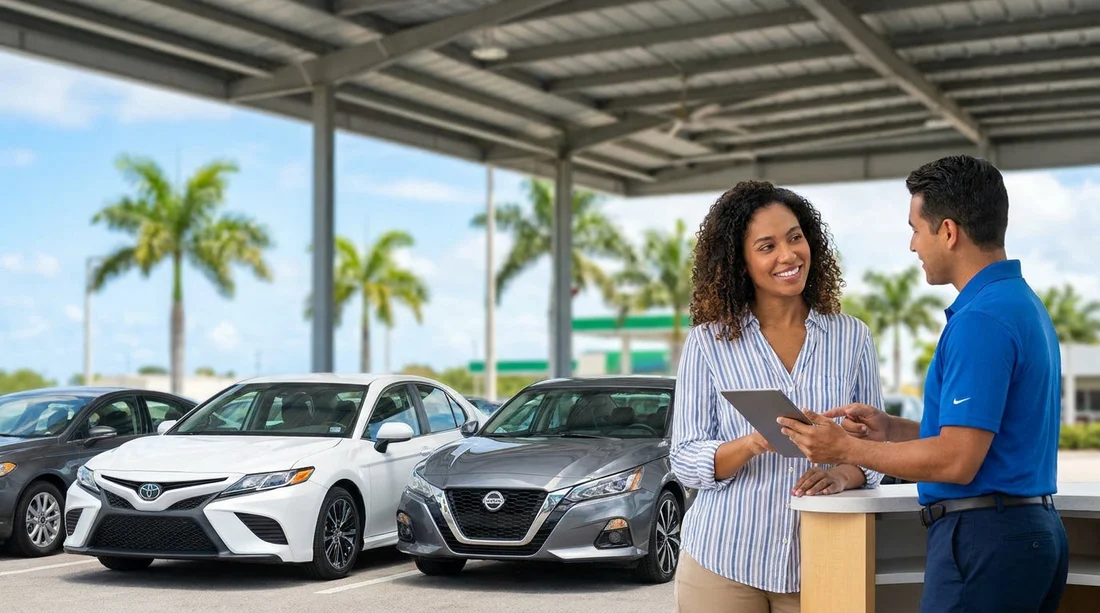
When you arrange car hire in Miami, you will often see a vehicle described as “Toyota Corolla or similar” or “Nissan Rogue or similar”. This wording causes confusion because travellers assume they are choosing a specific car. In rental terms, “or similar” means the provider is promising a car group (also called a category or class) rather than an exact make, model, year, colour, trim level, or engine type.
Miami is a high demand market with busy airport arrivals, cruise departures, weekend leisure travel, and strong seasonality. Fleets rotate quickly, cars go out for cleaning or maintenance, and availability changes hour by hour. “Or similar” gives the rental company flexibility to supply an equivalent vehicle within the same class, while still meeting the essential specifications attached to that class.
If you are comparing options for Miami pickup locations, it helps to start with the right branch page and then focus on category details rather than the photo. For example, you can review location-specific options via car rental in Florida, or narrow it down if you prefer a central collection point such as car hire in Downtown Miami.
What “or similar” usually guarantees in Miami
Although wording differs slightly by brand, “or similar” normally guarantees the vehicle category you paid for. That category tends to define the practical basics that affect your trip.
1) Vehicle size and general class
If you select an economy, compact, intermediate, standard, full-size, premium, SUV, or minivan category, you should receive a vehicle that fits that overall class. The brand might change, but the footprint and intended use should be comparable.
2) Seating capacity within the group
Category listings often show seats and doors, such as “5 seats, 4 doors”. This is the core promise for most mainstream categories. Still, seats can be the area where assumptions cause problems, for example, a “5-seat” SUV might be comfortable for four adults plus luggage, but tight for five adults on a long drive.
3) Transmission type when specified
In Miami, most cars are automatic. If the listing explicitly states automatic, you should not be given a manual. If it does not specify, do not assume. If you need automatic for comfort, or manual for preference, make sure the transmission line is present on the confirmation.
4) The rate and inclusions you selected
“Or similar” should not affect the price you locked in, the mileage allowance (often unlimited), and the inclusions shown at checkout such as basic protection options, additional driver terms, or whether fuel is “full to full”. Those elements are tied to the rental agreement, not the exact model.
What can vary, even within the same car group
The practical differences between “similar” vehicles can be small or significant. These are the common variables to expect at Miami pick-up.
Make, model, trim, and model year
This is the headline variation. A photo is illustrative, not a promise. You might get a Corolla, a Jetta, an Elantra, or another equivalent, depending on what is clean, serviced, and ready.
Boot space and luggage practicality
Two cars in the same class can have different boot shapes. A compact saloon and a compact hatchback may both be “compact”, but handle suitcases differently.
Features and technology
Apple CarPlay, Android Auto, built-in navigation, reversing cameras, USB-C ports, keyless entry, and driver assistance systems can vary. Do not assume these are included unless they are specifically listed as guaranteed features.
Fuel type and efficiency
Within the same class, you might receive a petrol model with different consumption, or occasionally a hybrid if available. Unless the listing states “hybrid guaranteed” or similar, it is not assured.
All-wheel drive versus two-wheel drive
In SUV categories, AWD is often not guaranteed in Florida. Many Miami SUVs are two-wheel drive, which is typically fine for paved roads, but it matters if you expected AWD by default.
Colour and extras
Colour is never guaranteed. Also, extras like child seats, toll devices, or satellite radio are separate items, subject to availability and local rules.
How to check key features before you arrive
The best way to avoid surprises is to treat “or similar” as a prompt to verify requirements, not as a red flag. Use this checklist before you travel.
Read the category line carefully, not the photo
Look for seats, doors, transmission, and whether the vehicle is listed as an SUV, saloon, or minivan. If something is critical, it should be stated in writing. If it is not stated, it is a preference rather than a guarantee.
Match the car group to your real passenger and luggage load
A “5-seat” label does not mean five adults plus five large suitcases will work. If you are travelling with family, consider stepping up a class, or choosing a larger SUV option. If you are staying near the beach and want more space, reviewing an SUV category can help set expectations, see SUV rental in Miami Beach.
Check transmission and air conditioning expectations
Automatic is common, but still confirm it is specified. Air conditioning is effectively standard in Miami due to climate, but if you are travelling in peak summer, you may also care about cooling performance, tinted windows, and remote start, which are not guaranteed.
Review pick-up location differences
Downtown, airport-area, and suburban branches can carry different mixes of cars. If you are collecting near Coral Gables, it can be useful to compare what is typical there, see car hire near Airport Coral Gables.
What to do at the counter if the car is not what you expected
Even with preparation, the assigned vehicle might not suit your needs. The key is to separate preferences from requirements.
1) Confirm it meets the promised category
Check the agreement for the class code or category description. If the supplied car is clearly a smaller group than you paid for, raise it immediately and ask for a correction. In most cases, staff can reassign you to an equivalent group if inventory allows.
2) Re-check seats, boot space, and child seat compatibility
Open the boot before leaving the lot. If you have child seats, ensure the vehicle has suitable seatbelts and headrests, and that ISOFIX or LATCH points match what your seat requires.
3) Ask about alternatives within the same group
If the vehicle meets the class but lacks a preferred feature, you can ask whether another car in the same group is available. The answer depends on what has returned and what is cleaned. Being flexible on colour and brand helps.
4) If you truly need a bigger class, treat it as an upgrade decision
Sometimes a larger group is the only way to secure more boot space or extra seating comfort. Any price difference should be clear before you accept. If you are managing costs carefully, looking at value-led options may help set expectations, see budget car rental in Coral Gables.
Why “or similar” is common and not a warning sign
Car rental fleets are designed around groups, not individual cars. The provider has to deliver a working vehicle that fits the booked class at the moment you arrive. Miami adds extra variability because of flight delays, one-way returns, rapid turnarounds, and weather-related disruptions. “Or similar” is how the industry communicates that operational reality.
For travellers, the goal is to make sure the group you choose matches the trip you are actually taking. If you pick the right category and verify must-have items like transmission and seating, “or similar” generally becomes a non-issue, and you can focus on driving rules, toll planning, and parking.
FAQ
Does “or similar” mean I might get a completely different type of car? Usually no. It means a different make or model within the same booked category, with comparable size and seating. If you booked an SUV group, you should not be given a small saloon group.
Is automatic transmission guaranteed for car hire in Miami? Only if it is stated on your booking confirmation or category details. Automatics are common in Miami, but you should still verify the transmission line to avoid assumptions.
Can I insist on the exact car shown in the photo? The photo is typically illustrative. Rental companies allocate based on what is available, clean, and ready. You can request the pictured model, but it is not guaranteed unless explicitly confirmed.
What should I check before driving away from the Miami location? Confirm the category on the agreement, inspect the car for damage, test lights and air conditioning, and check boot space fits your luggage. Also confirm fuel level and any toll or charging arrangements.
If the car is smaller than the category I paid for, what happens? Raise it at the counter straight away. If the supplied vehicle is not in the correct group, staff will usually correct the assignment or adjust pricing according to the agreement terms.