


Quick Summary:
- Ask if the vehicle has a spare wheel, donut, or inflator kit.
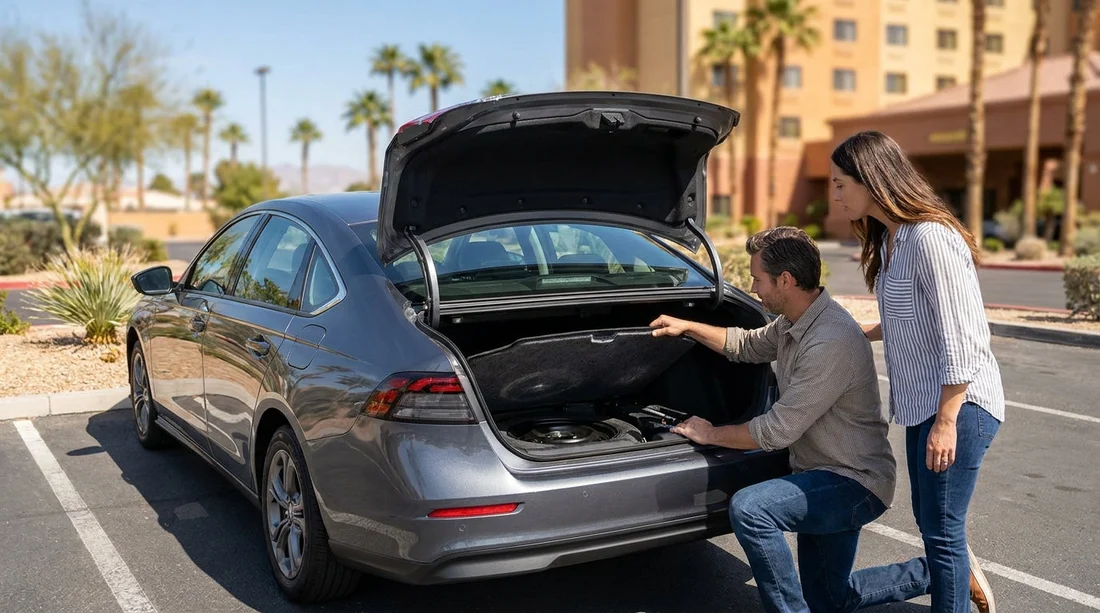
- Open the boot and check under the floor for tyre equipment.
- Confirm the jack, tow hook, and locking wheel nut key are present.
- Photograph the kit and read the tyre label before leaving.
When you pick up a vehicle for car hire in Las Vegas, it is easy to focus on fuel policy, deposits, and the first drive out of the garage. A more practical check is what happens if a tyre loses pressure on I-15, the 215 Beltway, or a desert road at night. Many modern rentals do not carry a full-size spare wheel, and some have no spare at all, relying on a sealant inflator kit or run-flat tyres. Knowing what your particular car includes, and where it is stored, helps you avoid confusion and wasted time later.
This checklist is designed for the minutes before you leave the counter and the pick-up bay. It explains what to look for, where it is usually kept, and why it matters in Las Vegas heat and long-distance driving conditions. If you are collecting near the terminals, the pick-up process can be quick, so it helps to have a routine. For airport collections, see Las Vegas airport car rental information for common collection setups.
Step 1, confirm what tyre support the vehicle is supposed to have
Before you take the keys, ask a simple question, “Does this car have a spare wheel, a donut spare, or an inflator kit?” The wording matters because “spare” can mean different things. A full-size spare is a normal wheel and tyre. A donut spare is a temporary, narrower tyre with speed and distance limits. An inflator kit is usually a small compressor plus sealant, intended for small tread punctures, not sidewall cuts.
If the agent cannot confirm, ask them to check the vehicle class notes, or check the boot with you. This is not about being difficult, it is about understanding what you are responsible for using on the roadside. If you are comparing vehicle categories for car hire in the city, the general options are outlined on car rental in Las Vegas, but the exact equipment can still vary by model year.
Step 2, locate the spare wheel or kit, do not assume it is included
In most saloons and hatchbacks, a spare wheel or kit is stored under the boot floor. Lift the boot mat, find the pull tab, and raise the floor panel. If the car is an SUV, the spare may be under the rear cargo floor, mounted underneath the vehicle, or not supplied at all. Some SUVs store tools in side compartments, so check the left and right panels as well. If you are hiring a larger vehicle class for longer drives, it is worth scanning the typical categories on SUV hire in Las Vegas to understand what you might be given.
What you want to see is one of the following:
Full-size spare: check the tyre looks properly inflated and has no obvious cracking.
Donut spare: look for the speed limit label, often 50 mph, and note any distance guidance.
Inflator kit: confirm you have both the compressor and the sealant bottle, and that the sealant is within date if a date is printed.
If you find an empty wheel well or a missing compressor, return to the desk immediately, before you exit the lot. It is easier to swap cars or have missing items logged while you are still on site.
Step 3, check the tools, jack, wheel brace, and locking wheel nut key
A spare wheel is only useful if you can fit it. In the boot well or tool pouch, look for:
Jack: usually a scissor jack, sometimes a small bottle jack.
Wheel brace or wrench: ensure it is the correct size for the wheel nuts.
Tow hook: commonly a threaded eyelet tucked into the tool tray.
Locking wheel nut key: if the wheels have locking nuts, you need the matching key adaptor. Without it, a roadside technician may not be able to remove the wheel.
Do a quick visual test by fitting the wheel brace onto one wheel nut to confirm it matches. You do not need to loosen anything in the car park, just check the tool size and access. If the car has wheel covers, make sure you know how to remove them, because the jack points and nuts must be accessible.
Step 5, understand what an inflator kit can and cannot do
An inflator kit is designed for small punctures in the tread area. It normally cannot seal a sidewall cut, a blowout, or damage from hitting a kerb or road debris. In very hot conditions, sealant performance can vary, and the tyre may still lose pressure after a temporary repair. If your rental has only an inflator kit, check the instructions booklet or the diagrams printed on the compressor. Confirm whether the sealant is pre-attached or separate, and where the 12V socket is located.
Also note that using sealant can make a tyre harder to repair later. That does not mean you should not use it when needed, but you should know it is often a get-you-moving solution to reach a safer location or a service centre, not a full fix.
Step 6, check the tyre pressures and condition before you leave
Even with a spare or kit, prevention is better. Walk around the car and look for visibly low tyres, bulges, or nails. Many vehicles show tyre pressures in the dashboard menu. If the reading is available, confirm all four tyres are in a sensible range and that no tyre warning light is on. Tyre pressures can rise with heat, but a tyre that is significantly lower than the others at pick-up is a red flag.
In Las Vegas, high temperatures can amplify small problems. A tyre that is borderline in the morning can become a bigger issue after highway speeds. If something looks wrong, request a different vehicle while you are still at the location.
Step 7, document what you found, photos save time later
Take clear photos of the spare wheel or inflator kit laid out as it is stored, plus a wide shot showing it in the boot area. If the kit is missing, photograph the empty compartment and report it right away. This is useful if there is any dispute about whether the equipment was supplied.
While you are taking photos, capture the tyre information label in the driver door jamb, and the mileage and fuel gauge at pick-up. These quick records help reduce stress if you need roadside assistance during your car hire period.
Where this check fits in a Las Vegas pick-up routine
A practical flow is, confirm equipment at the counter, check the boot and tool kit in the bay, then do a slow walk-around for tyre condition and warning lights. If you are picking up from a particular provider, knowing their typical fleet practices can help, but do not rely on assumptions. For example, you can review brand pages like Alamo car rental in Nevada and Budget car rental in Nevada for general context, then still verify the exact car you receive.
Finally, remember that “spare wheel included” does not guarantee it is usable. A flat spare, missing jack handle, or absent locking nut key can turn a simple puncture into a towing situation. Two minutes in the pick-up bay is often the difference between a quick roadside wheel change and a long wait.
FAQ
Do all car hire vehicles in Las Vegas include a spare wheel?
No. Many newer models provide an inflator kit or run-flat tyres instead of a spare, and equipment can vary by model and trim.
Where should I look for the spare wheel or inflator kit?
Start under the boot floor panel. In SUVs, also check side compartments, under the rear cargo floor, or beneath the vehicle if an external carrier is fitted.
What should be included with a spare wheel?
You should have a jack, wheel brace or wrench, and any adaptor for locking wheel nuts. Without these, fitting the spare can be impossible.
Can I rely on an inflator kit for any puncture?
No. Inflator sealant usually works only for small tread punctures. Sidewall damage, blowouts, or large holes typically require a tyre replacement or towing.
What is the quickest way to avoid problems later?
Check tyre support equipment before leaving the lot, photograph what is present, and report any missing items immediately while you are still at pick-up.




























































































