


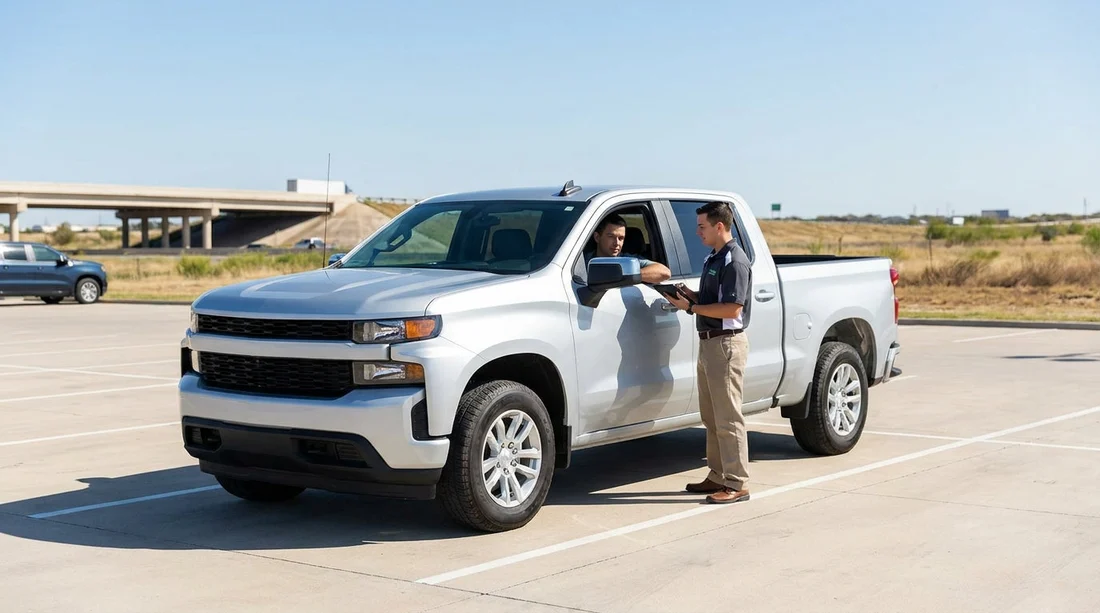
Quick Summary:
- One-way fees depend on demand, vehicle class, and return location.
- Airport returns may add facility fees separate from one-way pricing.
- Compare identical dates, times, and car class because fees change daily.
- Check if crossing state lines restricts returns or increases charges.
One-way pricing is one of the most confusing parts of car hire, especially in a large state like Texas where popular routes can run hundreds of miles. You may see it described as a one-way fee, drop-off charge, or return charge. While the labels vary, the idea is consistent, you are returning the vehicle to a different location than where you collected it, and the supplier may charge extra for that.
This guide breaks down how those fees are set in Texas, what commonly triggers extra charges, and how to compare routes so you can avoid surprises when you reach checkout.
What is a one-way fee versus a drop-off charge?
In everyday use, “one-way fee” and “drop-off charge” usually mean the same thing, an extra charge for returning the vehicle somewhere else. However, it helps to think of your total return cost as potentially made up of several parts.
First is the supplier’s one-way fee, which is the amount they charge to cover the cost of repositioning the car back to where it is needed. Second can be location-based fees, often seen at airports, where there may be concession recovery charges or facility fees. Those are not one-way fees, but they can make an airport return look more expensive than a city return even on the same route.
How car hire companies set one-way pricing in Texas
One-way fees are not a simple per-mile calculation. In Texas, pricing tends to reflect operational demand rather than distance. A long drive can sometimes have a low fee, while a shorter drive can be expensive if it moves a vehicle away from where it is needed.
Fleet balancing and demand is the biggest factor. If more customers want to pick up in Austin and return in San Antonio than the reverse, the supplier may charge more for that direction to compensate for the imbalance. The fee helps fund the logistics of moving vehicles back, either by staff driving them, vehicle transport, or encouraging other renters to take the opposite one-way route.
Seasonality and events can change fees sharply. Texas has spikes around major festivals, sporting events, and holiday weekends. A route that is cheap midweek can become costly on peak dates because the supplier expects to need vehicles in a different place the next day.
Vehicle class also matters. Larger SUVs and vans can be more expensive to reposition, and suppliers may have fewer of them at each location. If you are comparing an economy car to an SUV, do not assume the one-way fee will scale evenly. For example, an airport SUV pick-up may be quoted differently than a city location SUV, as shown on pages like SUV hire in Texas (IAH) where the available classes and suppliers can differ by location.
Inventory at the return branch influences whether the return is welcomed or penalised. If a return station already has too many cars, the supplier may charge more to discourage returns there. Conversely, if that station is short on vehicles, you may see a low one-way fee, or sometimes none at all, because your route helps them.
Airport versus city drop-offs: why airports can look pricier
Texas airports often have additional charges that are not strictly one-way fees. These can include airport concession recovery fees and facility charges that support the rental car centre. If your return location is an airport, your overall cost may rise even if the supplier’s one-way fee is modest.
If you are considering an airport start or finish, it can help to compare the same dates and times using airport-specific listings such as car rental at Austin (AUS) or Avis at San Antonio (SAT), then check how the total changes when you switch the return point to a city location.
Common Texas one-way routes and what affects the fee
Texas has several high-demand corridors. While exact pricing changes daily, the same factors tend to shape whether the fee is low or high.
Austin to San Antonio is a frequent business and leisure route. Because it is short, people often assume it will be cheap. In reality, the fee depends on whether suppliers need cars in the return city that day. If there is a big event in Austin, suppliers may prefer cars to remain there, making Austin pick-up and San Antonio return potentially pricier.
Houston airport to Austin or San Antonio can show varied pricing because airport inventory and airline-driven demand influence fleet flow. If you are looking at larger vehicles, the difference can be more pronounced. For vans, for instance, availability and repositioning costs can drive the fee, which is why comparing like-for-like through options such as van hire in Texas (IAH) can prevent mismatched comparisons.
El Paso to other Texas cities is an important case because distance and regional inventory both come into play. El Paso is far from central Texas hubs, and suppliers may have fewer transfer options, so one-way fees can be higher or availability more restricted. If you are assessing west Texas routes, review location-specific inventory such as car rental in El Paso (ELP) to see what classes are realistically offered for one-way returns.
What you should check before you compare prices
To compare one-way costs accurately, you need to standardise the details. Small differences can change the quote or make a route appear cheaper than it is.
Match pick-up and drop-off times. A different return time can push you into an extra day, which may be bigger than the one-way fee. It can also change the fee itself because suppliers often price by day and demand.
Keep the car class consistent. If one quote is for a compact and another is for a midsize SUV, the one-way component may not be comparable. Even within SUV, full-size models can be treated differently than compact crossovers.
Confirm the return location type. San Antonio might mean the airport, a downtown branch, or a suburban location. Airport fees can distort the comparison, and branch-to-branch transfers can have different one-way rules.
Look for fee timing. Some suppliers include the one-way fee in the prepaid total, while others show it as payable on arrival. If you only compare the prepaid number, you can miss a large counter-collected charge.
How to avoid surprises at checkout and at the counter
Surprises typically come from two places, misunderstanding what is included in the displayed price, and changing details late in the process.
First, re-check that the quote reflects a one-way rental, meaning the pick-up and return locations are different on the same booking. If you change the return location during the final steps, the system may refresh the pricing, and the one-way fee can appear or change.
Second, read the fee breakdown and terms for anything described as a one-way, drop-off, or intercity charge. If the one-way fee is payable at the counter, treat it as part of the real total when you compare providers.
FAQ
Are one-way fees in Texas based on distance? Not usually. They are mainly based on fleet demand, vehicle class, and how much the supplier needs cars at each location.
Why did my one-way fee change when I changed the time by an hour? Pricing can refresh when you change pick-up or drop-off times, because daily demand, rate bands, and minimum day rules may apply.
Is an airport drop-off charge the same as a one-way fee? Sometimes it is shown together, but airports may also add separate facility or concession-related charges that apply even on non one-way rentals.
Can I avoid one-way fees by returning to a different branch in the same city? Not always. Some same-city returns are still treated as one-way if the branch is in a different pricing zone or has different inventory rules.
Do all vehicle types allow one-way returns across Texas? No. Specialty vehicles like large SUVs or vans may have limited one-way availability, especially on long routes or into smaller locations.





























































































