


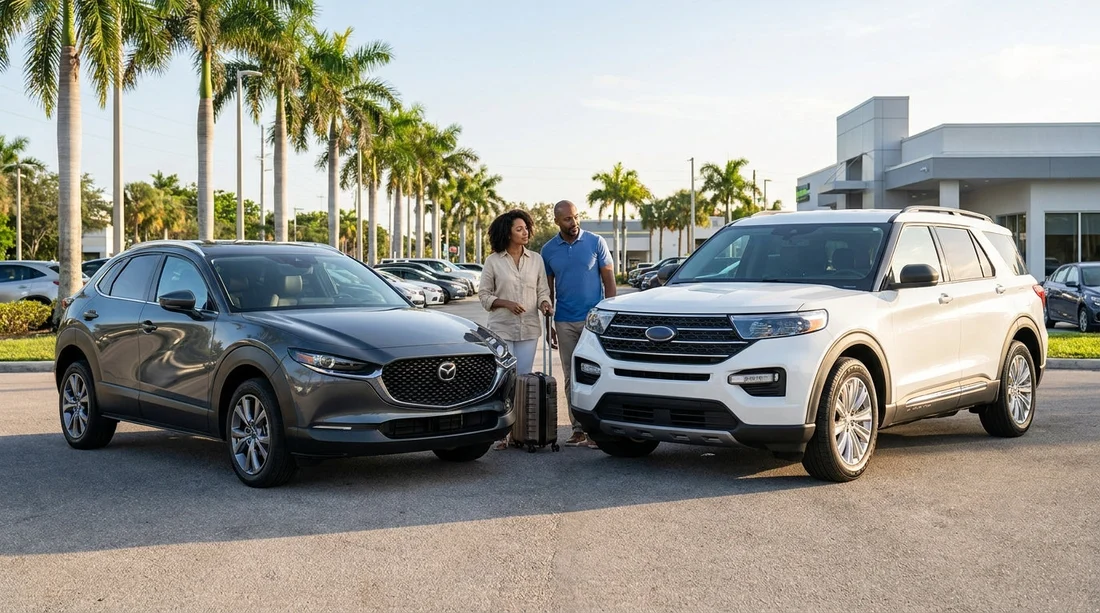
Quick Summary:
- Intermediate SUVs seat five, with boot space for about two cases.
- Standard SUVs feel roomier, often fitting three cases and a pushchair.
- Class labels vary by brand, so confirm passenger and luggage numbers.
- Pick intermediate for cities, standard for families and longer Florida drives.
When you arrange car hire in Florida, SUV categories can feel confusing because the labels do not always match what you drive at home. “Intermediate SUV” and “Standard SUV” sit next to each other in many booking flows, yet the real-world difference can be meaningful if you are travelling with luggage, a buggy, or taller passengers.
This guide explains typical seating, boot space, and how US car-class labels are used, so you can select the right SUV size without paying for an unnecessary upgrade. It also highlights what can change between rental brands and locations, which matters in a state where one trip could include Miami city parking and a long motorway run to Orlando.
How US SUV classes are typically defined
In the US, rental “classes” are primarily a pricing and inventory system, not a promise of a specific model. You are usually booking a category with “or similar” terms, so the best approach is to think in practical measurements: passenger comfort, luggage volume, and overall footprint for parking.
If you are picking up near Orlando International, the local fleet mix tends to be heavy on SUVs, which can make categories look close together. When comparing options from Orlando Airport car rental, focus on stated passenger and luggage capacity rather than the label alone.
Intermediate SUV: what you usually get
An intermediate SUV is commonly the entry point into the “proper SUV” feel for Florida roads without jumping into a large body size. It is typically a compact-to-mid compact crossover, higher seating position than a saloon, and enough ground clearance for rough car parks or sandy access roads, but not intended for off-road driving.
Typical seating: most intermediate SUVs are five-seat vehicles, but the middle rear seat is often narrower. For five adults, expect best comfort for four adults plus a child or smaller adult for longer drives.
Typical boot space: the boot is usually suitable for about two medium suitcases plus a couple of soft bags. If all five seats are occupied by adults and everyone has a hard case, you may need to stack luggage higher, or split items between the boot and rear footwells.
Typical “or similar” models: fleet examples often sit in the Nissan Rogue, Jeep Compass, Hyundai Tucson, or Toyota RAV4 neighbourhood, though the exact mix changes constantly.
Best for: couples, small families, and travellers doing city stops in places like Miami or Fort Lauderdale, where parking garages and kerbside spaces can be tight. Intermediate SUVs are also easier if you will be visiting dense areas such as Brickell. If that is your plan, browsing car rental in Brickell can help you compare category wording across suppliers.
Standard SUV: what “one step up” really means
A standard SUV is generally a larger two-row SUV with noticeably more rear-seat space and a deeper boot. It still often seats five, but the cabin is wider and the rear bench tends to be more usable for three passengers for shorter journeys.
Typical seating: usually five seats, with better shoulder room than intermediate. Headroom is often excellent, which matters if your group includes tall teenagers or adults.
Typical boot space: you are more likely to fit three medium suitcases, or two large cases plus day bags, shopping, and a pushchair. The extra boot length and height can be the difference between packing neatly and playing luggage Tetris every morning.
Typical “or similar” models: think Chevrolet Equinox, GMC Terrain, Toyota Highlander in some fleets, or similar mid-size SUVs, although Highlander-class vehicles can sometimes appear in “full-size” instead. The key is that standard generally delivers more usable cargo room and rear-seat comfort than intermediate.
Best for: families carrying beach gear, cooler bags, and prams, or anyone planning longer drives across Florida where comfort matters. If you are collecting near Tampa for Gulf Coast beaches, compare how categories are described on Alamo car hire in Tampa, as “standard” can be stocked slightly differently to Miami-area locations.
Seating and luggage: a practical comparison
Because “intermediate” and “standard” can overlap, use these practical checks when deciding.
If you are four people with four cases: intermediate can work if some bags are soft or you pack lightly. Standard is usually more comfortable and keeps the rear view clearer because luggage can sit lower.
If you are five people with luggage: standard is often the safer pick, but even then, consider whether you actually need a three-row SUV or a people carrier. Many five-seat SUVs struggle when all five seats are filled and everyone has a suitcase.
If you are travelling with a buggy or child seat: both categories can handle child seats, but standard tends to make it easier to keep the buggy in the boot without folding it into awkward shapes.
Why labels vary between rental companies
US rental companies manage fleets by availability, regional popularity, and resale cycles. That is why an intermediate SUV from one brand might look close to a standard SUV from another. You might even see the same model appear in two adjacent categories depending on trim level, wheel size, or internal pricing rules.
This is also why it helps to compare across suppliers and locations. For example, if you are hiring around Fort Lauderdale, you may see different “or similar” guidance than in Orlando. Checking Avis car rental in Fort Lauderdale alongside other options can give you a better sense of how each class is described.
When you book car hire, look for the stated numbers such as “5 passengers, 2 bags” versus “5 passengers, 3 bags”. Those bag counts are imperfect, but they reflect the supplier’s intention for capacity more reliably than the class name alone.
How to choose without paying for unnecessary upgrades
Use a simple decision rule: upgrade only when you can name the space you need. If you cannot describe the specific benefit, intermediate is often sufficient.
Choose a standard SUV if: you are a family, you will carry bulky items (pushchair, beach chairs, cooler), or you want extra comfort for longer highway days. The added boot space is often the real benefit, not just a bigger-looking vehicle.
Consider alternatives if: you are five adults with full-size cases. In that situation, even a standard SUV may feel tight, and a van or people carrier can be more practical. If your trip revolves around Orlando and you need maximum luggage flexibility, compare with van hire at Orlando MCO to see whether it better fits your group.
FAQ
Are intermediate and standard SUVs always five-seaters in Florida? Most of the time, yes. Both categories are usually two-row, five-seat SUVs, but the middle rear seat can be tight in intermediate SUVs, especially for adults.
How many suitcases fit in an intermediate SUV boot? Typically around two medium suitcases plus a couple of soft bags. If you have larger hard-shell cases or five passengers, space can become limited quickly.
Does “standard SUV” mean a three-row SUV like a Ford Explorer? Not usually. Three-row SUVs are more often classed as full-size or premium, but fleets vary, so rely on the listed passenger and luggage numbers rather than the label.
Why do I see the same model name in different SUV classes? Rental classing can depend on trim, pricing, and supplier rules. A better guide is the stated capacity (passengers and bags) and the vehicle’s boot shape.
Is upgrading from intermediate to standard worth it for a Florida holiday? It is worth it if you need extra boot space for family gear, shopping, or longer road-trip comfort. If you are travelling light and parking in cities, intermediate often makes more sense.

























































































