


Quick Summary:
- Ask staff to check pressures with a gauge, not visually.
- Photograph the warning light, odometer, and tyre sidewalls immediately.
- Request the issue is written on the rental agreement before leaving.
- Do a short loop, then confirm the light stays off.
Seeing a tyre-pressure warning light at car hire pick-up can feel awkward, especially when there is a queue behind you and you just want to get on the road. In Texas, where long highway drives, heat, and sudden weather shifts are common, correct tyre pressure matters for safety, comfort, and fuel use. The key is to treat the warning as a checkable condition at the counter, document what you saw, and make sure the rental paperwork reflects the situation before you drive away.
This guide gives you a counter-ready checklist you can follow in Austin, Dallas, Fort Worth, El Paso, or anywhere else in Texas. It focuses on three outcomes: you get an on-the-spot pressure check, you have clear evidence of the dashboard warning and vehicle condition, and your agreement notes the issue so there is no dispute later.
Understand what the warning light usually means
Most modern vehicles use TPMS, a tyre-pressure monitoring system. The light often indicates one or more tyres are below the recommended pressure, but it can also come on after a temperature change, after tyres were inflated incorrectly, or if a sensor is faulty. At pick-up, you do not need to diagnose the cause. You need to ensure the vehicle is safe and that any warning present at handover is recorded.
If you are arranging car hire around a major hub such as Dallas DFW or arriving via Austin Airport (AUS), you may be collecting a car that has just been turned around quickly. That is normal, but it is exactly why you should slow down for a two-minute check when a warning appears.
Counter-ready checklist: what to do before you accept the keys
1) Pause the handover and ask for a pressure check with a gauge. Say clearly that you are happy to proceed once the tyres are checked and corrected. A visual glance is not enough. Ask staff to check all four tyres, and if applicable, the spare. If the vehicle has a tyre-inflation kit instead of a spare, ask staff to confirm it is present and sealed.
2) Ask where the recommended pressures are listed. Many cars show the correct PSI on a sticker inside the driver’s door jamb. The number on the tyre sidewall is a maximum rating, not the recommended running pressure. If staff quote the sidewall number, ask them to use the door sticker or the vehicle settings screen instead.
3) Ask whether the light is steady or flashing. A steady light typically means low pressure. A flashing light often points to a TPMS sensor issue. Either way, it should be addressed at pick-up because you should not be expected to drive away with a warning present. If it is flashing, request a different vehicle, or written confirmation that the agency has accepted the sensor fault and that you have reported it at handover.
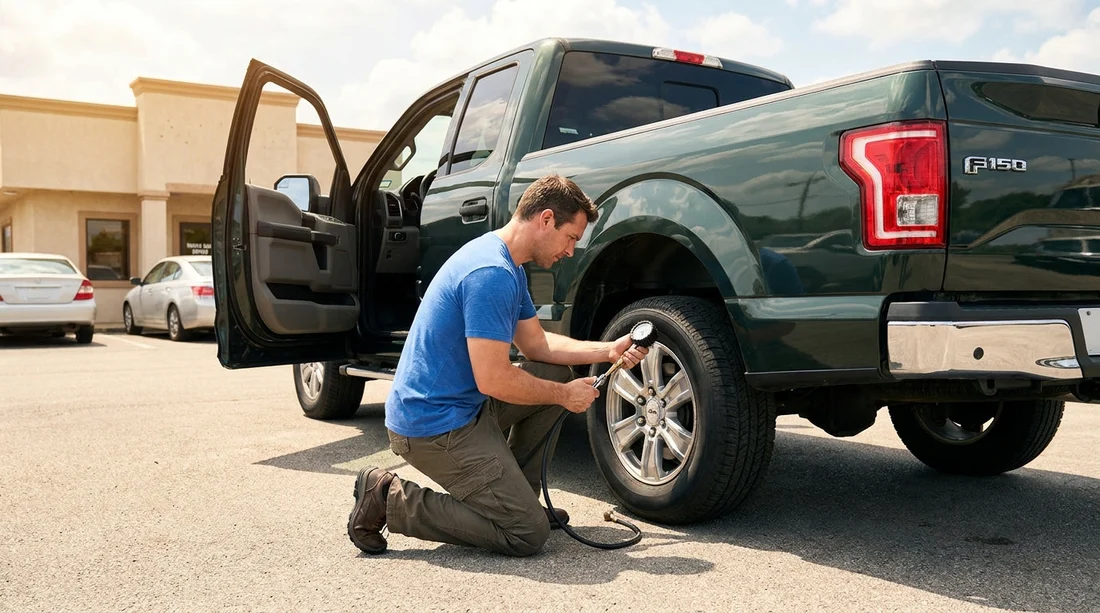
4) Request that they inflate and then re-check. Good practice is to inflate to the specified PSI, then re-check with the gauge. In Texas heat, tyres can read higher after driving, so it is best to do this before you leave the lot. If the agency uses their own forecourt inflator, ask for the final PSI reading for each tyre.
Documentation checklist: photos, video, and notes that protect you
Take photos before anyone touches the car. Get a clear shot of the warning light illuminated on the dashboard. Then photograph the odometer. Take a wide photo showing the whole instrument cluster so it is obvious the car is in the handover bay.
Photograph each tyre and wheel. Take one photo per corner showing the tyre tread and wheel rim. If a tyre looks visibly low, take an extra close photo. Also photograph the tyre sidewall where the size is printed, this helps identify the exact tyre later if there is any confusion.
Write down who you spoke to and what was agreed. Note the staff member’s name, the time, and the action taken, for example “front right inflated to 35 PSI, light cleared after reset”. If you are picking up through a busy desk like Hertz at Dallas DFW or a city location such as Austin AUS area, a simple note can prevent confusion across shifts.
Make sure the rental agreement reflects the issue
Ask for the condition to be written on the agreement or check-out report. The wording should state that the tyre-pressure warning was present at pick-up and that you reported it immediately. If they performed an inflation and the light cleared, ask them to note that as well, including the time.
Check the damage and comments section. Many agreements have a tick-box for warning lights or mechanical notes. If there is no obvious field, ask them to add a manual note. The goal is not to argue, it is to create a clear record that protects both you and the rental company.
Before leaving the lot: verify the fix
Do a short, slow loop in the pick-up area. After the tyres are checked and inflated, drive for a couple of minutes at low speed if permitted. Some TPMS lights clear after the car detects stable pressure readings. If the light stays on, return immediately to the counter rather than hoping it will sort itself out on the highway.
If the light comes back on later during your Texas trip
If the warning reappears after you have left, pull into a safe place and visually inspect the tyres. If you have access to a gauge, check pressures against the door-sticker PSI, then inflate as needed. If a tyre is losing pressure repeatedly, you may have a puncture. Contact the rental provider using the number in your paperwork and follow their breakdown or roadside process. Keep taking photos of the dashboard and the tyre each time, and note dates and times. If you are travelling with a larger group and using a people carrier, remember that recommended pressures can differ front to rear depending on load.
If you are switching vehicles or adjusting plans in West Texas, having your booking details handy for locations such as El Paso ELP can make it easier to explain where you collected the car and what was documented at handover.
FAQ
Q: Is it safe to drive off if the tyre-pressure light is on but the car feels fine?
A: Treat it as unsafe until pressures are checked with a gauge. A tyre can be significantly low before you feel a handling change, especially at lower speeds.
Q: What should I ask the desk to write on the agreement?
A: Ask them to note the warning was present at pick-up, that you reported it immediately, and what action was taken, including inflation, PSI readings, reset, or a vehicle swap.
Q: What if staff say the light will reset itself after driving?
A: Ask for tyre pressures to be verified first and request a short on-site confirmation drive. If the light remains on, ask for a different vehicle or a written mechanical note.
Q: Do temperature changes in Texas trigger the warning light?
A: Yes. Pressure can drop after cooler nights and rise in heat. That is still a real pressure change, so the correct response is to measure and adjust to the recommended PSI.
Q: If I top up air myself, do I still need to tell the rental company?
A: Yes. Report that the light came on and that you adjusted pressures, then keep photos and receipts if you paid for air. It helps show you acted promptly and responsibly.

























































































