


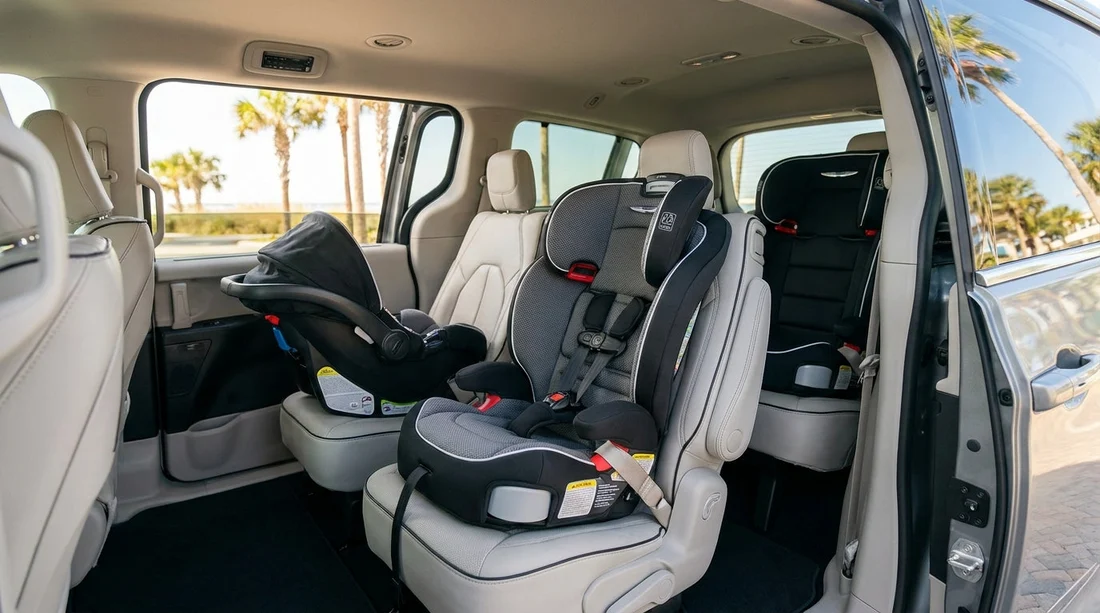
Quick Summary:
- Choose a minivan or full-size SUV to make three seats feasible.
- Confirm three headrests, three seatbelts, and easy buckle access.
- Check LATCH positions, the centre often lacks lower anchors.
- Use narrow seats or one booster to improve three-across fit.
Fitting three child seats across the back is one of the hardest real-world tests for car hire in Florida. The challenge is not only total cabin space, but the exact rear-seat width, how far the seatbelts emerge from the cushion, and whether the vehicle’s LATCH layout matches your seats. Rental listings usually show a “class” rather than a guaranteed model, so the safest approach is to pick a class that gives you margin, then verify the critical features at collection.
In the US, most cars have LATCH (Lower Anchors and Tethers for CHildren) on the two outboard seats only. That means if you need three harnessed seats, at least one typically installs using the vehicle seatbelt, and you may need to use top tethers depending on seat type and child size. Understanding these constraints helps you choose a vehicle class that is likely to work, even when the exact model varies.
Which rental car class usually works for three child seats?
Most reliable choices: minivans and full-size SUVs. They give you the highest probability of three usable rear seating positions, adequate hip room, and easier access to buckles and tether anchors. A minivan is often the simplest solution because many have three-across potential on the second row, or a combination of second and third rows that keeps installation straightforward.
Sometimes workable: large or full-size sedans and some midsize SUVs. These can work if you are using at least one narrow seat or a backless booster, and if the belt buckles are flexible enough to avoid “buckle crunch” where a child seat presses on the latchplate. Some models have a slightly raised centre position that reduces usable width.
Least likely: compact cars, economy cars, and many midsize sedans. Even when they advertise five seats, the centre rear position can be very narrow, with stiff buckles that become inaccessible once two seats are installed. If you must try, plan to use narrow seats and expect a careful installation check.
If you are collecting near Orlando, the family-friendly inventory often includes people carriers. For context on local options, see Alamo car hire Disney Orlando MCO, where minivan-style classes are commonly available.
The three checks to make before confirming any class
1) Rear-seat width and shape. “Three-across” depends on usable hip room and a bench shape that lets child seats sit flat. A wide bench with a nearly flat cushion is easier than a sculpted bench with raised bolsters. In practice, minivans and full-size SUVs give the best odds because they are designed for adults in all rear positions.
2) Seatbelts and buckle access. You need three separate rear seatbelts, including a true lap-and-shoulder belt in the centre. Many US cars have this, but buckle placement matters more than you might think. If the buckle stalks are rigid and close to the adjacent seat, you may not be able to click in a booster or a seatbelt-installed car seat once the neighbouring seats are tight. Look for longer, flexible buckle stalks and buckles that are not buried in the cushion.
3) LATCH and tether anchor layout. In the US, LATCH lower anchors are usually only on the two outboard positions. The centre may have a tether anchor, but not lower anchors. If your centre seat will use a seatbelt install, confirm you can still use a top tether if required by your child seat manual. In SUVs with a third row, tethers can be on the seatback, floor, or cargo wall, and sometimes only for certain positions.
If you are collecting at Miami International, you may see a broad spread of models within a class, so these checks become even more important. Useful background is on car hire at Miami Airport and car hire in Miami.
How many child seats, and which types, change the answer
Three harnessed seats (all with internal harness) is the hardest scenario. Plan for a minivan or full-size SUV. You will likely use LATCH on the two outboard seats (if permitted by seat and child weight limits) and a seatbelt install in the centre. Make sure there is a tether anchor available for any forward-facing harnessed seat, including possibly the centre position.
Two harnessed seats plus one booster is much easier. Boosters need access to a buckle and a shoulder belt that routes correctly. A wide rear bench and buckles that are not recessed are critical. Many large sedans and midsize SUVs can work if the booster rider can buckle independently without unfastening the adjacent seat.
Florida-specific practicalities for families
Florida driving often includes long motorway stretches, sudden downpours, and heavy theme-park traffic. With three children, the “fit” question is not just safety compliance, but daily usability. Sliding doors on a minivan reduce door-dings in tight car parks and make buckling easier. A large SUV can provide similar space, but third-row access can be awkward if you need to reach a middle seat frequently.
Boot space matters too. Three seats can push you toward using a third row, which reduces luggage room in many SUVs. Minivans usually keep more practical cargo space behind the third row, which is useful for prams and holiday bags.
If Tampa pickup suits your route, minivan availability is often strong. See minivan rental Tampa TPA for a sense of that category.
What to ask or check at the rental counter and on the car
Confirm the seating plan before you leave. Open the rear doors, count the headrests, and identify three distinct seatbelts in the row you intend to use. Sit your booster rider where they will ride and test buckling with the adjacent seats in place, because buckle access changes once the seats are tightened.
Locate tether anchors. For forward-facing harnessed seats, find the tether anchor for each intended position and ensure the strap can route without twisting or crossing cargo. In some SUVs, third-row tethers can be easy to miss because they are on the back of the seat or in the cargo floor.
Do a tightness check. After installing each seat, confirm it moves less than about 2.5 cm at the belt path when pulled side-to-side. If you cannot achieve a secure install due to overlapping bases or inaccessible buckles, changing the seating order can fix it, for example swapping which seat is centre, or moving one child to the third row in a minivan.
Recommended classes for three child seats in Florida
Best overall: Minivan. Highest chance of three usable seating positions, easier loading, and flexible second and third row options. For many families, this is the least stressful choice for car hire in Florida.
Strong alternative: Full-size SUV. Works well when you need ground clearance and space, but check third-row tether anchors and cargo room if you must use the third row.
Possible with planning: Large sedan or midsize SUV. More dependent on your exact seat widths and whether one child can use a booster. Expect to spend extra time checking buckle access.
If you are staying near Coral Gables and want to compare people-carrier categories, you can reference minivan hire Coral Gables GBL.
FAQ
Do I need a minivan to fit three child seats safely? Not always, but it is the most reliable class. A full-size SUV can also work well. Large sedans and midsize SUVs sometimes work if at least one seat is narrow or a booster.
Can I use LATCH for all three seats in a US rental car? Usually no. Most US vehicles have lower anchors only on the two outboard rear seats. The centre position commonly requires a seatbelt install, though it may still have a top tether anchor.
What should I check first when I see the assigned vehicle? Check three rear seatbelts, buckle accessibility, and tether anchor locations. Then test-fit the widest seat first and confirm each install is tight at the belt path.
Is it safer to put a child seat in the centre? The centre can be a good position if you can achieve a correct, tight installation and have the right belt and tether setup. If the fit forces a loose install or buckle interference, an outboard position with a proper install is safer.
Will the rental company guarantee a specific model with a wide back seat? Typically no, most rentals are by class, not exact model. Choose a class with enough margin, like a minivan, and verify the belt and LATCH layout at pickup.

























































































