


Quick Summary:
- Count large, medium, and cabin cases, then allow room for soft bags.
- Use trunk volume rules, two large cases typically need mid-size or larger.
- Remember stroller, cooler, golf clubs, and shopping often require an upgrade.
- Check rear-seat split-fold options if luggage exceeds the quoted trunk.
Car hire classes are useful, but they are not a promise of a specific model. In Miami you might be offered several different vehicles within the same class, each with slightly different boot shapes, spare wheel bulges, and opening widths. The good news is you can still estimate luggage space quite reliably if you translate “class” into suitcase counts, and you apply a few practical checks that reflect real-world travel in South Florida.
This guide focuses on matching suitcase numbers to common car hire categories, so you choose the right size first time. It also explains why some suitcases do not fit even when the litres look fine, and how to plan for Miami-specific extras like beach gear, outlet shopping, and prams.
Start with a simple luggage inventory
Before you compare car hire classes, write down what you are actually loading. Most packing problems come from mixing suitcase sizes and forgetting bulky extras.
Use three suitcase buckets, then add “odd items”:
Large checked case (roughly 75–82 cm tall): the stiff, heavy case that usually dictates boot height.
Medium checked case (roughly 65–70 cm): often stacks better but still needs depth.
Cabin case (roughly 55 cm): fits in many boots, sometimes upright behind the wheel arches.
Odd items: pram, travel cot, beach umbrella, cooler, folding chairs, golf clubs, stroller wagon, or big shopping hauls.
Now apply a realism rule: if you have any odd items, treat them like one additional medium case in terms of space demand, unless you know the exact dimensions.
Translate car hire classes into “real” boot expectations
Car hire listings often show “bags” icons, but those icons are inconsistent between suppliers. A better approach is to estimate by class and by luggage type. The ranges below assume typical modern saloons and hatchbacks you commonly see in Miami fleets.
Mini and Economy
Best for: one to two people travelling light.
Typical fit: 1 large case, or 2 cabin cases plus soft bags.
Watch-outs: short boot length and narrow opening. A hard-shell large case may need to go diagonally, which reduces space for anything else. If you are collecting after a flight into Miami International Airport car hire, economy can feel tight once you add personal items and snacks for the drive.
Compact
Best for: two adults with normal holiday luggage.
Typical fit: 1 large + 1 medium, or 2 medium + 1 cabin.
Watch-outs: some compacts are hatchbacks with flexible loading, others are small saloons with a smaller boot opening. If you have rigid cases, a hatchback style tends to be more forgiving.
Intermediate and Standard (mid-size)
Best for: two to four people with a couple of checked cases.
Typical fit: 2 large cases, or 1 large + 2 medium + 1 cabin.
Watch-outs: it is common to assume “mid-size equals loads of boot space”, but the limiting factor can be boot height rather than litres. Two large cases fit most reliably when at least one can lie flat, and the boot opening is not too narrow.
Full-size (large saloon)
Best for: families with heavier luggage, without needing an SUV.
Typical fit: 2 large + 1 medium, or 3 medium + 2 cabin.
Watch-outs: long boots suit suitcases, but tall items like a folded pram can still be awkward. If you are staying centrally, a large saloon can be a comfortable choice for trips in and out of Brickell car rental areas where you may prefer a secure enclosed boot.
Premium and Luxury
Best for: comfort and style, not necessarily maximum packing.
Typical fit: similar to intermediate through full-size, depending on model.
Watch-outs: some premium models prioritise design and battery placement (in hybrids), which can reduce boot depth. Do not assume “premium” means “bigger boot”. Use the same suitcase-count logic rather than price point.
SUV classes, compact to full-size
Best for: taller loading, flexible cabin space, and bulky extras.
Typical fit: 2 large in compact SUV, 3 large in mid-size or full-size SUV if the third row is not present.
Watch-outs: SUVs vary hugely. A seven-seat SUV can have a small boot when all seats are up. If you need luggage space first, prioritise “two-row SUV” or confirm that the rear seats fold flat. For Florida road trips, it can help to compare options under SUV hire in Florida to see which class best matches your luggage volume.
People carriers and vans
Best for: big groups, strollers, beach gear, and multiple large suitcases.
Typical fit: depends on seating. A van with all seats in use may still have limited luggage space, while a similar van with a slightly different seat layout can take far more.
Watch-outs: measure your biggest item. Surfboards, golf clubs, and travel cots can force you into a van even if suitcase counts look manageable. If you know you will have bulkier kit, checking van hire in Doral options can be a sensible benchmark for space planning.
The three fastest “fit checks” before you choose a class
1) The two-large-case rule. If you have two large hard-shell cases, start your search at intermediate or standard. Compact sometimes works, but it is the class where travellers most often need to reshuffle or fold seats.
2) The boot-opening rule. A boot can have decent volume but a narrow opening. Hard-shell cases need both depth and a wide opening. Hatchbacks and SUVs usually win here.
3) The “Miami extras” rule. Add one medium-case worth of space if you expect outlet shopping, beach kit, or a cooler. Miami trips commonly grow luggage during the stay, especially with day trips around Florida car rental routes where you pick up extra gear.
Why litres and “bag icons” can mislead
Boot volume in litres is measured to a specific standard, but it does not tell you whether a suitcase fits through the opening or clears the boot lid. Suitcases are rigid rectangles, while boots have curves, hinges, wheel arches, and sometimes subwoofers.
Bag icons are even less dependable. One supplier’s “2 bags” might mean two cabin cases, while another assumes two medium cases. Treat them as a rough hint only.
Practical tips for avoiding last-minute luggage surprises
Prioritise folding-seat flexibility. If your luggage might exceed the boot, a 60/40 split rear seat is often the easiest solution. It allows one passenger seat in the back while extending the load area.
Plan for passengers first. If you must carry four adults, relying on rear seats folded is not realistic. In that situation, move up a class until your suitcase count fits with seats up.
Keep one “arrival access” bag. Place a small soft bag on top or in the cabin so you can reach chargers, documents, and suncream without unloading everything at a Miami hotel drop-off.
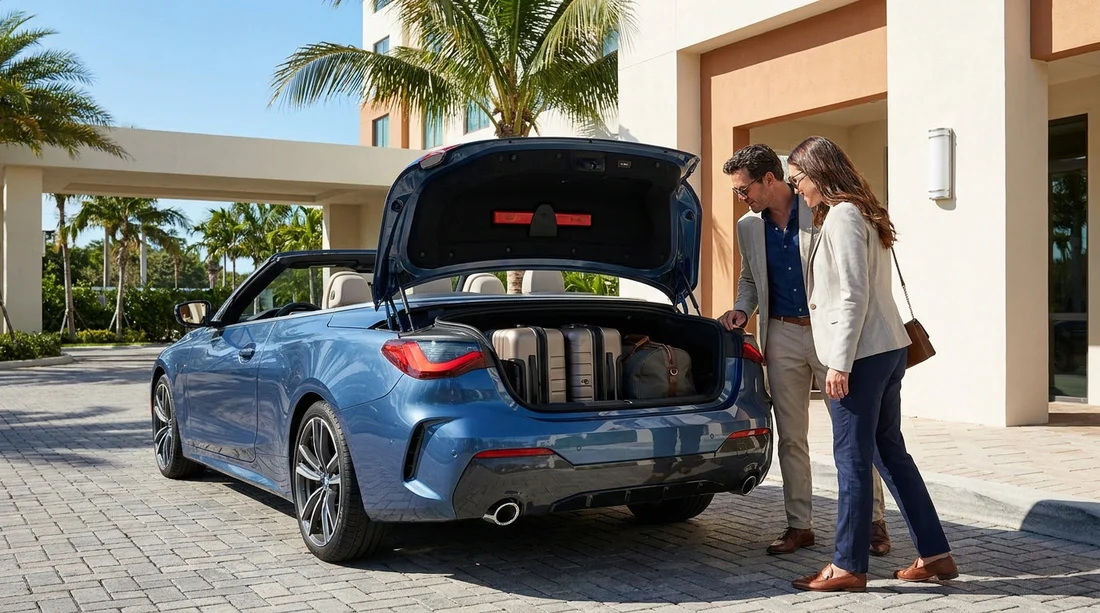
Beware of convertibles for luggage. Even when classed similarly to a mid-size car, convertibles often have reduced boot space due to roof mechanisms.
Think about parking and loading. A larger car can make luggage easy, but tight garages can make unloading harder. If you plan to park in busy areas, consider whether a mid-size SUV gives you both access and manageable dimensions.
How to decide quickly using suitcase counts
If you want a simple decision framework, use this:
1 large or less: economy or compact.
2 large: intermediate, standard, or compact SUV.
3 large: full-size, full-size SUV (two-row), or a van depending on passengers.
4+ large or bulky items: van, or a larger SUV with luggage-first seating.
This is not about “bigger is always better”. It is about choosing the smallest car hire class that comfortably fits your real luggage, while keeping space for people, visibility, and a less stressful start to your Miami trip.
FAQ
Q: How many suitcases fit in an economy car hire in Miami?
A: Typically one large suitcase, or two cabin cases plus a couple of soft bags. Two large hard-shell cases are unlikely to fit well.
Q: Is a compact SUV always better for luggage than a standard saloon?
A: Not always. SUVs often have a wider opening and more height, but some standard saloons have longer boots that suit suitcases. Seat layout and boot shape matter most.
Q: What if my group has four adults and two large suitcases?
A: Aim for intermediate or standard at minimum, and consider full-size if you also have day bags or shopping. Folding seats is not a good plan with four adults.
Q: Do strollers and travel cots change the recommended car hire class?
A: Yes. Treat a stroller or travel cot like an extra medium suitcase, and consider an SUV or van if you already have two large cases.
Q: Can I rely on the “bags” indicator shown during car hire search results?
A: Use it as a rough guide only. Bag icons vary by supplier, so suitcase-count rules and boot-opening considerations are more reliable.

























































































