


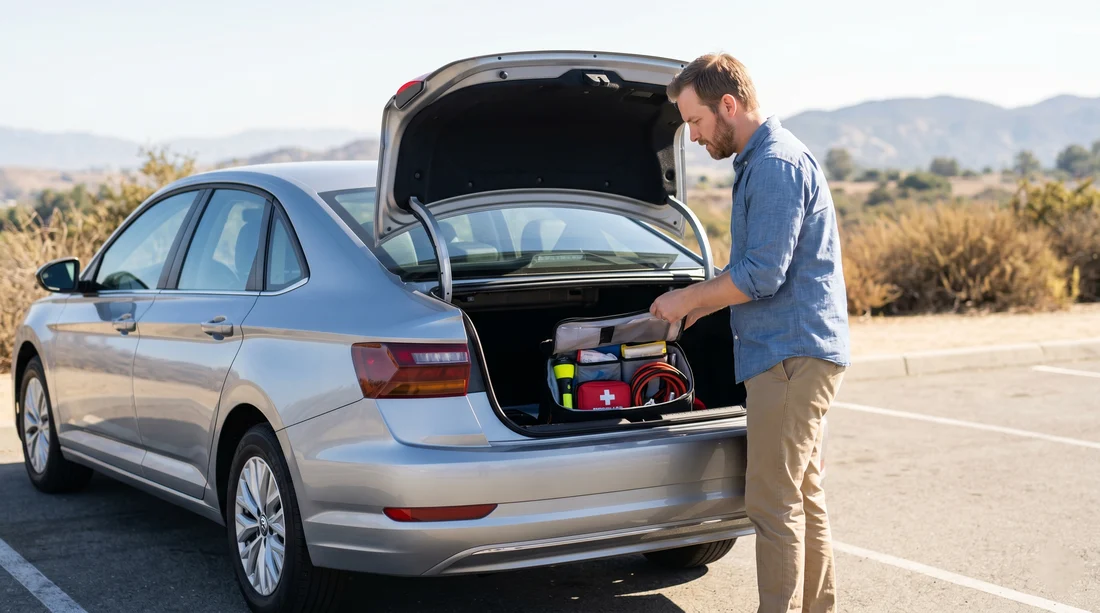
Quick Summary:
- Confirm you have a spare tyre or inflator kit before leaving.
- Locate warning triangle if supplied, and save roadside assistance numbers.
- Check for jack, wheel wrench, and any locking wheel-nut key.
- Bring water, torch, phone charger, power bank, and first-aid supplies.
Before you leave the lot with a California car hire, spend a few minutes checking what emergency equipment is actually in the boot. California driving can mean long gaps between services, desert heat, mountain routes, and fast freeways, so being prepared is less about worst-case panic and more about avoiding an avoidable delay turning into a bigger problem.
This guide covers what to check at pick-up, what to ask the desk if anything is unclear, and what to pack yourself, especially if you are heading outside city centres.
What “emergency kit” usually means for a rental car
In car hire terms, “emergency kit” is not a single standard pack. Some vehicles come with a spare wheel and tools, others come with a tyre inflator and sealant, and some provide minimal equipment beyond the vehicle’s built-in safety features. The aim is to make sure you can handle the most common roadside interruption, a puncture, and keep yourself visible and safe while you wait for help.
If you are picking up near a major airport and planning a longer drive, it is worth being a bit more thorough at handover. For example, travellers collecting a vehicle via car hire at San Jose Airport (SJC) often head towards coastal routes or into the mountains, where reception and services vary. The same applies when arranging car rental in San Diego and driving across county lines.
At pick-up: the puncture and wheel-change essentials
Punctures are the most common practical issue you can prepare for. Your first task is to confirm what the car actually has, and where it is stored.
1) Spare tyre or inflator kit
Open the boot and lift the floor panel. You are looking for either a spare wheel (full-size or temporary “donut”) or an inflator kit. A spare is straightforward but takes space. An inflator kit typically includes a 12V compressor and either sealant or a plug kit.
If there is a spare tyre, check that it looks inflated and that the securing bolt is present. If it is a temporary spare, note any speed or distance limits printed on the tyre sidewall or on a label in the boot area.
If there is no spare, locate the inflator kit and check the compressor hose and power connector are present. Ask whether sealant is included and whether it is in-date. Sealant can be less effective for sidewall damage or larger punctures, and it may affect tyre repair options later, so it is important to know what you have.
2) Jack, wheel-nut wrench, and locking wheel-nut key
If the car has a spare tyre, it should have a jack and a wheel brace (lug wrench). Also look for the locking wheel-nut key, a small adaptor required for certain alloy wheels. Without it, you may have a spare tyre and still be unable to remove the wheel nuts. If you cannot immediately see these tools, ask staff to point them out rather than assuming they are missing.
At pick-up: visibility and roadside safety items
After puncture equipment, the next priority is being seen and staying safe if you have to stop on the hard shoulder or a quiet road at night.
Warning triangle
Not every vehicle in the US carries a warning triangle, but some fleets do provide one. If present, check you can access it quickly. Even without a triangle, switching on hazard lights immediately is essential.
Roadside assistance information
Make sure you know exactly who to call. Check the rental agreement, the key fob tag, or the glovebox paperwork for roadside assistance and accident reporting numbers. Save them to your phone before you leave the car park. If you are picking up in Southern California, having contacts ready matters as traffic and heat can turn a minor stop into a longer wait, whether you used car hire at Santa Ana (SNA) or collected a larger vehicle through minivan rental at Los Angeles (LAX).
Under the bonnet and in the cabin: quick checks worth doing
You are not expected to be a mechanic, but a two-minute scan helps reduce surprises.
Fuel type and range
Confirm whether the car is petrol only or a hybrid, and note the fuel gauge and estimated range. Running low on fuel is not an emergency kit issue, but it is a common avoidable problem, particularly when driving long distances between towns.
Lights and hazards
Check you can find and operate hazards, headlights, and high beams quickly. If you have to stop unexpectedly, you do not want to be learning the stalk controls on the shoulder.
What to bring yourself for California driving
Even a well-equipped car hire rarely includes everything you might want for comfort and safety. Pack a small kit that fits in a tote bag and stays in the cabin, not the boot, so you can access it if the boot is jammed or you are stopped in an unsafe area.
Water and snacks
Carry at least a few litres of water for the group, plus shelf-stable snacks. Heat, traffic, and long stretches of road can quickly make a delay more stressful than it needs to be.
Phone charger and power bank
A 12V car charger plus a power bank covers you if the car’s ports stop working or you need to conserve the vehicle battery. Keep cables compatible with your phone.
Torch
A small torch (flashlight) is invaluable for checking tyres at night, finding items in the boot, or signalling. Choose one that runs on common batteries or is rechargeable.
First-aid kit
Bring a basic kit with plasters, antiseptic wipes, gauze, tape, and any personal medication. Rental cars do not reliably provide medical supplies.
Paper map or offline navigation
Download offline maps for the areas you will drive through. Reception can be inconsistent in mountainous or remote zones.
What to do if something is missing at pick-up
If you cannot find the spare, inflator, or jack that you expected, ask immediately, before you leave the lot. Fleets can vary by model and trim, and sometimes equipment is stored in a side compartment or under a rear seat. If the car is meant to have an inflator or toolkit and it is missing, it is far easier to address at the counter than later on the shoulder of a freeway.
If you are comparing providers for a California car hire, it can also help to know the brand desk you are collecting from. For example, some travellers arrange pick-up through Alamo car hire at Los Angeles (LAX) for LA trips, or choose Enterprise car hire in San Diego (SAN) when planning coastal driving.
FAQ
Does a California rental car always come with a spare tyre? Not always. Many newer vehicles use a tyre inflator and sealant kit instead of a spare. Check the boot at pick-up and ask staff to confirm what the car is equipped with.
Should I expect a jack and wheel wrench in my car hire? Only if the vehicle has a spare tyre. If the car uses an inflator kit, it may not include a jack. If there is a spare, confirm the jack, wheel brace, and any locking wheel-nut key are present.
Are warning triangles required in California rental cars? They are not universally provided, and requirements differ by vehicle type and situation. If your car has one, learn where it is stored. If not, rely on hazard lights and safe positioning while you contact roadside assistance.
What should I personally pack for emergencies on long California drives? Water, a torch, a phone charger and power bank, a small first-aid kit, and offline maps. These cover the most common breakdown and delay scenarios.
What is the quickest pick-up check before driving off? Confirm puncture equipment (spare or inflator), locate any jack tools, save roadside assistance numbers to your phone, and make sure you can access hazards and headlights quickly.





























































































