


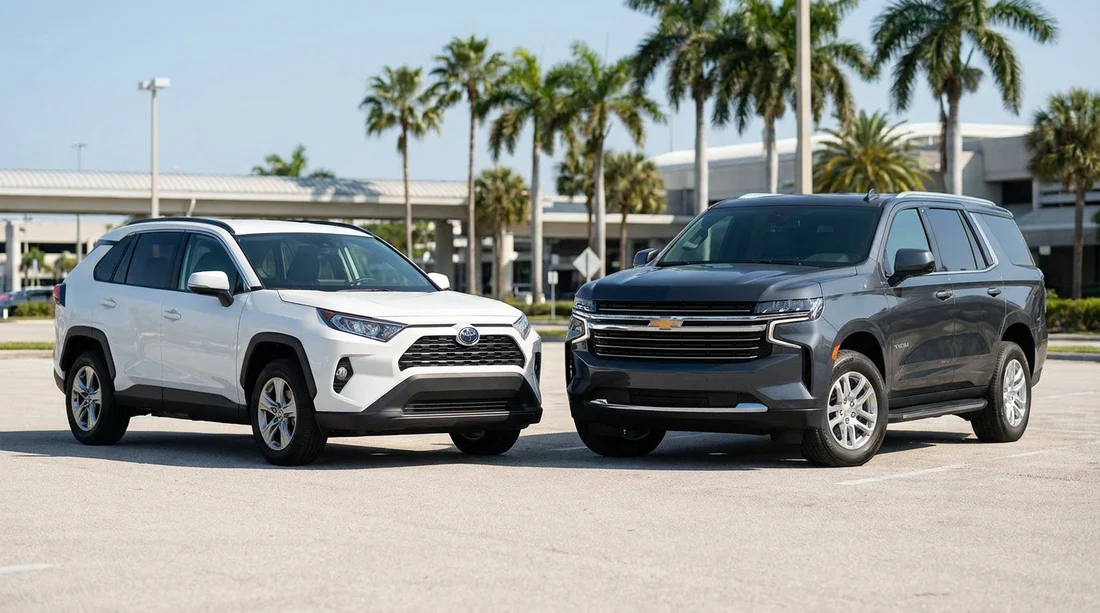
Quick Summary:
- IFAR usually means an intermediate SUV with five seats and moderate luggage.
- FFAR typically indicates a full size SUV with extra cabin space.
- Codes describe a category, so the exact model is not guaranteed.
- Choose based on passengers, luggage size, and where you will park.
When you book car hire in Florida, you often choose a category rather than a specific vehicle. That is why you will see short codes such as IFAR and FFAR next to “SUV” on comparison sites and rental confirmations. These codes are part of a global shorthand used across the industry to describe the vehicle class in a consistent way, especially for size, transmission, fuel type, and general body style.
Understanding what these SUV class codes mean helps you pick a vehicle that fits your passengers, luggage, and the type of driving you will do in Florida, from city parking in Miami to longer motorway drives toward Orlando or the Keys. It also sets the right expectations, because codes describe a group of similar vehicles, not a guaranteed badge, trim, or exact boot shape.
If you are collecting from Miami, the pick-up point can influence what feels practical. For example, airport collections often mean more luggage on day one, while a city collection can suit shorter trips. If you are comparing options, you can explore location pages like Miami Airport car rental or Miami Beach airport car hire to see how categories are presented.
What do codes like IFAR and FFAR actually stand for?
Most rental class codes follow a pattern of letters. You do not need to memorise every letter, but it helps to know the basics. In many systems, the first letter broadly reflects size category, the next relates to body style or doors, and other letters can indicate transmission and fuel or air conditioning. You will see variations by supplier, but the purpose is the same, to give a quick, standardised description.
For SUVs, the codes you will commonly see in Florida include IFAR and FFAR. In plain English, these usually map to intermediate SUV and full size SUV. The “SUV” label itself can cover a wide range, from compact crossovers to larger, taller vehicles with more cargo volume. The code is the hint that tells you where on that spectrum the category sits.
Two important caveats apply. First, “or similar” is built into category bookings, so you may receive a different model with comparable space and features. Second, luggage capacity is not just about litres, it is about shape. Two SUVs can both be five seaters, yet one fits large suitcases better because the boot is squarer or deeper.
IFAR explained: what to expect from an intermediate SUV
IFAR generally indicates an intermediate SUV category. In Florida, this often means a practical, everyday five seater that is taller than a saloon, with easier access and a bit more cargo height. It is a popular choice for couples or small families who want a comfortable driving position without moving up to a larger footprint.
Typical expectations for IFAR in Florida car hire include:
Seating: Usually five seats, with best comfort for four adults on longer drives.
Luggage: Often suits two medium suitcases plus soft bags, depending on the boot shape and whether the rear seats are used fully.
Driving feel: Easy to handle in urban traffic, generally simpler for parking in busier areas.
Fuel and range: Often more efficient than larger SUVs, helpful for longer day trips.
IFAR is a strong match if you want SUV practicality for Florida roads while keeping manoeuvrability for places like Miami and Fort Lauderdale. If you are staying in a suburban base such as Doral, where roads and parking are typically more forgiving, an intermediate SUV can still be the sweet spot. You can compare how suppliers present similar classes on pages like car hire in Doral.
How to choose between IFAR and FFAR for a Florida trip
Use a simple checklist before selecting an SUV category. The goal is to avoid paying for unused size, but also to avoid the common issue of real-world luggage not fitting as you expected.
1) Count people, then count seatbelts you will truly use. Both IFAR and FFAR are typically five seat categories. The difference is comfort and space, not just seat count. If you will regularly have five people in the car, a larger SUV category often feels less cramped, especially for longer motorway stretches.
2) Translate luggage into suitcase sizes. “Two bags” can mean two cabin cases or two 23 kg suitcases. If you have more than two large cases, a bigger SUV class is usually more forgiving. Remember that a five seat SUV may lose most of its luggage space if you try to keep the parcel shelf in place and maintain good rear visibility.
3) Consider where you will park most days. If your itinerary involves busy beachfront areas, tighter multi-storey car parks, or frequent parallel parking, an intermediate SUV may be easier. If you are primarily on larger roads with straightforward parking, a full size SUV can be more relaxed.
4) Think about trip style, not just distance. Florida trips often combine city driving, toll roads, and day trips. If you plan beach days with chairs and umbrellas or theme park days with backpacks and souvenirs, a larger boot can make life simpler.
For travellers who need more people capacity rather than just more SUV space, a people carrier can be a better match than moving up SUV classes. If your group is six or seven, it is worth comparing against a dedicated option such as minivan hire in Coral Gables, which is designed around passengers and luggage together.
Practical tips to avoid common SUV category mistakes
Do not assume seven seats. IFAR and FFAR are commonly five seat categories. If you need a third row, look specifically for a seven seat SUV or minivan category.
Plan for child seats and boosters. Child seats can reduce usable space and make the rear bench tighter. If you need multiple child seats, a larger cabin is usually more comfortable.
Allow for day-to-day cargo. Beach kit, shopping, and theme park bags add up. Choosing a class with a bit of spare boot room can make the trip feel easier.
Think about pick-up logistics. If you land with several large suitcases, starting with enough boot space is key. Comparing airport options like Hertz car hire in Florida (Miami) can help you see how categories are grouped and described.
FAQ
What does IFAR mean for car hire in Florida? IFAR commonly indicates an intermediate SUV category. Expect a five seat SUV with moderate luggage space and an easy-to-drive size for mixed city and motorway use.
What does FFAR mean when I book an SUV in Florida? FFAR typically refers to a full size SUV category. It is usually roomier for passengers and luggage than intermediate SUV classes, but can be wider for parking.
Do class codes like IFAR and FFAR guarantee a specific model? No. These codes describe a category, so you receive a vehicle that matches the class features, not necessarily the exact model shown in photos.
Is a full size SUV always better than an intermediate SUV? Not always. Full size SUVs are helpful for more luggage and comfort, but intermediate SUVs can be easier to park and often use less fuel.
How can I choose the right SUV category for my trip? Start with passenger count, then map your luggage to real suitcase sizes, and consider where you will park most days. If you need extra seats, compare with a minivan category.





























































































