


Quick Summary:
- Assume posted work-zone speeds apply, even when workers seem absent.
- Double fines usually increase monetary penalties, not points or licence effects.
- Tickets often go to the car-hire owner first, then transferred.
- Expect a rental admin fee when your details are provided to authorities.
Work zones are everywhere in Pennsylvania, from interstate resurfacing to bridge repairs on local routes. If you are using car hire, the rules can feel less familiar because signs change quickly and enforcement methods vary by corridor. The key is to treat a work-zone limit as a real, enforceable speed limit, not a suggestion. In many locations, penalties increase, and the way a ticket reaches you can involve both the issuing authority and the rental company.
This article explains how temporary work-zone speed limits are set and enforced in Pennsylvania, what “double fines” really means in practice, and how rental administration fees typically apply when a citation is linked to a hired vehicle.
What counts as a work zone in Pennsylvania?
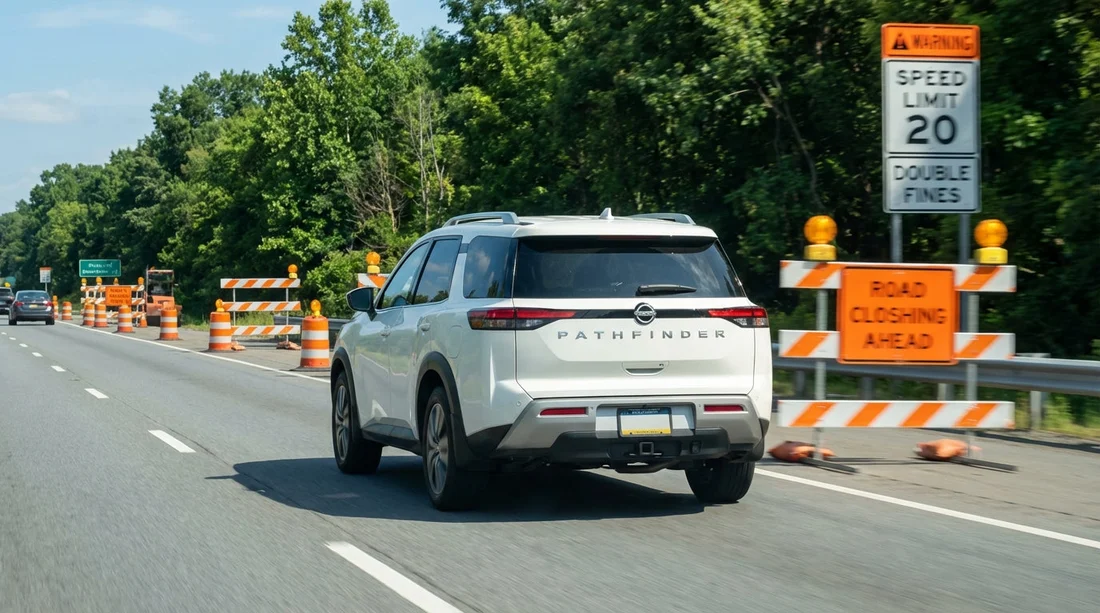
In Pennsylvania, a work zone generally means an area of a road where construction, maintenance, or utility work affects traffic patterns. You will usually see advance warning signs, orange signage, cones, temporary barriers, reduced speed limit signs, and sometimes flaggers. The reduced limit can be posted on a standard “Speed Limit” sign with an orange work-zone context, or it can appear alongside “Work Zone” or “Road Work Ahead” notices.
Two details matter for drivers in rental cars. First, the applicable speed is the one currently posted, even if it differs from your map app or what you expect on that road. Second, a work zone can extend longer than you think. It may start well before workers and equipment appear and may remain in effect through lane shifts, narrowed shoulders, or uneven surfaces.
How temporary work-zone speed limits are set
Temporary work-zone limits are not random. They are typically chosen by the responsible road authority, often PennDOT or a local agency, based on lane configuration, worker proximity, barrier placement, sightlines, and the severity of the traffic change. In some projects, the reduced limit may only apply during certain phases. In others, it stays in place for weeks because the road geometry has changed, even when workers are not present at that moment.
For someone using car hire in Pennsylvania, the practical approach is simple: drive by the posted signs in front of you. If you are arriving via Philadelphia Airport car hire and you head straight onto major routes, you can move from a standard limit into a work-zone reduction within minutes, especially during ongoing projects around interchanges and bridges.
How work-zone speed limits are enforced
Enforcement can be more visible in work zones because the safety risk is higher. Pennsylvania work-zone speeding enforcement commonly involves:
Traditional traffic stops. Police may monitor work zones from shoulders, pull-offs, or nearby ramps. If you are stopped, you receive the citation directly, and the rental company is not involved in delivery. Your contract still matters because it governs what happens if the car is impounded or towed, but the ticket itself is handed to you.
Automated work-zone speed enforcement (where permitted). Pennsylvania has allowed automated speed enforcement in certain active work zones under specific programmes and conditions. In these setups, a speed camera system records vehicles exceeding the limit, and a notice of violation is mailed to the registered owner of the vehicle. For a rental car, that owner is usually the rental company or its fleet/registration entity, which is why the citation may not reach you immediately.
Targeted patrol periods. Even where cameras are not in use, work zones may have extra patrols during high-risk periods, such as the start of a lane closure pattern or when traffic volumes spike.
Because enforcement can be automated and mailed, drivers in hired vehicles often learn about a violation later. This delayed timeline is normal and is one reason it helps to keep your rental documents and itinerary organised, including the dates and times you had the vehicle.
What “double fines” really means
Work-zone signs sometimes reference higher penalties. People often describe this as “double fines,” but it is important to understand what typically doubles, and what does not.
Usually, the monetary penalty increases. “Double fines” generally means the base fine amount for certain offences is increased when the violation occurs in a work zone, especially for speeding. It does not automatically mean your speed is measured differently or that enforcement thresholds change.
It does not necessarily double every component of the total amount. Tickets often include several parts: the base fine, court costs, and various administrative surcharges. Depending on the statute and how the notice is structured, the “doubling” may apply to the fine portion rather than every fee line on the payment page.
It does not automatically change licence points or out-of-state treatment. Points and licence consequences depend on your licence jurisdiction and the type of violation. If you hold a non-US licence and are visiting, the impact may be mainly financial, but you should still take any notice seriously, because unpaid penalties can lead to collection processes or issues if you return and rent again.
The most practical takeaway for car hire drivers is to treat any work-zone sign as a warning that penalties can rise quickly. Going “a little over” can become significantly more expensive, particularly on multi-lane highways where traffic flow makes it easy to drift above the posted temporary limit.
How tickets reach you when you are in a rental car
The delivery route depends on how the ticket is issued.
1) You are stopped by police. You receive the citation on the spot. You are responsible for responding by the deadline shown. The rental company may not know about it unless you tell them, or unless the stop results in towing or other follow-up with the vehicle record.
2) A camera-based notice is mailed. The notice is sent to the vehicle’s registered owner. With car hire, that is typically the rental company or its registration services provider. The rental company then identifies the renter for the date and time of the alleged offence and responds according to the programme rules and the rental agreement. In many cases, the authority will then re-issue the notice to you, or the rental company may charge you directly if the rules allow them to pay and recover the amount.
3) A toll-road style “notice later” experience. Some drivers assume work-zone enforcement works like tolls. It can feel similar in terms of timing, but a speeding citation is not a toll. It is still a legal notice with response requirements.
If you rented in the Philadelphia area, you may see different workflows depending on the supplier and pick-up channel. For example, rentals arranged through car rental in Philadelphia may still be fulfilled by a major supplier whose central office handles violations. That can add processing time before the notice reaches you.
Typical rental administration fees and why they apply
When a violation is linked to a rental vehicle, the rental company usually has to spend time and resources to identify the renter, provide documentation, and respond to the issuing authority. This is where an administration fee often comes in.
What the admin fee usually covers. Processing the notice, retrieving the agreement, confirming driver details, communicating with authorities, and maintaining records. It is typically a separate charge from the fine itself.
When it is charged. Often when the rental company provides your details to the authority, or when it processes a payment/transfer on your behalf, depending on the rules of the issuing body and the wording of your rental terms.
How much it is. Amounts vary by company and location. Rather than assuming a figure, check your rental agreement terms for “traffic violations,” “fines,” “tolls,” or “administrative fees.” If you are comparing options such as Alamo car hire in Philadelphia versus other suppliers, read the violations section as carefully as the fuel policy or deposit.
Can you dispute the admin fee? You can ask questions and request documentation, but many agreements allow it if the company had to process the notice. Disputing the underlying ticket is separate. If you plan to contest the citation, do so with the issuing authority by the deadline, and keep records of your communications.
What to do if you receive a work-zone ticket after your trip
Getting a notice weeks later is frustrating, but it is manageable if you take a structured approach.
Check the details carefully. Confirm date, time, location, vehicle plate, and the alleged speed and limit. Compare it to your itinerary and any emails showing when you collected and returned the vehicle. If you had multiple drivers, confirm who was driving at that time.
Identify who issued it. A police-issued citation and an automated work-zone notice can look different and have different response steps. Follow the instructions on the notice itself.
Do not ignore deadlines. Late fees can stack up, and unresolved matters can be sent to collections. If you have questions, contact the issuing authority using the contact information shown on the notice, not through random web searches.
Ask the rental company for supporting documents. If the rental company charged an admin fee, ask for the notice reference and the date they processed it. This helps you track timelines and avoid duplicate payments. If you hired a larger vehicle, such as through van rental in Philadelphia, note that plates and fleet registrations can sometimes be associated with corporate entities, so paperwork may look unfamiliar at first glance.
How to avoid problems in Pennsylvania work zones
Look for the first reduced limit sign, then lock in your speed. Many drivers slow only when they see cones. In Pennsylvania, the reduced limit can begin earlier. Use cruise control when conditions allow, but turn it off if traffic is stop-start.
Assume enforcement can be present even when workers are not visible. A quiet site can still be an active work zone due to lane shifts, narrowed shoulders, or temporary surfaces.
Give yourself more stopping distance. Work zones often have sudden braking where lanes merge. Tailgating increases risk and can draw attention from patrols.
Be careful with speed differentials. If you are driving an SUV, the higher seating position can make it feel slower than it is. If you are using SUV hire in Philadelphia, check your speedometer more frequently during long work-zone corridors.
Keep your rental contact details up to date. Tickets mailed later depend on accurate address and email information. If your billing address differs from where you receive post, consider how you will access mailed notices after you return home.
FAQ
Do work-zone speed limits apply in Pennsylvania when no workers are present? Yes, if the reduced limit is posted, it is enforceable even when workers are not visible. Temporary limits are often set for changed road conditions, not only for active labour.
What does “double fines” mean for work-zone speeding? It usually means the fine amount for certain offences increases in a work zone. It does not necessarily double every fee on the total bill, and it does not automatically change licence points.
If I get a camera-issued work-zone ticket in a rental car, who receives it first? Typically the registered owner receives it first, which is usually the rental company or a fleet registration entity. Your details may then be provided so the notice can be reissued to you.
Will the car hire company charge me an admin fee as well as the fine? Often yes. Many rental agreements allow an administration fee for processing fines and providing renter information, separate from the authority’s penalty.
What should I do if I think the ticket is wrong? Follow the dispute or hearing instructions on the notice and keep copies of your rental agreement and travel records. Meet all deadlines, even while you request clarification.





























































































