


Quick Summary:
- Check your rental agreement fuel line and the assigned vehicle description.
- Read the key tag label for petrol, diesel, hybrid, or EV.
- Open the fuel flap to confirm unleaded, diesel, or charging instructions.
- Verify dashboard icons and range display before you drive away.
Misfuelling is one of the most avoidable problems with car hire in California, yet it still happens because travellers assume every car takes regular petrol. In reality, fleets can include diesel models, hybrids that still need petrol, plug in hybrids that can be charged, and full EVs that never visit a fuel station. The good news is that you can confirm the fuel type in under two minutes if you know where to look and what wording to trust.
This guide explains three reliable checks, the rental agreement, the key tag, and the fuel flap, plus a quick dashboard sanity check. Do these before you leave the lot, even if you are picking up at a busy airport counter.
If you are collecting near Los Angeles, the pick up flow may differ slightly by provider and terminal, but the fuel type checks stay the same. For location specific information on local car hire, see Los Angeles Airport car rental or California car hire near LAX.
1) Confirm the fuel type on your rental agreement first
Your rental agreement (paper printout or digital contract) is the most authoritative record of what you have been assigned. Before you start the engine, find the section that lists vehicle details. Depending on the company, you may see fuel information shown as:
Fuel type: petrol, gasoline, diesel, hybrid, plug in hybrid (PHEV), electric (EV). You may also see “Unleaded” wording for petrol.
Vehicle description: for example, “Toyota Corolla Hybrid” (still uses petrol), “Jeep Wrangler 4xe” (plug in hybrid, also uses petrol), or “Tesla Model 3” (electric only). Treat the model name as a clue, but rely on the explicit fuel type line where possible.
Fuel policy and level: this is not the same as fuel type. “Full to Full” or “Prepaid fuel” tells you how it is charged, not what to put in the tank.
If the agreement only shows a vehicle class, such as “Intermediate SUV”, and does not state fuel type, do not guess. Ask the agent at the exit booth or the lot attendant to confirm the assigned vehicle’s fuel. This is particularly useful for larger categories where some trims are diesel, hybrid, or petrol. If you are comparing options for bigger vehicles, SUV hire in California pages can help you understand typical models in each class, but your specific car should still be verified on the day.
2) Use the key tag and key fob as a fast cross check
Most car hire operations in California attach a tag to the keys with essential reminders, often including fuel type. Look for printed terms like:
GAS or UNL, meaning petrol (unleaded). In the US, “gas” refers to petrol, not LPG.
DIESEL, sometimes in bold because the mistake is costly.
EV or ELECTRIC, often paired with “return charge level” notes.
HYBRID, which still needs petrol, unless it is clearly labelled EV.
The key tag is helpful because it stays with you when you drive to a station later. However, key tags can occasionally be swapped if keys are reissued or vehicles are rotated quickly. That is why you should also check the fuel flap label (next section) before leaving the car park.
If you are collecting in Southern California, different brands may format tags differently. Information on local supplier counters can be found on pages such as San Diego car hire and, for a specific brand example, Dollar car hire in San Diego.
3) Check the fuel flap, cap, and labels on the car itself
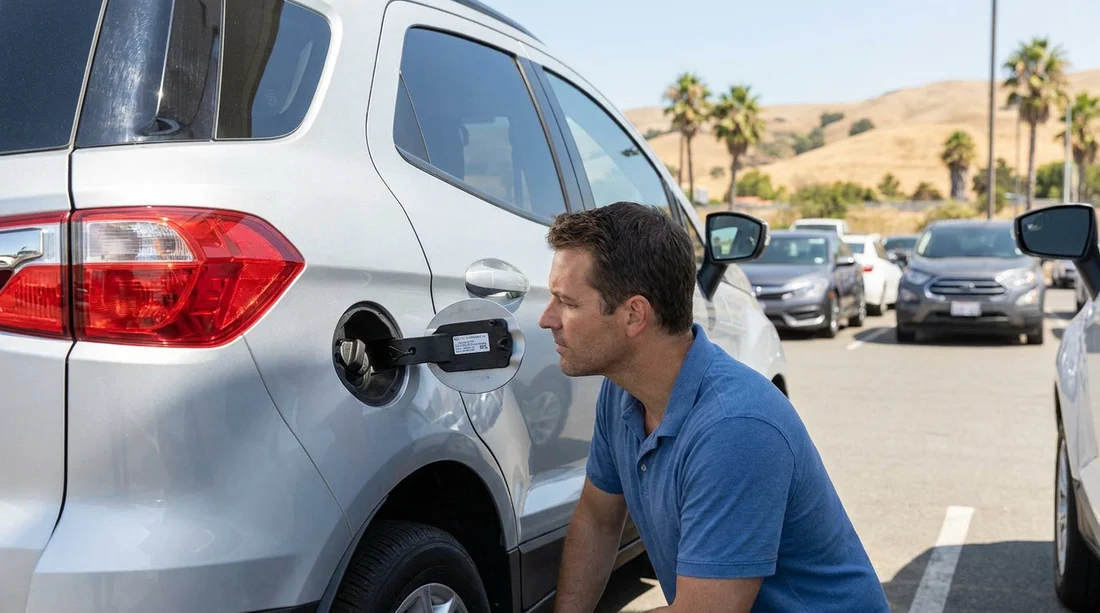
The most foolproof confirmation is on the vehicle. Before you drive off, open the fuel flap (or charging port door) and read what is printed on or around it. This avoids relying on paperwork that might not match the physical car.
If it is petrol: You will usually see “Unleaded fuel only” or “Unleaded gasoline only.” Sometimes there is an octane recommendation, for example 87 AKI, which is common in California. You do not need premium unless the label specifies it.
If it is diesel: The word “Diesel” is typically printed on the cap or inside the flap. Diesel filler necks are often larger than petrol, but do not use size as your only test because adapters exist.
If it is a hybrid (non plug in): You will still see unleaded instructions, because it fuels like a petrol car. The hybrid badge on the boot does not mean you can charge it at a public charger.
If it is a plug in hybrid (PHEV): You may find both a fuel filler and a separate charging port. The fuel flap will still say unleaded. The charging door may include charging level instructions and connector type information.
If it is a full EV: There is no fuel filler. You will find a charging port with labels that may mention “J1772” (common for slower AC charging) or “CCS” for fast charging on many non Tesla models. Some EVs show charging instructions on the inside of the port door.
Practical tip: take a quick photo of the flap label or charging port label. If you forget later at the station, you can check your phone instead of guessing under pressure.
4) Do a dashboard sanity check before leaving the lot
With the car in accessory mode or ready to drive, glance at the instrument cluster and centre display. You are not trying to diagnose the vehicle, just confirming the fuel system matches what you think you are driving.
Petrol or diesel cars usually show a fuel pump icon and a range estimate after you start. Some modern cars label the fuel door side with an arrow near the pump icon.
Hybrids commonly show an “EV” indicator for electric running, plus a traditional fuel gauge. This can confuse drivers into thinking the car is fully electric. If there is a fuel gauge, it still needs petrol.
EVs show battery percentage, charging status, and often a miles remaining figure, not a fuel pump icon.
Warnings to look for: if the display shows “Diesel Exhaust Fluid” (DEF) messages, that is a strong hint the vehicle is diesel, but not all diesels will show it. If anything on the dash conflicts with your paperwork, stop and ask the lot attendant to confirm the fuel type against the vehicle registration or VIN.
6) What to do if you are not 100% sure
If you cannot clearly verify the fuel type using the agreement, key tag, and fuel flap, do not drive off. In California car hire lots, the exit gate or attendant station is used to resolve exactly these questions. Ask them to confirm fuel type while standing next to the open fuel flap or charging port. It takes moments and can save hours of disruption.
If you are already away from the airport and realise you are unsure, pull into a safe place, open the fuel flap, and read the label. If it is an EV and you cannot find the charging port, consult the quick start guide in the glovebox or use the vehicle’s on screen help menu. Avoid guessing at a pump.
FAQ
Where is the most reliable place to confirm petrol vs diesel on a rental car? The fuel flap or fuel cap label on the car is the most reliable, because it reflects the actual vehicle you are driving. Use the rental agreement and key tag as cross checks.
My agreement says “gas”. Does that mean LPG or petrol in California? In California and the wider US, “gas” on car hire paperwork means petrol (gasoline). It does not mean LPG.
How can I tell a hybrid from a fully electric car quickly? Open the fuel flap area. If there is a petrol filler and it says unleaded, it is a hybrid or plug in hybrid. A full EV has only a charging port and no fuel filler.
If I accidentally put the wrong fuel in, should I start the engine? No. Do not start the car, because that can circulate the wrong fuel and increase damage. Contact the rental provider’s roadside assistance number in your paperwork immediately.
Do I need premium petrol for car hire in California? Only if the label inside the fuel flap explicitly requires premium. Most standard rentals specify unleaded and run on regular 87 AKI, which is widely available.





























































































