


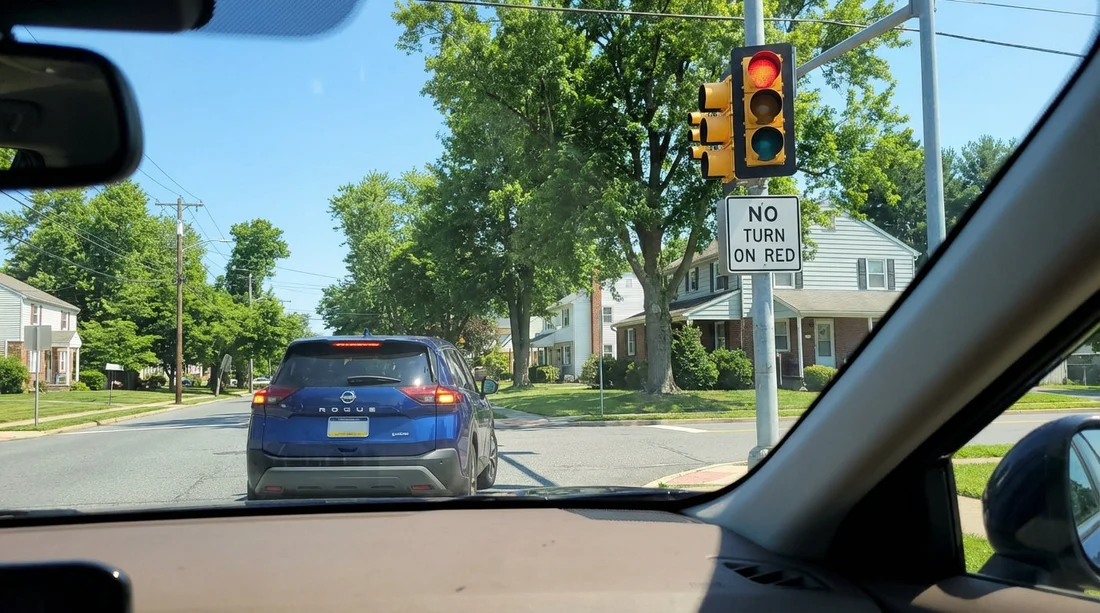
Quick Summary:
- In Pennsylvania, you may turn right on red after stopping fully.
- Do not turn if a posted No Turn on Red sign applies.
- Check for pedestrians, bike lanes, and one-way traffic before turning.
- When in doubt, wait for green to avoid tickets.
Hiring a car for a trip around Pennsylvania is straightforward, but junction rules can still catch visitors out, especially the right turn on red. The good news is that Pennsylvania broadly follows the common US approach: a right turn on red is usually permitted, but only after a complete stop and only when signs and conditions allow it. The bad news is that failing to read the intersection properly can lead to an automatic ticket at camera enforced sites or a stop by an officer.
This guide explains the default rule, the most common places you will see No Turn on Red restrictions, and a quick checklist you can run through at any junction. If you are arriving into the state by air and arranging car hire around Philadelphia, it also helps to know that urban intersections are more likely to have special signal phases and sign posted limits than rural ones.
What is the default right on red rule in Pennsylvania?
In Pennsylvania, you can generally turn right at a red light after you have come to a complete stop, and after yielding to pedestrians and other traffic that has the right of way. Think of it as similar to a stop sign that you approach while the signal is red: you stop first, you assess, then you proceed only if it is safe and legal.
A complete stop means the vehicle stops rolling entirely behind the stop line, or before the crosswalk if there is no stop line, or before entering the intersection if neither is marked. A slow roll is not a stop. If you are in a hire car with sensitive brake lights and an officer is watching the line, that rolling approach is an easy reason for a pull over.
After stopping, you must yield to:
Pedestrians in the crosswalk or stepping off the kerb with the signal in their favour, including those crossing from your right to your left.
Cyclists in bike lanes, including those approaching from behind on your right.
Traffic with a green light, including vehicles coming from the left that may be turning left into your path.
Importantly, “may turn” does not mean “must turn”. If visibility is poor, the turn radius is tight, or the intersection feels confusing, waiting for green is always allowed and is often the safest option, particularly in unfamiliar areas of Philadelphia.
If you are collecting a vehicle via car hire at Philadelphia Airport (PHL), expect heavier pedestrian movement, more lane markings, and more sign posted exceptions near major arterials. Give yourself extra time at the first few lights to settle into local flow.
When must you wait, the signs and signals that override the default
The default rule disappears as soon as an instruction tells you to wait. The most obvious is a rectangular sign reading NO TURN ON RED. If it is posted for your approach, you must stay put until the light is green, even if the road looks empty.
There are also intersection designs that effectively block a right on red even without that exact phrase. Watch for these common scenarios:
A red arrow. A red right arrow means no right turn while the arrow is red. Many drivers assume a red arrow works like a normal red light, but in practice it is used to control a specific movement. If you have a red arrow, treat it as a firm prohibition unless signage explicitly permits turning after stop.
Time based restrictions. Some signs allow right on red at certain times only, or ban it during peak hours. The sign may state hours and days. If you are not confident you have read it correctly, waiting for green avoids a preventable ticket.
Lane specific restrictions. A sign may apply only to the far right lane, or only to a slip lane. Read any supplementary plaques carefully. If your lane has its own signal head, follow that signal.
Pedestrian leading intervals and scramble crossings. In busy city centres, signals may give pedestrians a head start. A right on red can be dangerous here, so restrictions are common. Even where permitted, you must yield completely.
If your plans involve driving in central Philadelphia, arranging car hire in Philadelphia is a convenient way to explore wider Pennsylvania, but it also means you are more likely to encounter the most strictly controlled intersections. In the suburbs and smaller towns, the default rule is more common, but you still need to check for signs every time.
Where No Turn on Red signs are commonly placed in Pennsylvania
You can spot patterns in where Pennsylvania authorities choose to restrict right on red. Knowing these patterns helps you look in the right place quickly, especially when driving a different car hire vehicle and trying to keep up with traffic behind you.
1) Downtown cores and high footfall crossings
Where pedestrian volumes are high, a right turn on red creates frequent conflict. Expect restrictions near transit hubs, stadium areas on event days, universities, and dense shopping corridors. Signs are typically mounted near the signal head, on the mast arm, or on a roadside post close to the stop line so that they are in your forward view.
2) Intersections with limited sight lines
If buildings, parked cars, bridge supports, or vegetation block your view of traffic approaching from the left, a right on red can be risky. Authorities often ban it rather than rely on driver judgement. You will sometimes notice the sign at exactly those corners where you would otherwise be creeping forward into the crosswalk for visibility.
3) Where there is a protected left turn phase from the opposite direction
This one surprises visitors. If oncoming traffic has a protected left turn that swings into the road you want to enter, your right on red can clash with their green arrow flow. To keep movements clean, a No Turn on Red sign is common.
4) Near schools and parks
School zones and child heavy crossings often come with stricter turning controls. You might see time specific signs that match school arrival and departure periods.
5) Multi lane right turns and complex channelisation
Where two lanes can turn right, or where a slip lane merges with a bike lane, the risk rises. Restrictions are common, and when permitted, you need extra care to stay in your lane and yield properly.
Driving a larger vehicle, such as through SUV hire in Philadelphia, can make sight lines and turn radius feel different. That does not change the legality, but it can change how confident you are judging gaps. When the intersection is tight, waiting for green can be the safer, calmer choice.
The quick junction checklist to avoid tickets and stops
Use this short mental routine whenever you approach a red light and are considering turning right. It takes a few seconds and can save you from both collisions and enforcement.
1) Identify the signal controlling your lane
Is it a standard red light or a red right arrow? If there are multiple signal heads, follow the one aligned with your lane. If it is a red arrow, assume you must wait unless a sign clearly allows a turn after stop.
2) Stop completely in the correct place
Stop behind the stop line. If there is a crosswalk, do not stop on it. A clean stop makes your next movement more predictable to pedestrians and other drivers, and it reduces the chance of being seen as aggressive.
3) Scan for signs on the near side and far side
Look for No Turn on Red, time restricted signs, lane specific plaques, and any construction signage. Check both near the signal and across the intersection, because some signs are positioned to be read once you are stopped.
4) Check pedestrian activity first, then vehicles and bikes
Prioritise the crosswalk. Many near misses happen because drivers watch only the left side traffic gap. Also check for cyclists approaching from behind in a bike lane or on the shoulder.
5) Confirm the destination road direction and lanes
If the road you are turning into is one way, traffic may be coming from an unexpected direction. Also confirm which lane you will enter, especially if there are multiple receiving lanes or a bus lane.
6) Make the turn slowly, staying in your lane
Do not swing wide. A slow, tight turn gives you time to stop if a pedestrian steps in or a cyclist appears. If anyone behind you honks, ignore it, your legal duty is to proceed only when safe.
These steps matter regardless of vehicle type. If you are managing costs with budget car hire in Philadelphia, you may be in a smaller car with better visibility, but the obligation to stop, read signs, and yield is identical.
Special cases visitors often misunderstand
Right on red from a dedicated slip lane
Some junctions have a separated right turn lane with its own yield sign or its own signal. If there is a signal, it controls you. If there is only a yield sign, treat it as a yield, but still be prepared for pedestrian crossings across the slip lane.
Turning right on red into a one way street
This can be permitted when signed and when the manoeuvre does not conflict with other movements. Because one way layouts vary, do not assume. Focus on signs and the direction of traffic flow.
Motorcycles and bicycles at the corner
A bike lane can place a cyclist exactly in your blind spot as you prepare to turn. Use mirrors and a shoulder check before moving, even at low speed.
Camera enforcement and officer discretion
Some intersections are monitored, and even where cameras are not used, rolling stops and crosswalk encroachment are easy to spot. If you want to reduce exposure while driving a car hire vehicle in Pennsylvania, the safest habit is an obvious, full stop followed by a patient yield.
Practical tips for car hire drivers in Pennsylvania
Give yourself time. Being late is a common reason people force a right on red. Build a few minutes into city journeys so you can wait for green if anything looks unclear.
Learn the feel of the brakes. Different cars have different bite points. On your first drive after pick up, practise smooth, complete stops in low pressure areas, so you do not creep past the line later.
Use navigation early. Knowing which lane you need reduces last second swerves at lights. If you miss a turn, reroute rather than forcing it at a red.
Expect more restrictions in dense areas. In central Philadelphia and near major interchanges, you are more likely to see red arrows and No Turn on Red signs, particularly where pedestrian phases are protected.
Whether you collect near the airport or in the city, the core idea is consistent: in Pennsylvania, right on red is a conditional permission, not a default right. Stop, read, yield, then move.
FAQ
Can you turn right on red in Pennsylvania by default? Yes, in most cases you may turn right on red after a complete stop, as long as you yield to pedestrians and any traffic with the right of way.
Does a No Turn on Red sign always mean you must wait? Yes, if the sign applies to your approach or lane, you must not turn until the signal shows green, even if the road appears clear.
Is a red right arrow different from a normal red light? Yes. A red right arrow controls the right turn movement and generally means you must wait until it changes, unless a sign clearly permits turning after stop.
Where are No Turn on Red signs most common in Pennsylvania? They are common in busy city centres, near schools, where sight lines are poor, and at intersections with complex signal phases or heavy pedestrian crossings.
What is the safest approach in an unfamiliar junction in a hire car? Make a full stop, scan for signs and pedestrians, and if anything is unclear, wait for green. It is legal to wait, and it reduces ticket risk.





























































































