


Quick Summary:
- Agents use your billing ZIP to support US card verification checks.
- It can reduce fraud risk and help avoid authorisation declines.
- Deposits and security holds often require extra billing detail confirmation.
- International travellers should provide their card billing postcode, not hotel ZIP.
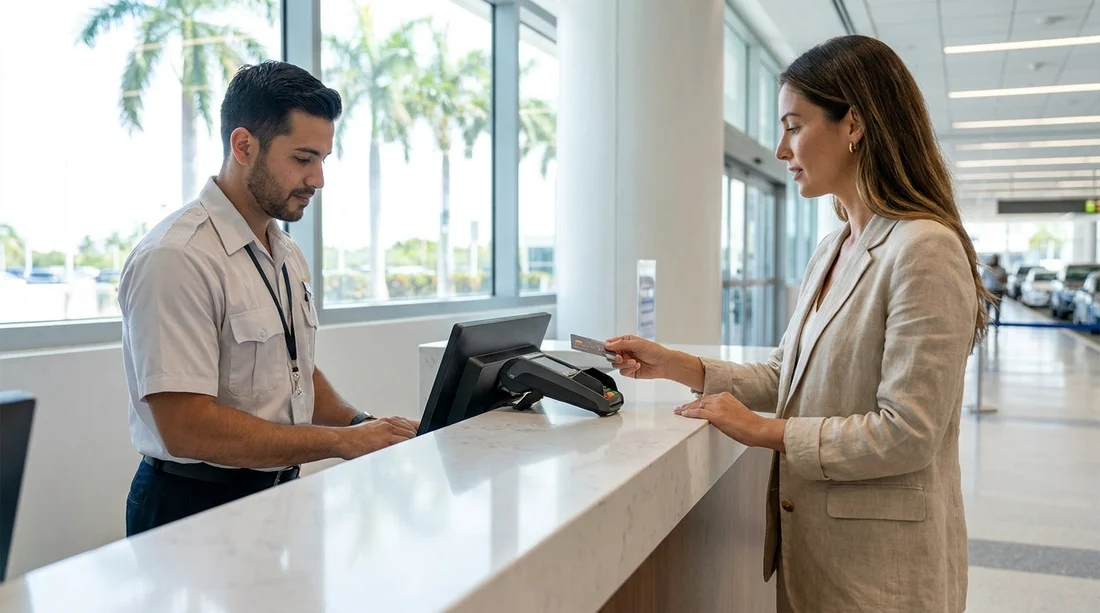
At a Miami car hire counter, being asked for your billing ZIP code can feel oddly specific, especially if you are paying with a card that already has your name on it. In practice, it is a routine payment security step used across the US travel industry. The ZIP code request is usually not about where you are staying, it is about proving that the person presenting the card knows the billing address information associated with that card.
This comes up most often at the moment of payment or when the agent runs a deposit. Even if you prepaid online, the counter may still need to verify the payment card for a security hold or any local charges. Some customers only meet the request when a transaction is flagged, while others will be asked every time because it is part of the local workflow.
ZIP code checks are part of US card verification
The most common reason is Address Verification Service, usually shortened to AVS. In the US and many US-backed card networks, AVS lets the merchant send numeric parts of your billing address to the card issuer during authorisation. The issuer responds with a match, partial match, or no match. For many transactions in travel, a successful match lowers the chance of a decline and can also lower the merchant’s fraud exposure.
In many US systems, the ZIP code is the fastest data point to collect and validate. It is numeric, short, and consistent. That is why the counter may ask for it even if they have already scanned your driving licence and checked your passport. The documents prove identity, while the ZIP code helps validate the payment instrument.
It helps prevent fraud and chargebacks
Car hire is a category that attracts fraud attempts because the service is immediate and the asset is mobile. If a stolen or compromised card is used, the merchant can face losses or chargebacks, particularly when the cardholder later disputes the transaction. By asking for the billing ZIP code, the counter adds a simple knowledge check that many fraudsters cannot pass.
This also protects legitimate customers. If your card is being misused and the thief does not know your billing details, an AVS mismatch may cause the payment to be declined before a vehicle is released. That can prevent a far bigger problem than a few extra seconds at the desk.
Deposits and preauthorisations often trigger the question
Even when the rental price itself is already paid, many providers still place a preauthorisation, sometimes called a security hold, on your card. This is common for fuel, tolls, damage excess, additional drivers, or age-related surcharges. In payment terms, a preauthorisation can be processed differently from a standard purchase, and some systems insist on AVS data for that type of transaction.
In Miami, where international visitors are frequent, the deposit stage is where people are most likely to be asked for a ZIP code. The agent needs a quick way to ensure that the billing details align before releasing the vehicle. If the transaction is routed through a US processor, the ZIP code field is a standard part of the authorisation message.
International travellers may need to translate “ZIP” into “postcode”
If you are from the UK or another country that uses postcodes, the request can be confusing. The important point is that the counter usually means your card billing postal code, the one tied to your bank account, not the ZIP code of your hotel in Miami. If your billing address is in the UK, you should provide your UK postcode exactly as your bank records it, even though the staff member says “ZIP”. Many systems accept alphanumeric postcodes, and some require only the numeric portion.
If your UK postcode includes letters, you can ask whether they need the full postcode or the numbers only. There is no single rule because it depends on the card terminal and payment gateway. If the terminal rejects the entry, the counter may switch to a different verification approach, such as manually keying the address line, using a different card, or processing a chip transaction rather than a keyed one.
When the ZIP code request is most likely
You are more likely to be asked for your billing ZIP code in situations that look higher-risk to a payment system. For example, if your booking name and cardholder name differ, if you are paying with a business card, if you are using a debit card, or if the card is being keyed in rather than read by chip. It can also appear when you add extras at the counter and the total changes from the original quote.
Another common trigger is when the counter needs to re-run the payment because the first authorisation did not go through. Many processors will recommend collecting AVS data on the second attempt. From the customer’s perspective, it feels like extra questioning, but for the agent it is a standard troubleshooting step.
What to do if you do not know the billing ZIP code
If you are not sure which ZIP or postcode your card uses, check your bank app before travelling. In some cases, travellers use a card linked to an old address, or they have recently moved and have not updated their billing details. That can cause an AVS mismatch and lead to a decline at the counter.
If you genuinely cannot provide it, tell the agent and ask what alternatives they can accept. Options might include using another card, paying with a card that supports chip-and-PIN verification, or presenting additional proof of address. Policies vary by provider and sometimes by location, so it helps to keep the conversation focused on solving the authorisation issue rather than debating why the question exists.
How this fits into the wider car hire process
ZIP code verification is just one of several checks that happen at pick-up. The desk is balancing speed, fraud control, and compliance with card network rules. Alongside the ZIP code, you may be asked to confirm your driving licence details, the rental period, and the method for paying tolls. The goal is to ensure the vehicle can be released with minimal risk of a later payment dispute.
If you are comparing procedures across different US airports, you may notice similar questions. Requirements can differ by brand, franchise, or local processing partner. For example, a transaction flow at car hire at Orlando Airport (MCO) may feel very similar to Miami, while other places may rely more on chip verification. Some desks use the same AVS prompts whether you are picking up in Florida or at hubs like car hire in Washington (IAD).
The same payment logic also shows up when you hire different vehicle types or through different brands. Deposits can be higher for larger vehicles, which can make verification stricter, as travellers sometimes find when arranging an SUV rental in Chicago (ORD). Likewise, brand-specific systems may prompt staff to capture AVS data more consistently, such as with Hertz car hire in Portland (PDX).
FAQ
Is the billing ZIP code the same as the ZIP code where I am staying in Miami?
No. It is usually the postal code tied to your card’s billing address, not your hotel or Airbnb ZIP code.
Will my payment be declined if I give the wrong ZIP code?
It can be. An AVS mismatch does not always force a decline, but it may trigger extra checks or cause the issuer to reject the authorisation.
I have a UK postcode, what should I enter when they ask for a ZIP?
Give your billing postcode as held by your bank. If the terminal will not accept letters, ask if they want only the numbers.
Why do they ask even if I have already paid online?
Because the desk may still run a deposit or add local charges. Those transactions can require address verification during authorisation.
Is it safe to provide my billing ZIP code at the counter?
Yes, in normal circumstances. It is a common card verification step, but you should never share your card PIN or online banking details.





























































































