


Quick Summary:
- Compare dashboard PSI to the driver door-jamb placard, not the tyre sidewall.
- Check pressures when tyres are cold, ideally before driving or after three hours.
- If readings are high, bleed air slowly to placard PSI, then recheck.
- Photograph placard and gauge readings, plus date and location, for records.
Seeing 45 to 50 PSI on the display of a Texas car hire can be unsettling, especially if you learned that many passenger cars run lower figures. The key is that tyre pressure is not one universal number. It depends on the vehicle, the tyre size fitted, and the load assumptions the manufacturer used when they set the recommendation. Your job is to verify which reference applies, then adjust carefully only if needed, and keep a clean record in case any tyre related questions come up later.
Texas heat also plays a part. Tyre pressure rises as the air inside warms up, and even a short drive to leave the airport can increase readings. If you start your day in Houston or Dallas with cool tyres, then park under the sun, the pressure can climb noticeably. That does not automatically mean the tyre was overinflated to begin with. It may simply be a warm reading.
If you are collecting a vehicle after a flight, you might be comparing apples and oranges: the number on the dashboard could be a hot pressure, while the label on the door pillar is a cold pressure target. Add the fact that rental fleets sometimes inflate slightly above target to cover temperature drops overnight or slow leaks, and you can understand why 45 to 50 PSI appears.
For travellers picking up around major hubs, the same checks apply whether you are arriving via Dallas DFW or heading out from Texas IAH. The process below is designed to be quick, practical, and defensible if you need to show you treated the vehicle responsibly.
Why 45 to 50 PSI can show up on a hire car
1) You are seeing a hot pressure, not a cold pressure. The recommendation on the door-jamb placard is almost always for cold tyres. Cold means the car has been parked for several hours and has not been driven more than a mile at low speed. After driving, the air heats up and expands, and the reading increases. In Texas summer conditions, the increase can be more obvious.
2) The placard PSI for some vehicles is genuinely higher. Many SUVs, people carriers, and vans specify higher pressures, especially at the rear. Some models have different front and rear targets. If you are in a larger vehicle category, or a fleet vehicle set up for frequent loading, 40 plus PSI may be correct. This is common for vans, including options you might see around Houston IAH van rentals.
3) The tyre sidewall is not the target. The sidewall shows the maximum pressure the tyre can safely take at maximum load. It is not what you should inflate to for normal driving. If someone inflates to the sidewall maximum, the ride can be harsh and grip can reduce. Always use the door-jamb placard as the baseline.
4) Fleet practices and slow leaks. Some fleets inflate a bit high to reduce low pressure warnings and to compensate for natural seepage. On the other hand, if one tyre is meaningfully lower than the rest, that can indicate a puncture or valve issue. Both scenarios are common in high turnover vehicles.
Your quick checklist at pick-up: confirm, measure, compare
Step 1: Find the manufacturer placard. Open the driver door and look for a sticker on the door jamb or B pillar. It lists recommended PSI for front and rear tyres, sometimes for normal load and full load. It may also list the spare, if fitted.
Step 2: Note the tyre size on the placard and tyre. Make sure the tyre size on the vehicle matches what the placard expects. Occasional fleet tyre substitutions happen. A mismatch does not automatically mean danger, but it can explain different pressures and deserves documentation.
Step 3: Check the dashboard or TPMS readout. If your vehicle displays individual tyre pressures, write down each corner, not just an average. Consistency matters. A single outlier is more important than an overall high number.
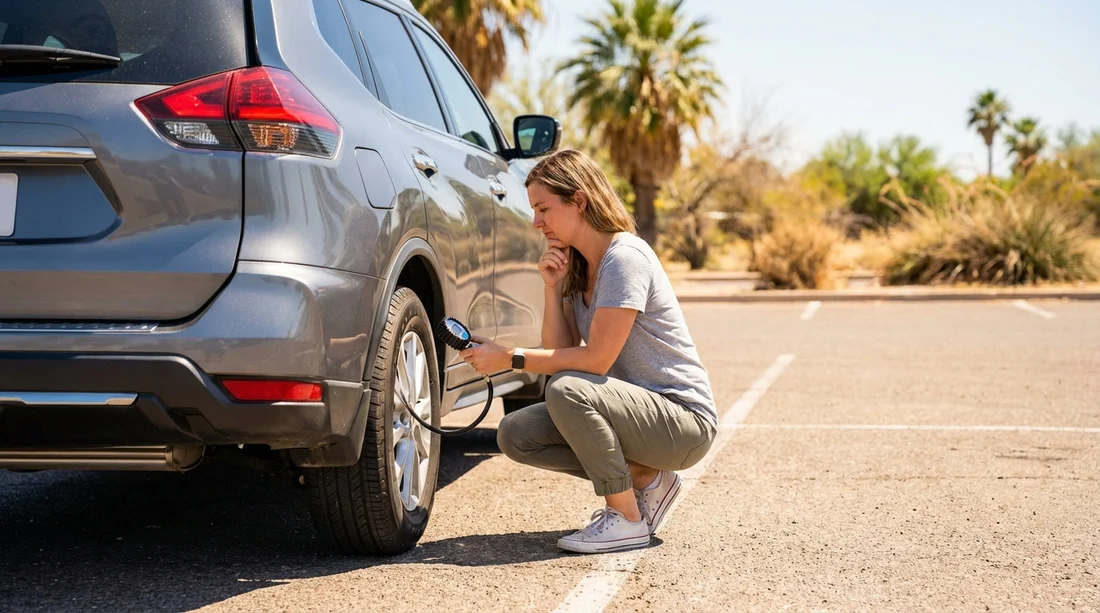
Step 4: Use a gauge to verify. TPMS can lag and can be slightly off. A simple gauge gives you a second data point. If you do not have one, many petrol stations sell them, and most station air machines have a built in gauge, though accuracy varies.
Step 5: Compare to placard, using a cold reference. If you have already driven, do not rush to bleed air immediately unless the tyre looks visibly overinflated or the value is extreme. Ideally, wait until the tyres are cold, then measure again. The cold reading is the one to compare to the placard.
How to adjust tyre pressures safely when tyres are cold
Choose the right moment. The best time is first thing in the morning, or after the car has sat for at least three hours. If you must check soon after driving, treat the reading as hot and do not bleed down to the placard cold figure, because you will end up underinflated once the tyres cool.
If pressure is too high when cold, bleed slowly. Use the valve cap, press the valve pin briefly, then recheck. Repeat in small steps. It is easy to go too far, and reinflating with a station pump can be less precise than bleeding.
If pressure is too low, inflate to the placard. Inflate in short bursts and recheck. Pay attention to different front and rear targets. If the placard offers normal and full load values, use normal load for typical luggage and passengers, and full load only if you are genuinely near that condition.
Keep left and right similar. A small difference of 1 to 2 PSI is not unusual. Larger differences on the same axle deserve attention. If you correct them and the difference returns later, there may be a leak.
Do not forget the spare. If the vehicle has a spare, especially a compact spare, it often requires a higher PSI. This can matter if you need it later. Only check it if you can access it safely and it is practical to do so.
When 45 to 50 PSI is a problem, and when it is not
Likely not a problem: all four tyres are similar, the car has been driven recently, and the placard cold target is near the high 30s or low 40s. A hot reading in the mid to high 40s can be normal after highway driving in warm conditions.
Needs action soon: your tyres are cold and the placard target is, for example, 32 to 35 PSI, yet you measure 45 to 50 PSI with a gauge. That is over the recommended operating pressure. Reduce to the placard figure, then recheck after a short drive and again when cold the next day.
Stop and seek assistance: one tyre is much higher than the others, a tyre looks misshapen, you see sidewall bulges, or the car pulls strongly to one side. Also treat any tyre warning light seriously if it is flashing, or if the vehicle reports rapid pressure loss.
Tyre pressure affects ride comfort, braking, grip, and tyre wear. Overinflation tends to reduce the tyre’s contact patch and can make the car feel skittish on rough surfaces. Underinflation builds heat and can risk tyre damage. The safest approach is simply to match the manufacturer placard when cold and keep all tyres balanced.
How to document readings to avoid tyre related disputes
Most travellers will never face a tyre claim, but documentation is quick and can remove stress if questions arise. A clear record shows that you checked the basics and acted reasonably.
At pick-up, take three photos. First, the door-jamb placard showing recommended PSI. Second, the dashboard TPMS screen showing pressures, if available. Third, a photo of your gauge on at least one tyre, ideally showing the value clearly. Make sure your phone captures time and location data if possible.
Write down conditions. In your notes app, add whether tyres were cold or hot, plus the approximate time since driving. In Texas, also note if the vehicle was parked in direct sun, because that can influence readings.
If you adjust pressures, record before and after. Take a quick photo of the gauge before adjustment and after. Note where you did it. If you are travelling between cities, this helps show the adjustment was a routine safety check, not a response to damage.
Report obvious issues promptly. If you see a nail, sidewall cut, or repeated pressure loss, report it through the provider’s normal channels. Keep your photos. This is especially sensible if you picked up through a branded counter such as Dollar Dallas DFW or Avis Texas IAH, where vehicle condition notes are routinely logged.
Common Texas scenarios that trigger high readings
Airport forecourts and long queues. If the car idles in a queue, then moves slowly, tyres warm slightly and pressures rise. The TPMS may update gradually, so you might see values creeping upward after you set off.
Highway driving and heat soak. A long run on I-10 or I-45 increases tyre temperature. Then parking at a rest stop in the sun can keep temperatures elevated. Expect higher numbers until the tyres fully cool.
Cooling overnight. If you check at sunrise and see the pressure lower than the previous afternoon, that is normal. Do not chase the number up and down constantly. Set it to the placard when cold and leave it unless a warning appears or a tyre is clearly drifting.
Load changes. Adding passengers and luggage does not usually require constant adjustment, but if you are close to maximum capacity, check whether the placard provides a higher full load setting.
FAQ
Is 45 to 50 PSI dangerous on a Texas hire car? Not automatically. If the tyres are hot, readings can rise into that range. Compare cold pressures to the door-jamb placard, and adjust only if cold readings exceed the recommendation.
Should I use the tyre sidewall PSI as the correct value? No. The sidewall shows a maximum pressure for maximum load. The correct everyday target is on the vehicle’s door-jamb placard, which is set by the manufacturer for the car.
When is the best time to check tyre pressure accurately? When tyres are cold, before driving or after at least three hours parked. If you check after driving, treat it as a hot reading and avoid bleeding down to the placard cold number.
What if one tyre reads much higher or lower than the others? Recheck with a gauge to confirm. A large difference can indicate a leak, a faulty valve, or a sensor issue. If the tyre loses pressure again, report it and document your readings.
Do I need to adjust pressures during my trip across Texas? Usually not. Set pressures to the placard when cold and monitor occasionally. Recheck if the weather changes sharply, you add a heavy load, or a warning light appears.





























































































