


Quick Summary:
- Level 2 works best for longer stops, adding steady range each hour.
- DC fast charging suits road trips, often reaching 80% in 20 to 45 minutes.
- Level 2 usually costs less, while DC fast pricing varies by speed.
- Set up Tesla, Electrify America, ChargePoint, and EVgo accounts before pickup.
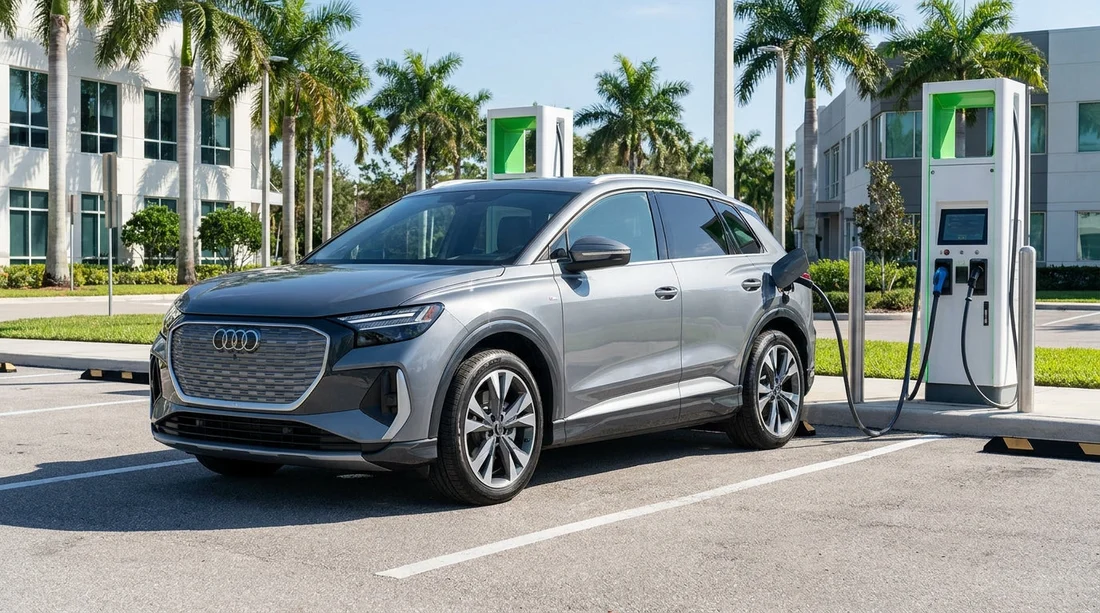
If you are considering an electric car hire in Florida, the charging type you rely on changes your whole schedule. Level 2 charging is typically where you top up while eating, shopping, or staying overnight. DC fast charging is for quick turnarounds between cities, and it is the option that most closely replaces the rhythm of fuel stops.
Before you collect your vehicle, it helps to understand how charging speeds are measured, what times are realistic in Florida heat, and what you will actually pay on different networks. It also helps to know which apps and accounts to set up in advance, so you are not troubleshooting logins at a busy charger.
Level 2 vs DC fast charging, the plain-English difference
Level 2 charging uses AC power. The charger provides AC electricity and the car’s onboard charger converts it to DC to store in the battery. Because the conversion is limited by the car’s onboard hardware, Level 2 speeds vary by vehicle, even when you plug into the same unit.
DC fast charging (also called Level 3) provides DC power directly to the battery through a dedicated fast-charge port. Because the station itself handles conversion, it can deliver much higher power, assuming the car is compatible and the battery is in a good window for fast charging.
As a rule of thumb, Level 2 is “add range while parked”, and DC fast is “add a lot of range quickly”. Both are useful during car hire, but you will use them differently depending on whether your Florida driving is city-based or includes longer motorway stretches.
Typical charging speeds and realistic charging times
Charging speed is usually shown in kilowatts (kW). Higher kW can mean faster charging, but your actual rate depends on the car, charger capability, battery temperature, and state of charge.
Level 2 speed is commonly 6 to 11 kW at public stations. Many cars add roughly 20 to 35 miles of range per hour on Level 2, sometimes a bit more on higher-power units. That makes it ideal for a 2 to 4 hour stop where you want a meaningful top-up, or an overnight hotel charge that brings you close to full.
DC fast speed ranges widely, commonly 50 kW, 150 kW, or up to 350 kW on newer sites. Not every EV can use the maximum rate. Many mainstream EVs peak somewhere around 70 to 180 kW, and some will only reach that peak briefly. A practical expectation for a road trip is a 20 to 45 minute stop to go from roughly 10% to 80%.
Why not charge to 100% on DC fast? Because charging slows down as the battery fills. That slowdown, called tapering, is normal and can make the final 20% take as long as the first 60%.
What you might pay in Florida for each type
Costs depend on network, location, and whether you pay per kWh or per minute. Florida is generally straightforward, but pricing still varies and can spike at prime tourist corridors.
Level 2 pricing is often billed per hour or per kWh, and it is usually the cheaper way to add energy. Some hotel and destination units are free for guests, but do not assume it. If it is a paid unit, Level 2 commonly works out as a budget-friendly way to top up, especially when you were already planning to park for several hours.
DC fast pricing is usually per kWh, sometimes with session fees, and occasionally with idle fees if you stay plugged in after charging ends. You are paying for speed and convenience. The biggest “hidden” cost is time, if you arrive at a busy site and wait, your effective cost of convenience rises even if the kWh rate is reasonable.
A simple way to compare, Level 2 is often best value when you can combine it with something you are doing anyway, such as dinner near Miami Beach. DC fast is best value when it replaces a longer detour or prevents you running low on a motorway segment.
Which apps and accounts to set up before you collect
For car hire, the biggest charging stress usually comes from account setup, not from finding a charger. Create accounts and add a payment method before you land, and keep your login details accessible.
Tesla app is worth having even if you do not think you will use Superchargers, because some destinations and partner locations are easiest to manage through Tesla’s ecosystem.
Electrify America is widely used for DC fast charging on major routes and can be a good option when travelling between cities.
ChargePoint is very common for Level 2 chargers at car parks, shopping centres, and some attractions.
EVgo covers a mix of urban and motorway-friendly fast charging, and can help fill gaps in certain areas.
Also enable location services and notifications in each app. Some networks send a push notification when charging stops, which helps you avoid idle fees and keeps chargers available for others.
Planning tips for Florida routes, heat, and driving patterns
Florida driving can include heavy air conditioning use, high speeds on interstates, and stop-start traffic in tourist zones. All three can reduce efficiency, which means your “miles per kWh” may be lower than you expect.
For a city-focused trip, Level 2 can cover most needs if you can charge during long parking windows. If you are staying near the coast, consider choosing accommodation near car hire in Miami Beach so you can plan charging around where you park.
If your plans include Miami, Fort Lauderdale, Tampa, or Orlando, think about where you are collecting and returning. Hola Car Rentals location pages can help you align your pickup area with your route planning, such as car hire at Miami Airport and Downtown, budget car hire in Fort Lauderdale, SUV hire in Tampa, or Alamo car rental in Orlando.
How to choose between Level 2 and DC fast during your rental
Use Level 2 when you have time on your side. It is often the best fit for overnight charging, longer meals, beach days, or theme park visits. It can also be easier on the battery and less expensive per added mile, depending on pricing.
Use DC fast when you have distance on your side. It is the right tool for intercity driving, unexpected detours, or when you are returning the vehicle and need a predictable top-up. It is also the easiest way to recover quickly if your efficiency drops due to heat, rain, or traffic.
A helpful habit for car hire is to charge little and often on road trip days, targeting 10% to 80% rather than pushing to full. This usually reduces total travel time because you spend less time charging in the slow taper zone.
FAQ
Is Level 2 charging fast enough for an electric car hire in Florida? Yes, if you can plug in for a few hours or overnight. Level 2 is best when your car is parked anyway, and it can add a useful amount of range without a dedicated stop.
How long does a DC fast charge take in real life? Many drivers plan 20 to 45 minutes to reach about 80%, depending on the car, charger power, and battery state. Charging from 80% to 100% can add a lot of time.
Do I need to download multiple charging apps? Usually, yes. Florida has several major networks, and having Tesla, Electrify America, ChargePoint, and EVgo set up reduces the risk of arriving unable to start a session.
Will the rental car come with a charging cable or adapter? It depends on the fleet and vehicle. Ask at collection what is included, and confirm the connector types so you can plan around compatible chargers.
Is DC fast charging always more expensive than Level 2? Often it is, but not always. DC fast can cost more per kWh, and it may add session or idle fees, while Level 2 may be cheaper or even included at some hotels or venues.





























































































