


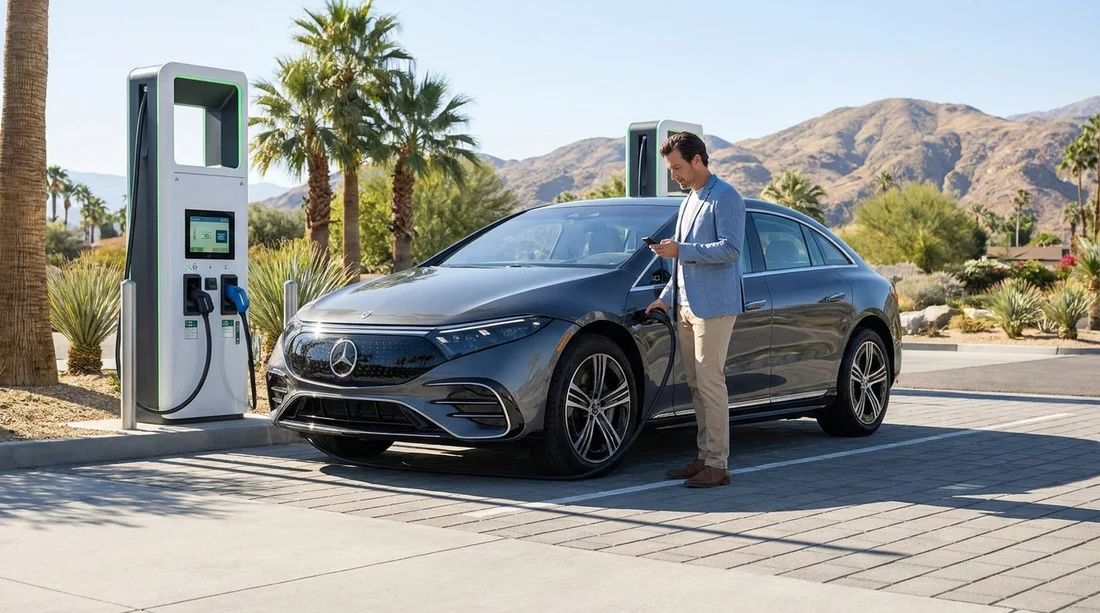
Quick Summary:
- Choose an EV only if fast chargers sit near your daily routes.
- Expect 20 to 50 minutes per fast charge, plus short detours.
- Set up charging apps before arrival, add payment and roaming options.
- Pick petrol if your itinerary is remote, packed, or highly unpredictable.
Not being able to charge overnight at your California hotel does not automatically rule out an EV rental. It does, however, change the maths. With home style overnight charging, an EV starts every day “full” with minimal effort. Without it, you are relying on public charging, which adds planning, app set up, and occasional queueing. Whether that is worth it depends on where you are driving, how tightly scheduled your days are, and how comfortable you are using charging networks.
This guide helps you decide between EV and petrol car hire in California, focusing on charging access, time costs, and the practical reality of apps, memberships, and payment.
1) Start with your trip shape, city loop or long road trip
EVs are easiest when you drive a repeatable pattern: hotel to attractions to restaurants and back, mostly within a metro area. Los Angeles, Orange County, and San Francisco have dense charging coverage, and you can often top up while you shop or eat. If you are picking up near the airport, it helps to know your collection point and first night location, for example car rental Los Angeles LAX or Dollar car hire San Francisco SFO.
EVs become trickier when your itinerary is both long and rigid, such as a one day drive from LA to Yosemite and back, or when you want to chase sunrise viewpoints, remote trailheads, or small towns with fewer chargers. You can still do it, but you must budget the charging time and accept that your plan may shift based on charger availability.
2) Public charging access in California, what is realistic?
California has the largest public charging network in the US, but coverage is uneven. Coastal urban areas generally have more options. Inland routes and mountain corridors can be sparser, and some sites have only a few working stalls. For EV travel without overnight hotel charging, you will rely on two types of charging.
DC fast charging is your main tool on a trip. It is designed for adding meaningful range quickly, but “quickly” still means a stop. A typical fast charge session might be 20 to 40 minutes to reach around 80 percent, sometimes longer depending on the car, charger power, battery temperature, and how full you arrive. If you arrive at a busy site, add time to queue or to move bays.
Level 2 charging is slower but useful when you can leave the car for a while, such as at a mall, a large car park, or certain attractions. If you cannot charge overnight at your hotel, Level 2 becomes more of a daytime top up than a full refill.
A practical rule: if you can identify at least two reliable fast charging locations near where you will spend most of your time, plus at least one option near your hotel area, an EV is feasible. If you can only find one convenient site, you are vulnerable to queues or outages.
3) The time cost, how much extra time should you budget?
Time is the biggest difference versus petrol. With petrol you can refuel almost anywhere in five minutes. With EVs, the total “charging overhead” is usually a mix of driving to a charger, waiting, charging, and then leaving. Even if the charging itself is 25 minutes, your door to door time can be 45 minutes or more.
For planning, consider three scenarios:
Urban touring, you might add 30 to 60 minutes every couple of days if you can combine charging with meals or shopping. In this case, the time cost is manageable.
Intercity drives, you may add 30 to 90 minutes per driving day, depending on how many sessions you need and how busy sites are. This can still be fine if you like structured breaks.
Remote or high mileage days, you might need multiple stops, and a single broken charger can cascade into a longer detour. This is where petrol can be less stressful.
4) App set up, what you should do before collecting the car
If you cannot charge at the hotel, you must assume you will charge publicly on day one. That means getting the tech ready before you land. Do this while on WiFi at home, not on the kerb outside the rental lot.
Install major charging apps and create accounts ahead of time. Most networks require a stored card, a verified phone number, and sometimes location permissions. Setup failures commonly happen because of weak mobile signal, foreign card verification, or an app that needs an update.
Enable contactless payment where possible. Some chargers accept tap to pay, but many still rely on apps. Even when contactless is available, it may be less reliable than the app at certain sites, so having both options helps.
Download a charger map and plan backups. Use your preferred route planning method to identify chargers near your hotel area and near each major stop. Always pick a backup charger in case a site is busy.
If you are collecting around Southern California, these practicalities matter no matter which supplier you choose, for example National car hire Santa Ana SNA can be a convenient base for Orange County trips, where you will likely charge during the day rather than overnight.
5) Cost comparison, EV savings are real but not guaranteed
Many travellers assume EV charging is always cheaper than petrol, but public fast charging prices can narrow the gap, especially at peak times or in premium locations. Your costs depend on how efficiently you drive, how often you fast charge, and local pricing. In California, electricity prices vary widely by network and area, and some sites have idle fees if you leave the car plugged in after charging completes.
Petrol has more predictable pricing and far more refuelling locations, which can simplify budgeting. For a mixed group trip, where you need certainty, petrol often wins on simplicity even if it costs a bit more.
6) Driving comfort and practical pros and cons without hotel charging
EV advantages include quiet cruising, smooth acceleration, and less fatigue in traffic. Many travellers also like the one pedal driving feel in congested areas. If most of your driving is in Los Angeles or the Bay Area, these comfort benefits can be noticeable.
EV downsides without overnight charging include having to think about state of charge each evening, and sometimes shaping your dinner stop around a charging location. If you prefer spontaneous detours, sunset chases, or last minute plan changes, a petrol car can fit your style better.
7) A simple decision checklist for California
Choose an EV rental if most of these statements are true: you are mainly in big metro areas, your daily mileage is moderate, you are happy to plan at least one charging stop every day or two, you can install and use apps comfortably, and you have at least two fast chargers near your key zones.
If you are undecided, a practical compromise is to pick petrol for the “big distance” part of your trip, then consider an EV on a later, more city based visit. For travellers collecting in LA, reviewing options across car rental California LAX can help you compare vehicle types and what fits your itinerary, without forcing a one size fits all choice.
FAQ
Can I rely on public chargers in California if my hotel has none? Yes in major cities and on popular corridors, but you should plan backups. Availability can change due to queues, broken stalls, or site maintenance.
How long does a typical fast charge take on a rental EV? Often 20 to 40 minutes to reach around 80 percent, plus time to arrive, possibly wait, and then exit. Plan 45 to 90 minutes door to door.
Do I need special apps to charge a rental EV? In many cases yes. Install key charging apps before your trip, add a payment method, and test login. Some chargers accept contactless, but it is not universal.
Is petrol car hire better for Yosemite or other mountain areas? It can be simpler, especially with early starts and limited charging near trailheads. EVs can work, but range drops with climbs and cold, and chargers may be farther apart.
What is the easiest way to reduce charging time on an EV trip? Charge little and often at convenient stops, aim for 20 to 80 percent rather than 100, and choose fast chargers close to your route to avoid detours.





























































































