


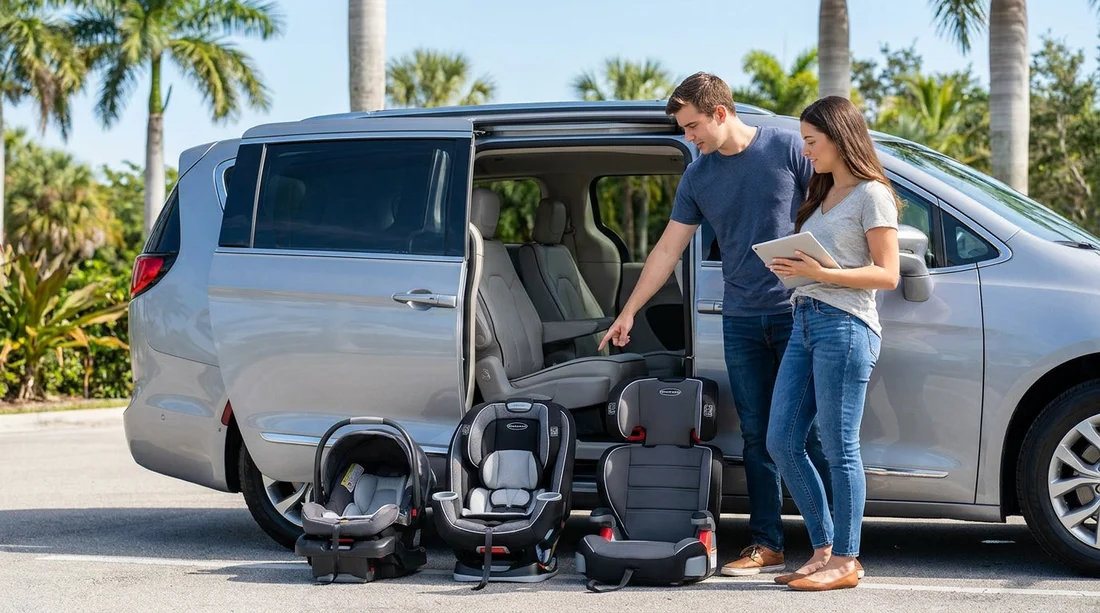
Quick Summary:
- Match seat type to your child’s height, weight, and travel behaviour.
- Prebook an infant seat for rear-facing travel, usually for under-twos.
- Choose a forward-facing child seat when rear-facing limits are exceeded.
- Use a booster once the seat belt fits hips and shoulder properly.
Choosing between an infant seat, child seat, or booster for car hire in Florida is easiest when you think in categories used across the US: rear-facing, forward-facing, then booster. Florida law sets minimum rules, but the safest choice is usually to follow the car seat manufacturer limits for your child’s height and weight, and to keep children in each stage for as long as they still fit.
If you are collecting in South Florida, it can help to review the pick-up basics for your airport location before you arrive, for example Miami (MIA) car rental information or Fort Lauderdale (FLL) car rental information. Knowing where you will fit the seat and buckle your child makes the first hour far calmer.
US child seat categories, explained simply
Car seats are sold and supplied by category, but each product has its own height and weight limits. When choosing for car hire, use the categories below, then confirm your child fits the typical range.
1) Infant seat (rear-facing only)
Often called an “infant carrier”, this is designed for rear-facing travel only. In the US, many children fit an infant seat from birth until around 9 to 18 months, sometimes longer, depending on height and weight. The key indicator is fit: if your child is at or above the seat’s stated height limit, or the top of their head is too close to the top of the shell, it is time to move on.
2) Child seat (convertible or forward-facing seat with harness)
For hiring purposes, “child seat” typically means a forward-facing seat with an internal harness. Many convertible seats can be rear-facing too, but hire fleets often separate options into “infant seat” and “child seat”. A forward-facing harness seat is usually appropriate once a child has outgrown rear-facing limits and is developmentally ready, often around age two or above. Again, check the seat limits rather than relying on age alone.
3) Booster seat (belt-positioning booster)
A booster helps the vehicle’s adult seat belt fit a child properly. There are high-back and backless boosters. High-back can be useful if the vehicle seat has a low headrest or your child needs more support. A booster is generally suitable once a child is mature enough to sit properly for the entire journey, and the adult belt can be positioned correctly with the booster’s help. Many children need a booster until roughly 10 to 12 years old, depending on height.
Florida rules vs best practice
Florida law is a minimum, and the safest practice often goes beyond it. In general terms, Florida requires children aged five and under to be in a federally approved child restraint, and children aged five can use a booster or seat belt. However, best practice is to keep children rear-facing as long as their seat allows, then in a forward-facing harness as long as they still fit, and only then move to a booster.
For visitors arranging car hire, the takeaway is simple: do not choose a booster just because a child has had a recent birthday. Choose a booster when the vehicle belt can fit correctly and the child can stay seated correctly without slouching, unbuckling, or leaning.
How to choose the right seat at pick-up
Use these checks to decide what to prebook and what to verify when you collect the car.
Step 1, start with rear-facing eligibility
If your child is under two, rear-facing is usually the best starting point. If they still fit within rear-facing limits, an infant seat category may be appropriate. If your child is tall or heavy for their age, they may have outgrown typical infant seats. In that scenario, bringing your own seat can provide certainty.
Step 2, confirm forward-facing harness need
A forward-facing child seat with a harness is the right choice when rear-facing limits are exceeded, and your child can sit upright reliably. The harness should sit at or above the shoulders for forward-facing, and you should be able to tighten it so it is snug with no slack. If you cannot get a snug fit because the straps are twisted or the adjuster is hard to reach, ask to swap the seat before leaving the lot.
Step 3, decide between high-back and backless booster
If your child is ready for a booster, the question becomes whether they need high-back support. A high-back booster can help with belt routing and comfort on long Florida drives. A backless booster can be easier to carry and fit, but it relies more on the vehicle’s head restraint and the child’s posture. If you are uncertain, high-back is often the safer, more versatile choice for mixed vehicles.
What to prebook so the right option is ready
With car hire, availability can vary by location and season. Prebooking the correct category helps, but you still need to verify the seat you are given matches your child’s size and your planned journey.
Prebook an infant seat if: your child still fits rear-facing-only limits, and you want the simplest rear-facing option for airport transfers and short journeys.
Prebook a child seat if: your child needs a forward-facing harness seat, typically after outgrowing rear-facing limits. This option is also common for toddlers and younger preschoolers who are not ready for booster behaviour.
Prebook a booster if: your child can sit correctly for the entire trip and needs help getting a safe belt fit. If your itinerary includes lots of motorway driving, long Orlando theme park days, or late-night transfers, be honest about whether your child will stay properly positioned when sleepy.
If you are comparing vehicle classes because you have multiple children, consider the space you need for fitting seats side-by-side. For families flying into Central Florida, a people carrier category can be useful, see van hire at Orlando (MCO) for an overview of options.
Installation and safety checks in a rental car
Even when you have chosen the right category, correct fitting matters. Rental staff may not be permitted to install seats for you, so plan a few extra minutes at pick-up.
Use the seat belt or LATCH, not both
Most seats allow either the vehicle belt or the LATCH system, but not both simultaneously unless the seat manual explicitly allows it. Many parents prefer the vehicle belt in rental cars because it is consistent across models and avoids LATCH weight limits that vary by seat.
Check for movement at the belt path
The seat should not move more than about an inch side-to-side or front-to-back when you test at the belt path. If it slides around, tighten and re-route before setting off.
Get the belt fit right in a booster
In a booster, the lap belt should sit low on the hips, not across the tummy. The shoulder belt should cross the middle of the shoulder, not cutting into the neck or slipping off the shoulder. If the belt does not sit correctly, try a different booster style or a different seating position in the car.
Choosing pick-up locations and timings for calmer fitting
When you collect at a busy airport location, fitting a seat in the queue can feel pressured. If you can, choose a time and place that allows you to park safely, open doors fully, and concentrate. These location guides can help you anticipate the set-up area and typical flow: car hire at Fort Lauderdale (FLL) and National car rental at Miami (MIA).
If you arrive late, remember that children are less likely to sit well in a booster when overtired. For evening arrivals, many families find a harness seat reduces the chances of belt misuse, even for children who sometimes use a booster at home.
FAQ
How do I choose between an infant seat and a child seat for car hire in Florida?
Choose an infant seat if your child still fits rear-facing-only limits. Choose a child seat when rear-facing limits are exceeded and a forward-facing harness is needed.
When is a booster appropriate in Florida?
A booster is appropriate when your child is mature enough to sit correctly for the whole trip and the booster gives a proper lap-and-shoulder belt fit.
Can I rely on Florida’s minimum legal age to pick a seat?
It is better to use manufacturer height and weight limits, plus your child’s behaviour. The legal minimum is not the same as the safest choice.
What should I check at pick-up to ensure the seat is safe?
Confirm the seat matches the category requested, straps tighten smoothly, buckles click securely, and the seat installs tightly with minimal movement.
Is it better to bring my own car seat instead of hiring one?
Bringing your own can give you known fit and features, especially for extended rear-facing needs. Hiring can be convenient if the category matches your child well.





























































































