


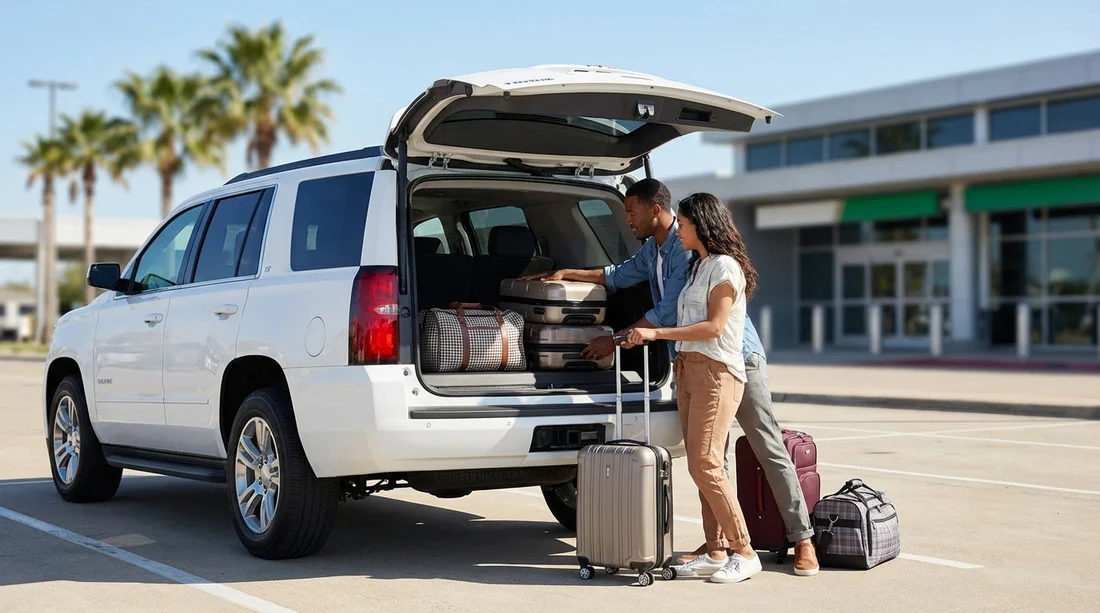
Quick Summary:
- Count suitcases by size, then choose a class with matching boot volume.
- Compact and midsize cars usually fit 1–2 large suitcases maximum.
- Full-size sedans suit 2–3 large cases, but check rear-seat flexibility.
- SUVs and minivans handle 4+ cases, depending on row use.
US car hire categories are useful, but they do not guarantee a specific model, boot shape, or luggage-friendly layout. In Texas, where road trips often mean bigger bags, extra water, and longer drives between cities, translating size categories into realistic suitcase capacity helps you avoid playing “boot Tetris” at the airport.
This guide maps common US vehicle classes to what most travellers actually care about, how many suitcases fit, and whether they will sit flat or need to be angled. It also highlights the two biggest variables that change everything, boot opening shape and whether the rear seats fold or must stay upright for passengers.
For reference, suitcase “sizes” vary by brand, but these rough categories are practical for car hire planning. A carry-on is roughly 55cm tall. A medium checked case is around 65–70cm. A large checked case is around 75–82cm. “Duffel” means a soft bag that can compress and fill gaps, which often matters more than litres of quoted boot space.
Why US car hire classes can mislead on luggage space
In US fleets, “Economy”, “Compact”, “Midsize”, and similar labels are primarily about overall vehicle size and price band, not a promise about boot capacity. Two cars in the same class can differ a lot, especially between sedans and hatchbacks, or between older and newer body shapes.
Boot volume is also not the whole story. A deep boot with a narrow opening can hold a lot but be hard to load with rigid cases. Conversely, a hatchback may have lower quoted litres but a taller, squarer space that swallows suitcases easily. When you pick a class for Texas travel, think in suitcases, not in marketing labels.
If you are comparing pickup points, Hola Car Rentals has Texas airport pages where you can review local category availability and suppliers, for example car hire at Austin AUS and car hire at San Antonio SAT. The right class is often available in multiple terminals, but the mix can change by city and season.
Suitcase capacity by US car hire category (realistic ranges)
Use the ranges below as “most likely” packing outcomes with the boot closed, not an absolute guarantee. If you are travelling with four adults and four large cases, treat anything under a large SUV or minivan as high risk.
Economy and Compact (often small sedans or small hatchbacks)
Best for: solo travellers, couples packing light, city breaks with short drives.
Typical suitcase fit: 1 large checked suitcase plus 1 carry-on, or 2 medium cases. Some models will manage 2 large cases, but often only if they are slimmer hard-shell designs and you load carefully.
What trips people up: the boot opening. Many compact sedans have a narrow aperture that forces you to angle large cases. If you have a rigid 82cm case, this is where you can get stuck even if the quoted volume sounds reasonable.
Texas tip: if you are flying into a smaller airport or arriving late, you might get a “similar to” model with a smaller boot than expected. If your trip includes shopping in outlets or extra gear for Hill Country or Big Bend, consider sizing up.
Midsize (intermediate) sedan
Best for: two adults with standard holiday luggage, or three adults with mixed bags.
Typical suitcase fit: 2 large checked suitcases, plus a carry-on or a soft duffel. Alternatively, 3 medium cases can often fit, especially if at least one is a soft bag.
What trips people up: rear-seat restrictions. With three passengers in the back, you lose the ability to slide or fold part of the rear seat for awkward items. If you are travelling as three or four adults, plan as if the boot is the only space available.
Full-size sedan
Best for: families of three to four who want a comfortable drive, business travel with bigger bags.
Typical suitcase fit: 2 to 3 large checked suitcases, plus 1 to 2 carry-ons depending on shape. Many full-size sedans have long boots that fit cases flat, which reduces the “angle loading” problem.
What trips people up: boot hinges and spare-wheel humps can steal useful space. If you have very boxy cases, you may still need to stack, which is not ideal for four large suitcases.
Premium and Luxury sedans
Best for: comfort-focused trips, couples with 2 large cases and extras.
Typical suitcase fit: similar to midsize or full-size, but less predictable. Some premium sedans have generous boots, others trade practicality for styling.
What trips people up: tapered boot openings and smaller “usable” depth. If luggage space is the priority, do not assume premium equals bigger.
Convertible
Best for: short scenic drives and light packing.
Typical suitcase fit: 1 large case or 2 carry-ons, sometimes less when the roof mechanism takes space. Convertibles are the least forgiving category for rigid suitcases.
Texas tip: for Austin to Hill Country day trips, a convertible can be fun, but plan to pack in soft bags if possible.
Small SUV (compact crossover)
Best for: two adults with larger luggage, or small families with a pushchair or cooler.
Typical suitcase fit: 2 to 3 large cases with the rear seats up, plus small items. The key advantage is the taller opening and squarer load bay compared with sedans.
What trips people up: “small SUV” can include sloping rear designs where the upper tailgate line reduces stack height. If you are carrying a pram, large cooler, or golf clubs, check whether you can fold part of the rear seat without losing passenger seating you need.
Midsize SUV
Best for: four travellers with regular checked luggage, road trips with extra gear.
Typical suitcase fit: 3 to 4 large checked cases with the second row up in many models, plus carry-ons in gaps. With a 60/40 split rear seat, you can often add long items by folding one section while still seating three in the back, depending on the vehicle.
Texas context: this is a common “safe choice” when you are uncertain about bag sizes and want to avoid moving luggage into the cabin.
Large SUV (often three-row)
Best for: five to seven passengers or high luggage volume.
Typical suitcase fit: with the third row folded, 4 to 6 large suitcases are often realistic. With the third row in use, luggage space can drop sharply, sometimes to 2 large cases or a few carry-ons, depending on model.
What trips people up: travellers assume a three-row SUV always fits seven people plus seven suitcases. In reality, seven seats usually means compromised luggage space, so plan for roofline limits and the need to fold a row for big cases.
Minivan
Best for: families, groups, and anyone who values simple loading.
Typical suitcase fit: 5 to 7 large suitcases with all seats in use in many minivans, and more when using the rear well and stacking intelligently. The low load height and wide tailgate make it easier than most SUVs for rigid cases.
If you are comparing options around North Texas, you can review category context on minivan hire at Fort Worth DFW. Minivans are often the most predictable solution for suitcase-heavy trips, even if they are not the most glamorous.
Passenger van (8 to 15 seats) and cargo-style vans
Best for: larger groups, sports teams, events, or travellers carrying bulky kit.
Typical suitcase fit: highly variable. Some passenger vans have limited luggage room when all seats are in use, while others have a deeper rear hold. Cargo-style vans can carry a lot but may be less comfortable for passengers and may have different insurance or driving considerations.
For flights into Houston, Hola Car Rentals provides a dedicated overview page for van rental in Texas at IAH, which is useful when you need more than a standard SUV or minivan can handle.
A practical suitcase planning method (works for Texas road trips)
Step one is to count “rigid boxes”. Hard-shell suitcases behave like boxes and define your minimum space need. Soft duffels can fill gaps around wheel arches and hinges, so treat them as flexible.
Step two is to assume you will not want luggage in the cabin for long drives, especially in summer heat. Keeping bags out of sight also helps reduce risk at stops. If you must put a bag in the cabin, aim for soft items on the floor behind a front seat rather than hard cases on seats.
Step three is to match your party size to luggage space. The same SUV can be “huge” for two people and “too small” for five. A helpful rule is: if you have four adults and four large checked cases, a midsize SUV is borderline, a large SUV with the third row down is safer, and a minivan is usually easiest.
Step four is to consider special items. Prams, mobility aids, coolers, golf clubs, and musical instruments often drive the decision more than suitcases do. If you have one awkward long item, a split-fold rear seat can matter as much as category size.
Texas airport reality, why model variation matters
Texas airports serve a mix of business and leisure demand, and fleets can change quickly. The same “Midsize” booking might yield a different body style depending on what has returned, been cleaned, or is being rotated. When you want a specific luggage outcome, choosing a slightly higher category reduces the chance of a tight fit.
If you are arriving into West Texas, you can compare local availability through pages like car hire at El Paso ELP. Different airports can skew toward different vehicle mixes, which affects how likely you are to see hatchbacks versus sedans within the same class.
Supplier differences also matter. Policies on “or similar” substitutions are common, and luggage space is rarely guaranteed by the label alone. If you are checking supplier options at Houston IAH, Alamo car hire in Texas at IAH is one example of a provider page where you can orient yourself to what is typically offered.
Common Texas traveller scenarios (and the safest class)
Two adults, two large suitcases, two carry-ons: midsize sedan can work, full-size sedan or small SUV is more comfortable.
Two adults plus two children, pushchair, and mixed bags: small or midsize SUV, or minivan if the pushchair is bulky.
Four adults, four large suitcases: large SUV with third row down, or minivan for a more reliable fit.
Seven passengers with suitcases: minivan if you can manage with fewer seats, or a larger passenger van if you truly need all seats plus luggage.
FAQ
How many large suitcases fit in a compact car hire in Texas? Most compact cars realistically fit one large checked suitcase plus a carry-on, or two medium cases. Two large suitcases can be possible in some models, but it is not dependable because boot openings vary.
Is a small SUV always better than a midsize sedan for luggage? Often yes for ease of loading, because SUVs tend to have taller, squarer openings. However, some small SUVs have sloping rear designs, so a full-size sedan can sometimes fit similar luggage more neatly.
Can a three-row SUV take seven people and seven suitcases? Usually not with standard large suitcases. With the third row in use, luggage space can shrink to a small rear compartment. Plan on folding the third row for big cases, or consider a van or minivan.
What is the most reliable car hire category for four large suitcases? A large SUV with the third row folded is commonly sufficient, but a minivan is usually the most predictable option because of its wide, boxy luggage area.
Should I choose a higher class if I have hard-shell cases? Yes. Hard-shell suitcases need square space and a generous opening. Moving up one category reduces the risk of a boot that is technically large enough but awkwardly shaped for rigid cases.





























































































