


Quick Summary:
- Expect a space-saver spare or sealant kit, depending on vehicle class.
- Check the boot for spare, jack, wheel key, or sealant kit.
- Run-flats and sealant kits limit speed, distance, and repair options.
- Confirm roadside assistance steps and keep your agreement and help number.
If you are arranging car hire in Los Angeles, it is sensible to set expectations about puncture equipment before you drive out of the pick-up area. Some vehicles have a compact spare tyre, some have a tyre inflator and sealant kit, and some rely on run-flat tyres or roadside assistance instead of any spare. What you receive can vary by vehicle class, model year, and even the specific car assigned on the day.
At major pick-up points such as Los Angeles Airport (LAX) car rental, fleets turn around quickly, so it is worth doing a two-minute check while you are still close to the rental counter. That quick check helps you understand what you can do yourself, what you should not do, and how to get help if a tyre loses pressure on Los Angeles freeways.
Will your Los Angeles rental usually include a spare tyre?
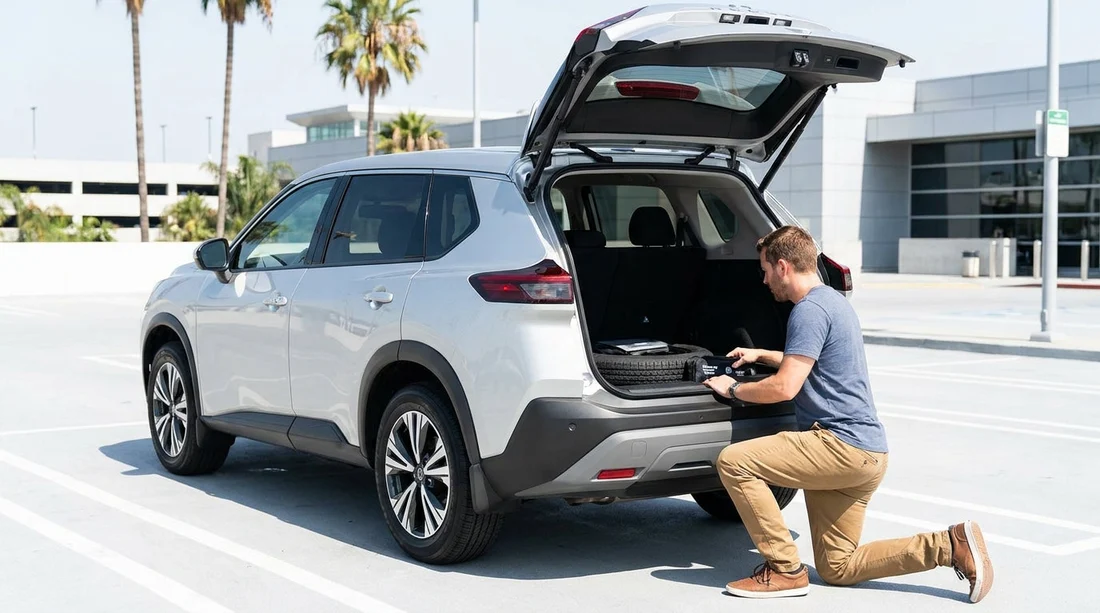
Many mainstream saloons and larger vehicles in US fleets still come with a compact spare tyre, often called a space-saver. It is typically stored under the boot floor, sometimes with a jack and wheel wrench in a foam tray. However, more newer vehicles ship from manufacturers without a spare to save weight and space, especially some smaller cars, hybrids, and premium models.
In practice, car hire at LAX and around the city often falls into one of three patterns:
1) Space-saver spare tyre fitted: You have a physical spare, a jack, and basic tools. The spare is temporary, with restrictions on speed and distance. It is meant to get you safely to a tyre shop.
2) Sealant and inflator kit provided: Instead of a spare, you get a compressor and a bottle of sealant. This can work for small tread punctures, but it cannot fix sidewall damage, cuts, or a tyre that has come off the rim.
3) Run-flat tyres or no self-repair kit: Some cars have run-flats that allow limited driving after a puncture, while some may have neither spare nor sealant. In those cases, the expected route is contacting roadside assistance.
If you prefer a vehicle more likely to have boot space and traditional equipment, consider that larger categories can be more accommodating. Information on vehicle categories and pick-up flow is available on pages like California car rental options at LAX and specific supplier pages such as Hertz car rental in California (LAX). Equipment still varies by exact car, so treat those as general guidance rather than a guarantee.
What a sealant kit can and cannot do
Sealant kits are designed for simple punctures in the tread area, commonly from a small nail or screw. The process usually involves attaching the sealant bottle, inflating the tyre to a target pressure, then driving a short distance to distribute the sealant. After that, you re-check pressure and proceed carefully to a tyre shop.
It may be a temporary fix only. Many tyre shops will not permanently repair a tyre that has been filled with sealant, or they may charge extra for clean-up. In some cases the tyre must be replaced.
It will not help for sidewall damage. If you hit a kerb in a tight parking structure or damage the tyre sidewall in a pothole, sealant is unlikely to work.
It adds a time pressure. You still need to arrange a proper repair promptly, rather than driving for days on a sealed tyre.
If a kit is present, check the sealant bottle expiry date. Expired sealant can fail when you need it most.
What to check before leaving the pick-up area
Before you join the traffic, park safely and do a quick inspection. This is especially useful at busy locations like LAX, where returning to the counter later can be inconvenient.
1) Look for the spare or kit: Open the boot and lift the floor panel. If there is a spare, confirm the jack and wrench are there too. If there is a kit, check that the compressor, hose, and sealant bottle are present.
2) Confirm there is a wheel lock key if needed: Some cars have locking wheel nuts. Without the key, you cannot remove a wheel even if you have a spare and tools.
3) Find the roadside assistance details: Locate the help number and procedure in your rental documents. Save the number on your phone. If your vehicle has no spare and no kit, this is essential.
4) Check the tyres already fitted: Look for obvious sidewall bulges, deep cuts, or very low tread. Report concerns immediately so they can be noted and addressed.
5) Understand any dashboard warnings: If the tyre pressure warning light is on at pick-up, do not assume it is minor. Ask for it to be resolved before you leave.
If you get a puncture in Los Angeles, what should you do?
Safety comes first. If you feel the car pulling, hear flapping, or see a tyre warning, signal and move to a safe place away from traffic. On Los Angeles freeways, try to reach a safer exit or a wide shoulder if the tyre is not shredding. If the tyre is failing rapidly, stop as soon as it is safe.
Next steps depend on what equipment you have:
If you have a space-saver spare: Fit it only if you are comfortable changing a wheel and can do so safely. Use the vehicle handbook instructions. Observe any speed limit shown on the spare tyre sidewall and avoid long distances. If you are in an unsafe area or do not feel confident, call roadside assistance instead.
If you have a sealant kit: Use it only for a simple tread puncture where the tyre is still seated on the rim. Follow the kit instructions carefully, then drive slowly and re-check pressure. Head to a tyre shop promptly.
If you have run-flat tyres: These can allow limited driving, but the allowed distance and speed vary by tyre. Do not push it. Contact roadside assistance and arrange inspection as soon as possible.
If you have neither: Call roadside assistance. Do not attempt to drive on a completely flat tyre, as it can destroy the wheel and create a bigger charge later.
How vehicle type can affect what you receive
While there is no universal rule, vehicle category can influence what is supplied. Smaller cars may have less space for a spare. Some SUVs have a spare under the rear of the vehicle, while others use sealant kits to keep cargo space flat. Premium and performance models sometimes use run-flats.
If you are comparing options, it can help to read category notes for different locations. Even outside Los Angeles, pages like car hire at Santa Ana (SNA) and SUV hire at Santa Ana (SNA) illustrate how equipment expectations can differ by class and station practices. For Los Angeles specifically, assume variability, then verify the actual car you are handed.
FAQ
Do all car hire vehicles in Los Angeles come with a spare tyre? No. Some have a compact spare, some have a sealant and inflator kit, and some rely on run-flat tyres or roadside assistance instead.
Where should I look for the spare tyre or sealant kit at pick-up? Check the boot first, lifting the floor panel. Some SUVs store a spare underneath the rear, and the jack and tools may be in a side compartment.
Can I use a sealant kit for any puncture? No. Sealant typically helps only with small tread punctures. It will not fix sidewall damage, large holes, or a tyre that has come off the rim.
What should I do if there is no spare and no sealant kit? Use the roadside assistance number in your rental documents. Stop somewhere safe, explain your location, and follow their instructions for recovery or a replacement vehicle.
Will driving on a space-saver spare be safe on Los Angeles freeways? It can be safe for short, careful driving, but it is temporary. Follow the speed limit marked on the tyre, avoid long distances, and arrange a proper repair promptly.





























































































