


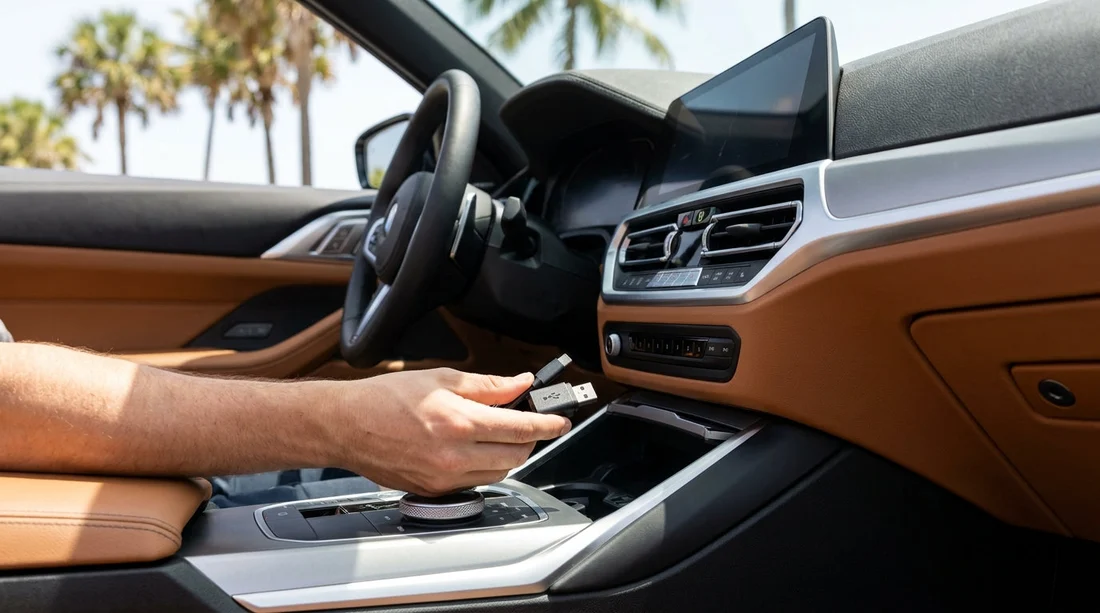
Quick Summary:
- Expect a mix of USB-A, USB-C, and 12V sockets in Florida rentals.
- Bring a dual USB-C and USB-A car charger as backup.
- Pack data-capable cables, some charge-only leads block CarPlay or Android Auto.
- Test charging at pick-up, then route cables safely away from controls.
USB-C is becoming standard in newer vehicles, but Florida car hire fleets are mixed. You might collect a brand-new SUV with multiple USB-C ports, or an older compact car with only USB-A and a 12V socket. Because you cannot always predict the exact trim level or model year, the safest plan is to assume you will need flexibility. With a small charging kit, you can keep phones, tablets, dash cams, and portable Wi‑Fi powered without stressing about what ports are in the centre console.
This guide explains what ports are common in rental cars, when USB-C is likely, and what adapters or cables to bring. It also covers real-world details that matter on Florida roads, like navigating with your phone under strong sun and multiple passengers wanting power at once.
What charging ports do rental cars usually have?
Most rental cars have at least one of these: USB-A ports, USB-C ports, and a 12V accessory socket (the old “cigarette lighter” style). Some vehicles add a 120V household-style outlet, but that is less consistent and often limited to certain trims.
USB-A is still the most widespread, especially in economy and mid-size categories. USB-A ports may provide basic charging only, and power output varies. In some cars, the USB-A ports are designed mainly for media playback, and may charge slowly.
USB-C is increasingly common in newer models and higher trims. Where available, USB-C often supports faster charging, but not always. Some USB-C ports in cars provide modest power compared with a proper USB-C Power Delivery car charger.
12V sockets are the most reliable “universal” option, because you can plug in your own charger. Even if the car has USB ports, a 12V charger can deliver more consistent power, especially when you are running navigation, music, and screen brightness at maximum.
How likely is USB-C for car hire in Florida?
USB-C availability depends heavily on the vehicle’s age, make, and trim. Florida car hire fleets can include a wide spread of model years because cars rotate in and out at different times, and some locations carry more family vehicles while others have more urban compacts.
In general, you are more likely to find USB-C in newer SUVs, minivans, and premium categories. You are less likely to find it in older economy models. Even within the same model name, one trim may have USB-C in the front row while another has only USB-A, so it is best to plan for both.
If you are collecting near major hubs, the mix can be broad. For example, pick-ups around Miami and Orlando can see everything from small city cars to larger family vehicles.
If you are comparing pick-up points, these pages can help you understand locations and vehicle options: car hire Airport Brickell, car hire Miami Beach, and Hertz car hire Disney Orlando.
USB-C in the car, what it can and cannot do
A USB-C port in the cabin does not automatically mean fast charging. Car manufacturers sometimes fit USB-C ports that deliver low-to-moderate power, designed to maintain battery level rather than rapidly charge a modern phone from near empty. If you rely on your phone for maps, music, and hotspot duties, that difference matters.
Also, the port’s location matters. Some cars have USB-C ports only in the rear seats, which is great for passengers but not ideal for a driver using wired CarPlay or Android Auto. Many vehicles still require a wired connection for stable phone integration, and not every car supports wireless projection.
What to pack, the simplest charging kit for Florida
If you want charging to “just work” regardless of the vehicle, pack a small set of items that covers the most common scenarios. None of this is bulky, and it prevents the usual headaches at pick-up.
1) A 12V car charger with USB-C and USB-A
Choose a quality dual-port charger, ideally with USB-C Power Delivery and a USB-A port for older devices. This single item covers the biggest uncertainty, because nearly every car has a 12V socket.
2) Two cables, one USB-C to USB-C and one USB-A to USB-C
This combination lets you use either in-car port type, plus your own 12V charger. If you use an iPhone, bring USB-C to Lightning and USB-A to Lightning instead, depending on your preferred charger.
3) A short cable for tidy routing
A 30 to 60 cm cable can be useful if the port is close to a phone mount. It reduces tangles around the gear selector and avoids snagging when you reach for drinks or sunglasses.
4) A multi-port charger for families
If you are travelling as a group, a charger with two to four outputs helps avoid arguments. This is especially relevant for longer drives to theme parks or the Gulf Coast, where everyone’s battery seems to drop at once.
What to look for during pick-up
When you first sit in the car, take 60 seconds to identify the available charging points. Look near the infotainment screen, inside the centre console, and by the rear vents. Plug in your phone and confirm it is charging at a sensible rate. If you plan to use wired phone integration, test that the car recognises the device before leaving the car park.
If you are travelling with lots of luggage or a family group, you may prefer a vehicle category that typically offers more rear-seat charging. For larger passenger loads, you can compare options such as minivan hire Florida.
Florida-specific considerations, heat, navigation, and long drives
Florida heat can push phones to work harder. High cabin temperatures, direct sun on a phone mount, and maximum screen brightness can increase power draw and may trigger thermal throttling. Air-con helps, but a phone baking in sunlight while charging can still overheat. If you see temperature warnings, move the device away from direct sun and consider using a vent mount where cooled air can reach it.
If you are collecting on the Gulf Coast side, you may still see a broad fleet mix, so the same packing advice applies. This location page is useful for planning: car rental Tampa.
Should you bring an adapter for car hire in Florida?
Yes, bringing an adapter is the most dependable approach. Even if your car ends up having USB-C, your own 12V charger and mixed cables give you options if the built-in ports are slow, occupied, or positioned awkwardly. Think of USB-C in the vehicle as a bonus, not a guarantee.
The minimal “no regrets” setup is a dual-port 12V charger (USB-C plus USB-A) and two compatible cables. That kit covers nearly every rental scenario, keeps devices charged for navigation, and reduces the chance you will need to shop for cables mid-trip.
FAQ
Do most rental cars in Florida have USB-C ports?
Not always. Many newer cars do, but plenty of rentals still provide USB-A and a 12V socket only, so it is best to pack for both.
If the car has USB-C, will it fast charge my phone?
Sometimes, but not guaranteed. Some in-car USB-C ports are low power, so a quality 12V USB-C Power Delivery charger is more consistent.
Can I use the car’s USB port for CarPlay or Android Auto?
Often yes, but you need a data-capable cable and a compatible infotainment system. Charge-only cables can prevent the car from recognising your phone.
What is the easiest charging kit to pack for car hire?
A dual-port 12V charger with USB-C and USB-A, plus two reliable cables that match your phone. Add a spare cable if more than one person will charge.
Where are USB ports usually located in rental cars?
Common places include below the infotainment controls, inside the centre console, and near rear-seat vents. Some vehicles have rear ports only.





























































































