


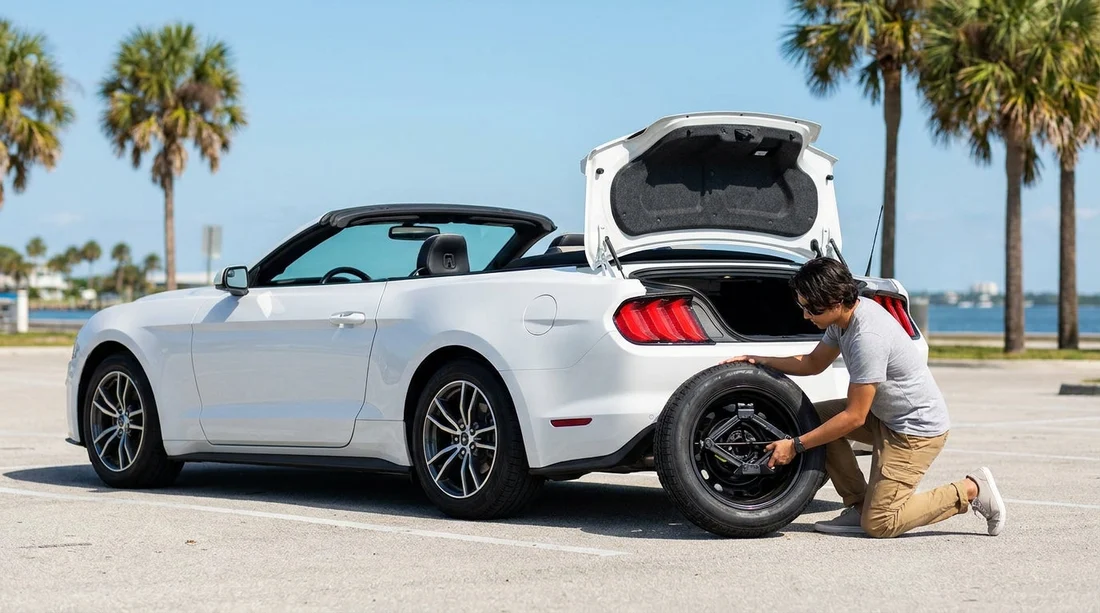
Quick Summary:
- Open the boot and confirm a spare wheel or inflator kit.
- Locate the jack, wheel brace, locking key, and towing eye.
- Check spare pressure or sealant expiry, and ensure the compressor runs.
- Find the correct jacking points before you need to lift the car.
Punctures are rare, but Florida driving can be hard on tyres, with heat, road debris and long highway miles. Before you pull away with your car hire, take two minutes at the counter or in the pick-up bay to confirm you actually have the kit you would need at the roadside. Many modern vehicles do not carry a full-size spare, some have a space-saver, and others only include an inflator and sealant.
If you are collecting from a busy location such as car hire at Orlando MCO or heading straight down to the coast after car rental in Miami Beach, it is worth doing this before you join fast traffic. If anything is missing, it is far simpler to sort out at the desk than from a hard shoulder.
1) Identify what “spare” solution the car actually has
Start by opening the boot (or tailgate). Lift the boot floor panel carefully, some have a latch, others lift from a fabric loop. Your goal is to establish which of these you have.
Full-size spare wheel, a normal tyre on a standard wheel. Best option, but less common in newer fleets.
Space-saver spare, a narrower tyre, often labelled with a maximum speed, typically 50 mph. It is designed for short, careful driving to a tyre shop.
Tyre inflator kit, usually a 12V compressor plus a sealant bottle or integrated canister. This is common on compact cars and some SUVs.
Run-flat tyres, some vehicles rely on reinforced tyres. Even then, you still need to know any limits, and whether a compressor is provided for slow leaks.
2) Confirm the jack is present, and right for the vehicle
Next, locate the jack. It is often stored beside the spare, clipped into the wheel well, or in a side compartment. In some SUVs it may be tucked behind a trim panel. With larger vehicles, especially if you have arranged SUV hire in Downtown Miami, the jack can be higher up in the boot area to keep it accessible when the cargo floor is raised.
Is it actually there? Sounds obvious, but it is the most common surprise.
Does it look complete? Some jacks use a separate crank handle or two-piece rod. Make sure all parts are present.
Is it undamaged? A bent scissor jack, missing saddle plate, or heavily corroded parts can be unsafe.
Can you identify how it engages? A scissor jack needs the crank to fit. A bottle jack needs a handle to pump. You are not testing it fully, just confirming you can operate it.
3) Find the wheel brace, locking wheel nut key, and towing eye
Do not stop at “spare present”. You also need the tools that make it possible to remove the wheel.
Wheel brace or lug wrench, it should fit the wheel nuts.
Locking wheel nut key, if the car has locking nuts. This is a small, shaped adaptor that lets the wrench turn the locking nut. Without it, you cannot remove the wheel.
Towing eye, usually a threaded metal loop. It may be needed if you must be recovered from a safe area after a puncture.
Open the glovebox and door pockets too. In some models, the locking key is stored in the glovebox in a small bag, separate from the spare wheel well.
4) Check spare tyre condition and pressure, or sealant expiry
A spare that is flat is nearly as bad as no spare at all. Space-savers often sit for months without being checked, and they can lose pressure over time.
If you have a spare wheel: look at the tyre sidewall for obvious cracking or bulges, then check pressure. The easiest method is the tyre pressure screen in the dashboard if the car shows individual tyre pressures. If it does not, many airport forecourts have an air line nearby. Space-savers often require higher pressure than regular tyres, so read the sticker in the driver door shut or the handbook.
If you have an inflator kit: check the sealant bottle expiry date. If it is out of date, it may not seal properly. Confirm the bottle is present, and that the cap is intact. Then locate the compressor power plug and check it matches the car, typically 12V in the cabin or boot.
Check the handbook or the quick guide sticker, sometimes attached under the boot floor, showing the correct points.
If you are unsure, ask staff at collection, especially at high-turnover counters such as Budget car rental in Orlando MCO, where different models rotate through the same category.
FAQ
Do all car hire vehicles in Florida come with a spare tyre? No. Many newer cars provide an inflator and sealant kit instead of a spare wheel, and some may have run-flat tyres. Check the boot before you leave.
Where is the jack usually stored in a rental car? Common places include under the boot floor with the spare, in a foam tool tray, or behind a side panel in the boot. Some vehicles store parts separately, so look for the crank handle too.
What if the locking wheel nut key is missing? Report it before you drive away. Without the key you may not be able to remove the wheel, even if you have a spare and jack.
Is it OK to drive long distances on a space-saver spare? It is intended only for short, careful driving and usually has a low maximum speed. Use it to reach a tyre shop, not for extended highway travel.
Should I use the sealant in the inflator kit for any puncture? Sealant is typically for small tread punctures only, not sidewall damage or a blowout. If you are unsure, or the location is unsafe, call the roadside number in your rental documents.































































































