


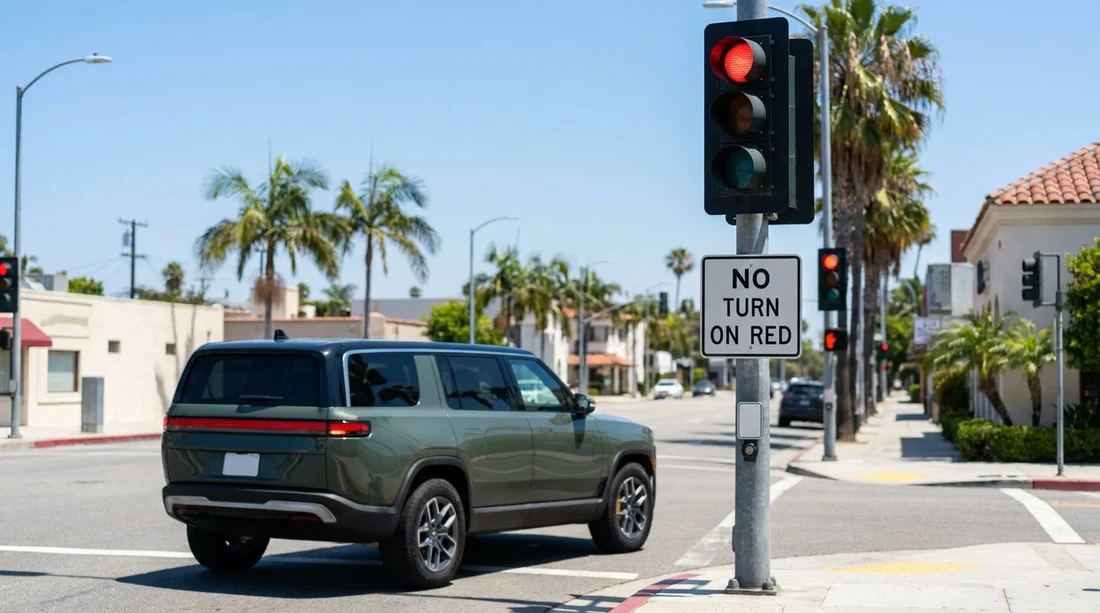
Quick Summary:
- In California, right turn on red is allowed unless a sign forbids it.
- Obey ‘NO TURN ON RED’ and red right arrows exactly.
- Expect restrictions near schools, busy downtown corners, and complex multi-lane junctions.
- Stop fully, check pedestrians and bikes, then turn only when permitted.
For many UK visitors, the biggest surprise after car hire pick-up in California is not driving on the right, it is the expectation that you may turn right at a red light. In the UK, a red traffic light generally means stop and wait, with only a few filtered movements allowed when signalled. In California, the default rule is different: after coming to a complete stop, you can often turn right on red if the way is clear, but only when there is no restriction sign and no red right-turn arrow.
This is where the ‘NO TURN ON RED’ sign matters. It removes that default permission at that specific junction or during stated times. If you miss it, you can easily find yourself turning against a clear prohibition, which is a common reason for a pulled-over chat with local police, or a near miss with a pedestrian stepping into a crosswalk.
If you are collecting a vehicle at a major hub such as Los Angeles LAX or heading out from San Diego Airport, you are likely to meet these signs quickly because airport-adjacent roads and city arterials have many signal-controlled turns. Understanding the common sign variations and where they tend to appear will help you settle into California driving with fewer surprises.
What ‘no turn on red’ means in California
In California, a red traffic signal requires you to stop at the limit line, crosswalk, or before entering the junction. After stopping, you may turn right when the signal is red, unless one of the following is true:
1) A sign says ‘NO TURN ON RED’. This means you must stay stopped and wait for a green light (or a green arrow if the turn is arrow-controlled).
2) A red right-turn arrow is showing. A red arrow prohibits the turn. Do not treat it like a normal red circle. Wait for a green arrow or green light as applicable.
3) Your movement is a left turn from a one-way to a one-way. California allows this in some cases after stopping, but it is less common for visitors and will often be signed or geometrically obvious. If in doubt, wait for green.
So, ‘no turn on red’ does not mean you cannot ever turn right at a red light in California. It means the normal permission is switched off at that place, sometimes only at certain times, and it is enforceable like any other signal instruction.
Sign variations UK drivers should recognise
California signage is fairly consistent, but several wording or signal combinations can convey the same practical message. Watch for these variations as you approach a junction, especially when you are in an unfamiliar car and focusing on lane choice.
‘NO TURN ON RED’ is the classic rectangular sign. It applies to the turn from the lane you are in, usually the rightmost lane, but sometimes a dedicated right-turn lane too. If you are alongside another right-turn lane, look for signs posted near each lane or on the signal head.
‘NO RIGHT ON RED’ is a close cousin, more explicit about direction. Treat it the same way, wait for a green indication.
Time-limited restrictions may appear as ‘NO TURN ON RED 7AM TO 7PM’ or similar. Outside those hours, the default rule returns, assuming no red arrow. The key is to read the times quickly and avoid guessing. If you are not sure whether the restriction is active, the safer choice is to wait for green.
Red arrow signals are common at larger junctions. A red right arrow means no right turn, even if there is no separate sign. A green right arrow means you may turn, but still yield to pedestrians in the crosswalk and watch for cyclists running alongside the kerb.
Where you’ll typically see ‘no turn on red’ in California
These signs are not random. They tend to show up where turning on red would create conflict, reduce visibility, or slow traffic flow. Knowing the patterns helps you scan early and pick the correct lane without last-second decisions.
Busy pedestrian crossings are a major trigger. Downtown corners, beach promenades, and shopping districts often prohibit turns on red to reduce pedestrian risk. California places strong emphasis on crosswalk priority, and a right-on-red turn can cut across pedestrians who have a walk signal.
School zones and parks are another common location, particularly during morning drop-off and afternoon pick-up windows. Even if the sign is time-limited, treat the area as high-risk for unexpected crossings.
Multi-lane right turns and slip lanes can prompt restrictions. If the junction geometry is complex, with multiple turning lanes or tight merges, banning turns on red reduces confusion and side-swipe risk.
High-speed arterials and freeway-adjacent roads often have signalised ramps and fast-moving cross traffic. Near major hubs like LAX, or when heading through Orange County corridors after collecting an SUV via Santa Ana SNA, you may notice more red arrows and explicit restrictions designed to keep movements predictable.
What to do at the light: a reliable checklist
1) Choose the correct lane early. Some junctions have a dedicated right-turn lane with its own signal head. If you are in a through lane, do not cut across late.
2) Make a full stop. California law expects a complete stop, not a rolling slow-down. Stop behind the limit line or before the crosswalk.
3) Read the signal head. If you see a red right arrow, do not turn. If it is a red circle, then look for signs that modify the default rule.
4) Scan for ‘NO TURN ON RED’ signs and any time windows. Signs can be on the signal pole, on a separate post, or suspended near the lights. At night, give yourself an extra moment to locate them.
5) Yield properly. Even when a turn is allowed, yield to pedestrians in the crosswalk, cyclists in bike lanes, and oncoming traffic where relevant. Do not edge into the crossing to “claim” space.
6) If unsure, wait for green. It is rarely wrong to wait. It is often wrong to guess.
After pick-up: why it matters for car hire in California
Right-after-pick-up driving often involves leaving a multi-level car park, joining unfamiliar lanes, and dealing with jet lag. Add in a left-hand-drive vehicle and right-hand traffic flow, and it is easy to miss a small but important sign. A few minutes spent resetting your expectations before you leave the car hire area can reduce stress.
Airport and city pick-up locations can place you onto one-way systems quickly. If you are starting your trip from Los Angeles Airport LAX or driving north after collecting near Sacramento SMF, expect several signalised junctions where turns on red are sometimes allowed and sometimes explicitly banned. Treat every red light as a decision point that depends on the posted controls at that exact junction.
FAQ
Do I ever have to turn right on red in California? No. It is usually permitted after stopping unless prohibited, but it is not mandatory. If you are unsure, wait for green.
If there’s no ‘NO TURN ON RED’ sign, can I always turn right on red? Not always. You must still stop fully, check for a red right-turn arrow, and yield to pedestrians, cyclists, and traffic.
What if the sign says ‘NO TURN ON RED’ only at certain times? The restriction applies only during the posted times. Outside those times, the default rule may apply, unless a red arrow or another sign restricts you.
Is ‘no turn on red’ the same as a red right-turn arrow? Both prohibit the turn, but they appear differently. A sign prohibits turning on a red circle, while a red arrow prohibits the arrowed movement directly.
Can I be ticketed for turning right on red where it’s banned? Yes. It is treated as a moving violation, and it can also create liability if it leads to a collision.































































































