


Quick Summary:
- MacArthur, Venetian and Julia Tuttle causeways may pause traffic for drawbridge openings.
- When gates drop, stop behind the line, stay calm, and wait.
- Allow extra time for flights, especially at peak marine and rush periods.
- Use live navigation apps, and choose alternative causeways if one backs up.
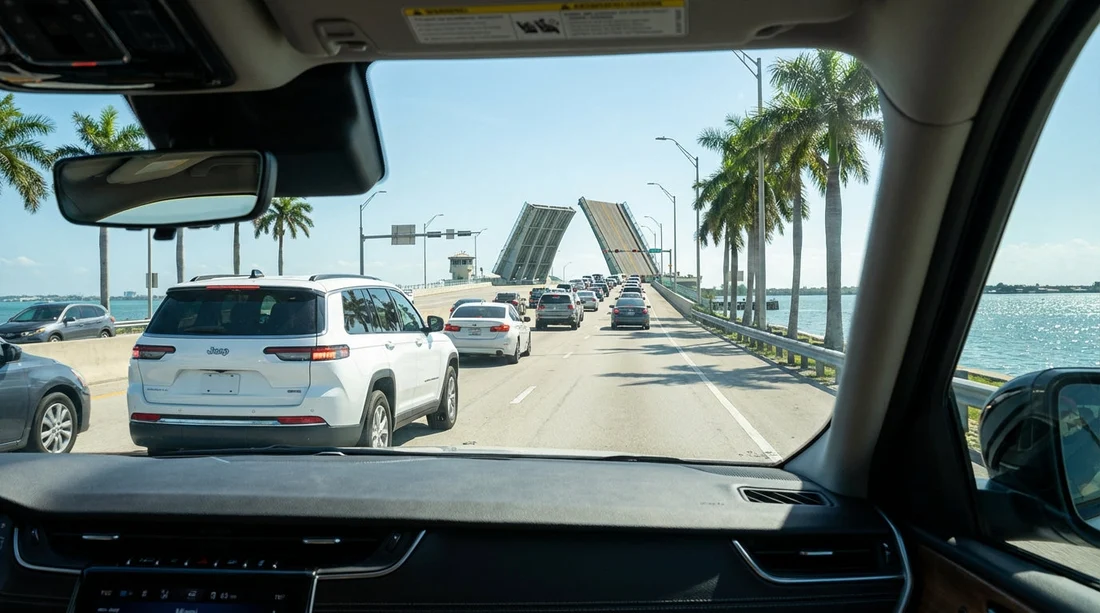
With Miami car hire, the drive between the mainland and Miami Beach feels straightforward until a drawbridge opening turns moving lanes into a standstill. It is normal, it is managed, and it is usually brief, but it can derail a dinner reservation or add stress when you are heading to the airport.
This guide explains how causeway drawbridges work, where they affect routes to Miami Beach, what to do when the gates drop, and how to plan your drive time sensibly when flights and timed reservations matter.
What is a causeway drawbridge, and why does it stop traffic?
Miami’s causeways are the main road links across Biscayne Bay. Some sections include movable bridges that lift or swing to let boats pass. When a vessel needs clearance, the bridge operator stops road traffic, lowers barrier gates, and then raises the bridge span. Once the vessel has cleared, the span lowers, the barriers lift, and traffic restarts.
The key point for drivers using car hire in Miami is that road closures are a safety requirement, not an unpredictable malfunction. When you see the gates down and lights flashing, the system is working as designed.
Where drawbridges can affect routes to Miami Beach
Most visitors reach Miami Beach from the mainland via three big causeways. Each has a different feel, and each can be affected by bridge operations and congestion.
MacArthur Causeway (I-395) connects Downtown Miami to South Beach and the Port of Miami area. It is a common choice for hotel zones around South Beach, cruise terminals, and connections from I-95. Portions include bridge structures and marine traffic nearby, so occasional openings and heavy peak traffic can combine to create delays.
Venetian Causeway is a scenic route linking Downtown and the islands toward Miami Beach. It includes multiple bridge segments, which means there are more points where marine traffic can interrupt cars. It can be appealing outside peak times, but it is often slower if any opening happens while commuter traffic is high.
Julia Tuttle Causeway (I-195) runs between Midtown and the central part of Miami Beach. It is a major commuter route and tends to stay busy. Even if bridge openings are short, queues can take time to clear during rush periods.
If your pick-up is in the city and you are heading straight to the sand, it helps to consider where you are starting and where you are parking. For example, if you are collecting from car rental Miami (MIA) and your hotel is in South Beach, MacArthur is often the most direct. If you are staying nearer Mid-Beach, Julia Tuttle may be the natural fit. If you are staying Downtown or Brickell and your plans are flexible, Venetian can be a pleasant option when traffic is light.
How bridge openings are scheduled in practice
Many drawbridges operate on either demand or scheduled opening windows, and operations can vary by time of day, weekday versus weekend, and special events. In real-world terms, you should assume:
Openings are usually short, but the delay you feel can be longer because queues take time to rebuild and then drain.
Rush hour amplifies everything. A five minute stop can translate into a longer crawl if the approach roads are already saturated.
Marine activity peaks at certain times. Weekends, sunny afternoons, and event days bring more boats, which can increase the chance of openings or slowdowns around bridge approaches.
Because you cannot reliably predict a specific opening without live information, the best strategy is to build in a buffer when timing matters.
What to do when the gates drop
When the barrier gates go down, treat it like a railway crossing. It is simple, but it is worth spelling out because visitors sometimes misread the situation as a temporary traffic light.
Stop behind the marked line. Leave space for emergency vehicles, and do not block junctions or side access points.
Do not change lanes aggressively. As the queue grows, sudden merges cause minor collisions and larger knock-on delays.
Stay in the vehicle. It is not safe to get out for photos, and it can attract enforcement attention.
Expect a surge when traffic restarts. Keep a steady gap, avoid hard acceleration, and watch for scooters, cyclists, and pedestrians near Miami Beach approaches.
If you are using sat nav, it may try to re-route the moment you stop. That can help, but only if an alternative route is genuinely better. If you are already at the bridge approach with gates down, turning around may be impossible or slower than waiting.
How to avoid delays, practical planning for car hire drivers
There is no guaranteed way to avoid a drawbridge opening, but you can reduce the chance that it ruins your schedule.
1) Build a realistic buffer for time-sensitive plans
If you have a flight, a show, or a fixed reservation, add time for both a bridge pause and the queue that follows. In practice, that means planning for traffic conditions, then adding extra time on top during peak periods. It is better to arrive early and park than to arrive stressed and late.
If your trip ends with a flight, consider where you are returning the vehicle. A return at Miami International can be straightforward, but approaches can be busy, and any causeway delay can compound. If you are flying from Fort Lauderdale, extra time matters even more because you are adding distance plus the possibility of congestion. If that is your plan, it can help to understand options around car hire at Fort Lauderdale Airport (FLL) as part of your broader timing strategy.
2) Time crossings away from the worst congestion
Drawbridge delays feel most painful when combined with rush hour. If your day allows it, cross earlier in the morning, later in the evening, or between typical commuter peaks. You will not eliminate openings, but you will reduce the chance of sitting in a long queue afterward.
3) Choose the causeway that fits your destination, not just your map
South Beach, Mid-Beach, and North Beach each connect differently to mainland routes. A causeway that looks shortest can drop you into heavy local traffic once you hit the beach side. If you are staying in Miami Beach and want the simplest local arrival, browsing car hire in Miami Beach (MBC) can help you visualise pick-up and drop-off points relative to your hotel area.
4) Use live navigation, but sanity-check the re-route
Apps are good at detecting standstills, but a re-route often pushes you onto local streets where parking, one-way systems, and school zones can slow you down. If the app suggests a detour that involves multiple turns through dense areas, it may not beat simply waiting for the bridge to reopen.
5) Plan parking so you are not circling after the crossing
On Miami Beach, time can disappear looking for a garage or a legal curb space. If your schedule is tight, decide on a garage or hotel valet plan in advance. This makes your crossing buffer more meaningful because you are not spending it driving around blocks after the causeway.
Special situations: port traffic, events, and weather
Even when a drawbridge opening itself is brief, Miami’s broader traffic patterns can magnify delays.
Cruise and port activity can affect areas near the Port of Miami and the MacArthur Causeway. On embarkation and disembarkation days, build additional time, especially if your route shares approach roads with port traffic.
Major events in Miami Beach and Downtown can change everything. Road closures, police-managed junctions, and surges in rideshare activity can create gridlock that makes any bridge pause feel longer.
Heavy rain reduces visibility and increases braking distances on causeways. If the weather turns, slow down, increase following distance, and assume your journey will take longer, even without a bridge opening.
Car hire tips for stress-free causeway driving
Drawbridges are only part of the experience. A few car hire habits can make the crossings easier and safer.
Pick the right vehicle size for your group and luggage. If you are travelling with family or lots of bags, a larger vehicle can keep the cabin calm and organised, which matters when traffic stops and starts. If that is your situation around Brickell or Downtown, it is useful to compare options like minivan rental in Brickell (BRK) for space and practicality.
Keep your toll strategy simple. Miami routes can include toll roads depending on where you are going. Decide early whether you will use tolls to bypass congestion, and confirm how tolls are handled for your rental.
Use fuel planning to protect your schedule. A low tank plus an unexpected bridge stop can add unnecessary worry. Top up before you head to the airport side, and avoid leaving refuelling to the final minutes.
Know where you are returning the car. Downtown returns can be convenient if you are staying centrally, but time your approach carefully if you are coming from Miami Beach. If you are comparing operators and locations, Enterprise car hire in Downtown Miami (DWN) is one example of a central return option to factor into your plan.
How much extra time should I allow for flights and reservations?
There is no single number that suits every day, because openings, traffic volumes, and events vary. However, you can apply a sensible rule of thumb: if you are crossing a causeway and the timing really matters, plan for a buffer that covers one full bridge cycle plus the time for queues to clear. Then add more buffer during rush hour, port surges, and bad weather.
For flights, remember you are not just driving to the terminal. You need time for returning the vehicle, shuttle or walk to the terminal, and check-in and security. A small road delay can become a big airport delay if it causes you to arrive during a busy wave.
For dinner reservations and tours, the best approach is to arrive on the beach side early and build in a parking plan. If you reach Miami Beach with time to spare, you can always have a coffee or take a short walk rather than sitting in traffic watching the minutes tick away.
FAQ
Do Miami causeway drawbridges open often? They can open regularly, especially when marine traffic is high, but many openings are brief. The bigger issue is the queue that forms and then takes time to clear.
What should I do if I see the barriers lowering ahead? Slow down smoothly, stop behind the line, and stay in your lane. Do not block junctions or attempt U-turns unless directed by signage or police.
Which route is best to avoid drawbridge delays to Miami Beach? There is no guaranteed best route. Use live navigation, consider your destination area on the beach, and avoid crossing during peak commuter periods when any stop creates long queues.
How much extra time should I allow to reach MIA from Miami Beach with car hire? Allow extra time for a possible bridge opening plus rush-hour traffic, then add time for returning the vehicle and getting through the airport. If timing is critical, build a generous buffer.
Can I rely on sat nav to reroute around a bridge opening? It can help, but re-routes may send you through slower local streets. If you are already near the bridge and traffic is controlled, waiting is often faster than trying to turn around.































































































