


Quick Summary:
- Ask to be charged in USD, and decline any “home currency” option.
- Watch for DCC wording on terminals, receipts, and emailed payment links.
- Use a credit card, avoid debit-only deposits that prompt currency conversion.
- Check the final receipt shows USD, then dispute quickly if converted.
Dynamic Currency Conversion, often shortened to DCC, is a payment option that can appear when you pay for car hire at pick-up in Miami. It happens when a card terminal detects your card is issued outside the US and offers to charge you in your home currency instead of US dollars. It can look convenient, but the exchange rate is typically worse than your card provider’s rate, and it may include extra margins or fees built into the conversion.
The good news is you can usually avoid DCC with a few simple habits. The key is recognising the prompts, asking for the charge in USD, and checking your receipt before you leave the counter. This matters whether you are collecting at the airport, downtown, or a neighbourhood branch. If you are comparing pick-up points, you can review options like car hire at Miami airport and downtown and still apply the same payment rules at the desk.
What DCC looks like at a Miami car hire desk
DCC rarely announces itself as “we are about to overcharge you”. Instead, it appears as a choice, often framed as helpful. Common on-screen messages include “Pay in GBP or USD?”, “Choose currency”, “Guaranteed exchange rate”, or “We can convert to your home currency”. Sometimes the screen displays two totals, one in USD and one in your home currency, then asks you to select a button to continue.
At a car hire pick-up, DCC can show up when you pay any of the following: the rental balance, upgrades, one-way fees, fuel purchases, toll packages, or incidentals. It can also appear when a deposit or pre-authorisation is taken. Even if the final payment is later, an initial authorisation processed with DCC can still mean you accepted a conversion you did not want.
DCC can be presented in several formats:
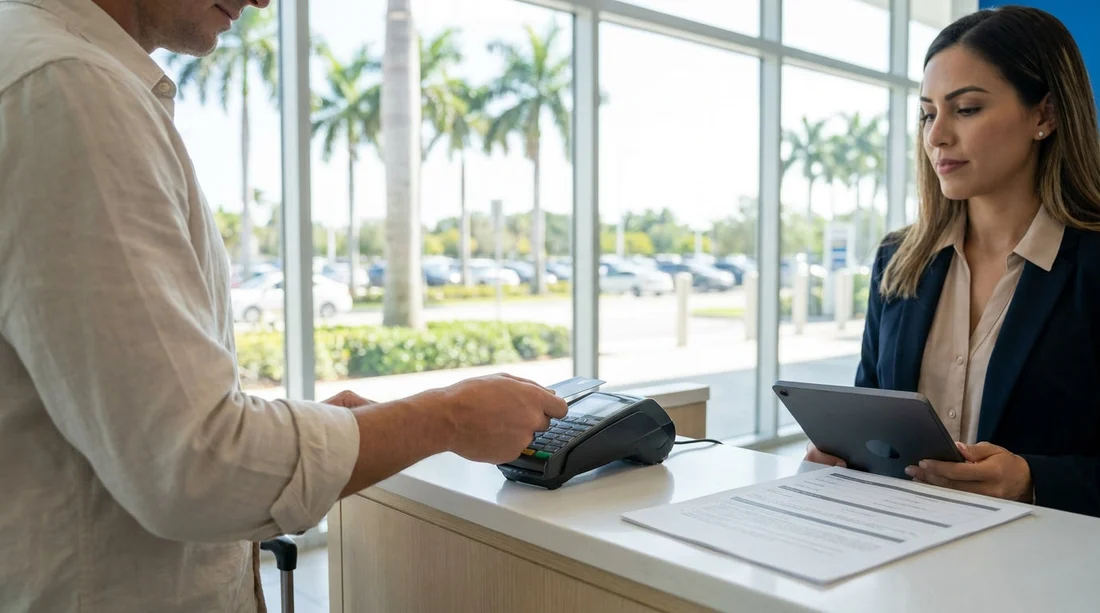
Card terminal prompts: The employee hands you the terminal and asks you to “choose” or “confirm”. If you press the wrong option, the transaction may be processed in your home currency.
Printed paperwork: A receipt may show an exchange rate, a converted amount, and a statement that you “accepted conversion”. If you see an exchange rate printed on a US transaction, treat that as a warning sign.
SMS or emailed payment links: Occasionally, pay-by-link systems may show currency choices. If you see anything other than USD as the transaction currency, stop and ask for it to be reissued in USD.
How to ensure you pay in USD, not your home currency
To avoid inflated exchange rates, your goal is simple: the transaction currency must be USD. These steps help you get there consistently.
1) State your preference before the terminal is handed over. Say clearly, “Please charge me in USD only.” Doing this early reduces the chance the staff member selects the wrong setting on the terminal before you see it.
2) Always decline conversion, even if it says “guaranteed”. “Guaranteed rate” is marketing language. Your card issuer typically provides a better wholesale rate, especially on credit cards with low foreign transaction fees. Choose USD, local currency, or “without conversion”, depending on the wording.
3) Do not be rushed. A busy Miami counter can feel fast-paced, particularly at peak arrival times. Take a moment to read the terminal screen. If the employee presses buttons for you, ask to restart the payment so you can confirm the currency choice.
4) Use a credit card for the deposit and payment. For car hire, credit cards are often the smoothest option for deposits. Debit cards can trigger additional verification or processing routes, and you want the simplest possible payment flow where you can control the currency. If you are hiring a larger vehicle, the deposit can be higher, so keeping the payment in USD matters even more. It is worth checking details for van hire in Miami if you expect a larger hold on your card.
5) Avoid “pay in pounds/euros” even if the USD amount looks similar. DCC can make the converted total seem close, but the hidden cost is in the exchange rate and potential additional mark-ups. The only fair comparison is the USD total charged to your card, then converted by your own card provider.
Where DCC often appears during Miami car hire pick-up
DCC can appear anywhere a card is tapped or inserted, but certain moments are more likely:
When paying at airport desks: Airport locations handle many international cards, so DCC prompts are common. If you are collecting in or near the airport area, stay alert during any card-present payment.
When adding extras: Upgrades, additional drivers, or prepaid fuel can trigger a new payment screen. Even if your main payment was in USD, an add-on transaction can still present DCC.
When paying for toll solutions: Some branches offer toll packages. If you accept one at the counter, it may generate an additional charge. Confirm the currency again.
When taking a deposit: A pre-authorisation is not always “just a hold” in the way people imagine. It is still a card transaction with currency parameters. Ask for the authorisation in USD and check paperwork that references the hold.
These principles apply whether you are picking up in Miami itself or nearby areas that serve Miami travellers. For example, if your itinerary includes a different arrival point, you might compare car hire at Fort Lauderdale, then apply the same anti-DCC checks at the payment step.
Receipt checks that catch DCC before it becomes a problem
The easiest time to fix DCC is immediately, while you are still at the desk. Before you leave, look for these indicators:
Currency code: The receipt should show USD. If you see GBP, EUR, or another home currency code, it is a sign DCC was used.
Exchange rate line: A US car hire receipt should not need to show an exchange rate for a straightforward USD payment. If a rate is printed, question it.
Wording of acceptance: Some receipts include statements like “Cardholder chose to pay in home currency” or “DCC accepted”. If you see that and you did not intend it, ask for a refund and re-charge in USD.
Total amounts shown twice: Dual totals, one USD and one home currency, often indicates a DCC choice was made or offered. Ensure the charge you authorised is the USD amount.
If DCC has already gone through, ask the staff to void it and reprocess in USD. Voiding immediately is typically cleaner than trying to sort it out days later. If you are collecting from a specific operator location, payment systems can vary, but your approach stays the same. For instance, if you are using an operator branch in the western part of Miami, see practical location context like Enterprise car rental in Doral and still insist on USD at the terminal.
Extra tips to reduce the chances of DCC
Carry a card that is fee-friendly for USD spending. If you have a credit card that offers competitive foreign exchange terms, you will be more confident declining DCC. DCC is often accepted because people worry their bank rate will be worse, but it is usually the other way around.
Know your card’s default currency behaviour. Some travellers use multi-currency cards. If your card can hold USD balances, you can still be offered DCC. The merchant controls the transaction currency, so you must still choose USD on the terminal.
Do not confuse DCC with normal card conversion. If you pay in USD and your statement later shows the amount in your home currency, that is normal conversion by your card provider. DCC is when the merchant converts at the point of sale, typically at a poorer rate.
Be careful with contactless “quick taps”. Contactless payments can still allow DCC. If the terminal prompts for a currency choice, avoid tapping again until USD is selected.
FAQ
What exactly is dynamic currency conversion at a Miami car hire pick-up? It is when the payment terminal offers to charge your card in your home currency instead of USD, using the merchant’s exchange rate rather than your card provider’s.
Which option should I pick on the terminal to avoid DCC? Choose USD, local currency, or “without conversion”. Decline options that mention your home currency or a “guaranteed” exchange rate.
Can DCC happen on the deposit or pre-authorisation? Yes. A deposit or hold can still be processed with a selected currency. Ask for the authorisation in USD and check the paperwork shows USD.
If I accidentally accepted DCC, can it be fixed? Often yes, if you notice immediately. Ask the desk to void the transaction and reprocess it in USD, then keep the updated receipt.
Is paying in USD always best even if my bank charges fees? Usually, yes. Even with a foreign transaction fee, your bank’s exchange rate is commonly better than DCC. A fee-friendly credit card helps most.































































































