


Quick Summary:
- Most Florida EV rentals include a basic charging cable, not every adaptor.
- Confirm the connector type, and ask staff to show all kit.
- Photograph the cable, adaptor, and any damage before leaving the lot.
- Set up charging apps and payment methods before collecting keys.
When you choose an electric car hire in Florida, the most common worry is simple, will the car come with a charging cable and the right adaptor, or will you be stuck hunting for equipment after a long flight. The short, practical answer is that many rental EVs are supplied with at least one charging cable, but the exact kit varies by model, branch, and fleet turnover. Some vehicles include a portable “granny” lead for slower AC charging, others only support public charging via the connector built into the car, and adaptors are not always included.
This guide explains what charging equipment is typically supplied, what to confirm at the counter, and which apps and accounts to set up before you drive away. The goal is to help you avoid wasted time and make your Florida trip smoother, whether you are collecting near Miami or heading north towards Orlando.
What charging equipment is typically supplied with an EV rental?
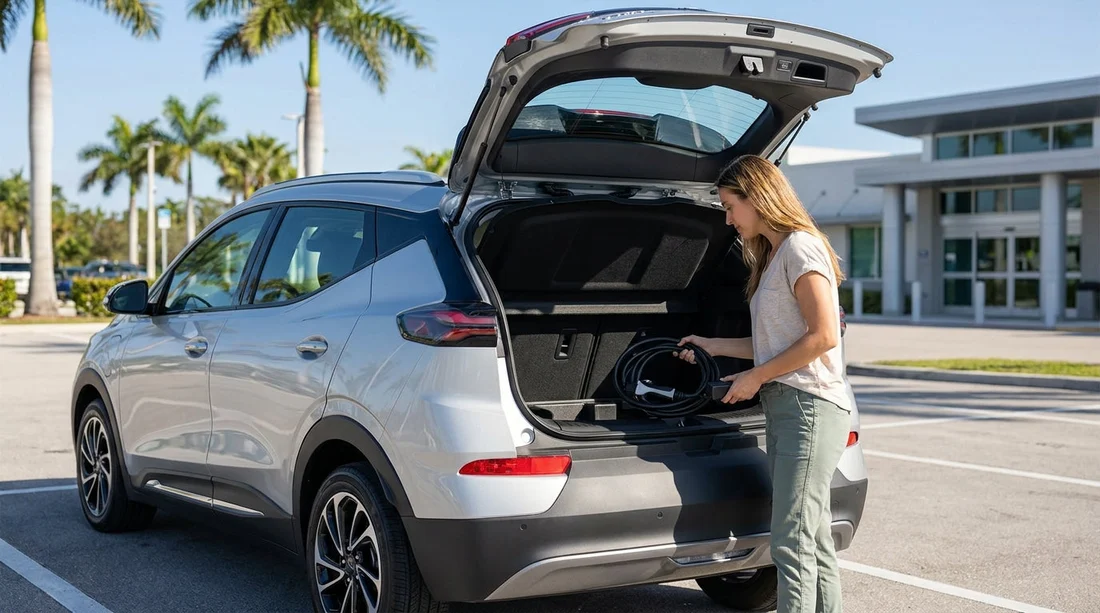
In Florida, EV rental fleets commonly include a charging cable intended for AC charging. This is often stored in the boot under the floor panel or in a side compartment. However, the definition of “charging cable” differs between cars, and that affects what you can do on day one.
Commonly supplied: a portable AC charging lead that plugs into the car and a power source, plus a small storage bag. If the vehicle supports AC charging via a Type 1 or J1772 inlet (common in the US for non Tesla), the cable may be J1772. If the vehicle is a Tesla, the car uses Tesla’s connector, and the included kit can vary widely by model year.
Not consistently supplied: adaptors for other connector types, extension leads, and fast charging accessories. Public fast chargers do not use a separate cable you carry, the cable is attached to the charger. What you need there is the correct inlet on the car and, in some cases, an adaptor that enables a different network’s plug to fit your vehicle.
Sometimes supplied: a compact adaptor in the vehicle case, particularly for Tesla vehicles that may include a J1772 adaptor. Some fleets remove loose accessories to prevent loss, so do not assume it will be there even if the car’s manual suggests it should be.
What to check at the counter and on the lot before you leave
Before you accept the keys, treat charging equipment like any other essential accessory. You are trying to confirm three things, that the car can charge where you need it to, that the required kit is actually in the vehicle, and that it is recorded as present to avoid disputes later.
1) Confirm the exact car and connector type
Ask staff to confirm the model and the charging inlet type. If you are expecting CCS but receive a different variant, that can change your charging options on the road.
2) Ask what charging cable is provided
Request clarity on whether the vehicle includes an AC cable, and if so, what plug it uses at the wall end. Some portable chargers are designed for standard household sockets, others need a higher power outlet. If you will stay in a hotel, the useful detail is whether you can use common sockets safely and legally, or whether you should rely on public chargers.
3) Physically locate the kit before you drive off
Open the boot and find the cable and any adaptors. Check the pins are straight, the latch works, and the cable jacket has no cuts. Take photos showing the equipment and where it was stored.
4) Verify it is noted on the rental documentation
If the branch tracks accessories, ask them to note that the charging kit and any adaptor were provided. This helps at return if the equipment was already missing or damaged.
5) Check the charging status and settings
Confirm the state of charge before you leave and whether any charging limits are set in the car’s menu. A low limit can make it look like the car “won’t charge” when it is simply set to stop early.
If you are arranging car hire in Miami areas, these checks are worth doing even if you have only hired for a day. For travellers collecting around Brickell, you can compare local options via car hire Airport Brickell. If you are nearer Coral Gables, see location information through car hire Coral Gables or car rental Coral Gables.
Apps and accounts to set up before you collect the keys
Many EV charging frustrations come from standing at a charger trying to download apps with poor signal. Set up accounts in advance, add a payment method, and practise finding chargers on your route.
Charging network apps: Install a couple of major network apps and create accounts ahead of time. The right choice depends on your route and vehicle compatibility. Having at least two apps reduces the risk of arriving at a charger that requires a specific account or payment method.
Mapping and route planning: Use a mapping app that filters by connector type and speed. Save a few backup charging stops near your accommodation and along any highway legs. This matters in Florida where distances can feel deceptively long, and detours around traffic or weather can add miles.
Payment readiness: Add a card to your chosen apps and check your bank will approve US transactions if you are visiting from abroad. Also keep a contactless card available, as some stations allow tap to pay without an app.
What if your rental EV does not include a cable or adaptor?
If you open the boot and find no charging kit, do not panic, but do act immediately. First, return to the counter or the lot attendant and ask them to confirm whether the vehicle should have a cable. In some cases, the intended charging method is public charging only, where the station provides the cable. In others, the cable was removed accidentally or stored in a different compartment.
If an adaptor is missing, ask whether they can supply one or swap the vehicle for a model that matches the chargers you expect to use. A swap can be the simplest fix if your itinerary depends on a specific connector type.
Also consider how you will charge during your first 24 hours. If your accommodation has no charging, plan a public charging stop near your route. In busier areas such as Doral, it can help to know your nearby pick-up context, for example National car rental Doral provides location context while you plan where you will drive first.
FAQ
Do electric rental cars in Florida usually come with a charging cable? Often yes, especially an AC charging lead for slower charging, but it depends on the specific vehicle and branch. Always confirm and physically check the boot before leaving.
Is an adaptor included for non Tesla chargers? Sometimes, but not reliably. If you need a specific adaptor to use certain connector types, ask staff to show it to you and record it as supplied.
Can I use fast chargers without carrying any cable? Yes. DC fast chargers have their own attached cables. You only need the car to have the compatible inlet, and occasionally an adaptor for certain networks.
Which apps should I set up before pick-up? Set up at least two major charging network apps, add a payment method, and download a charger mapping app that filters by connector type and speed.
What should I photograph at pick-up? Take clear photos of the cable, any adaptor, and where they were stored, plus the battery percentage and any visible damage. This helps prevent disputes at return.































































































