


Quick Summary:
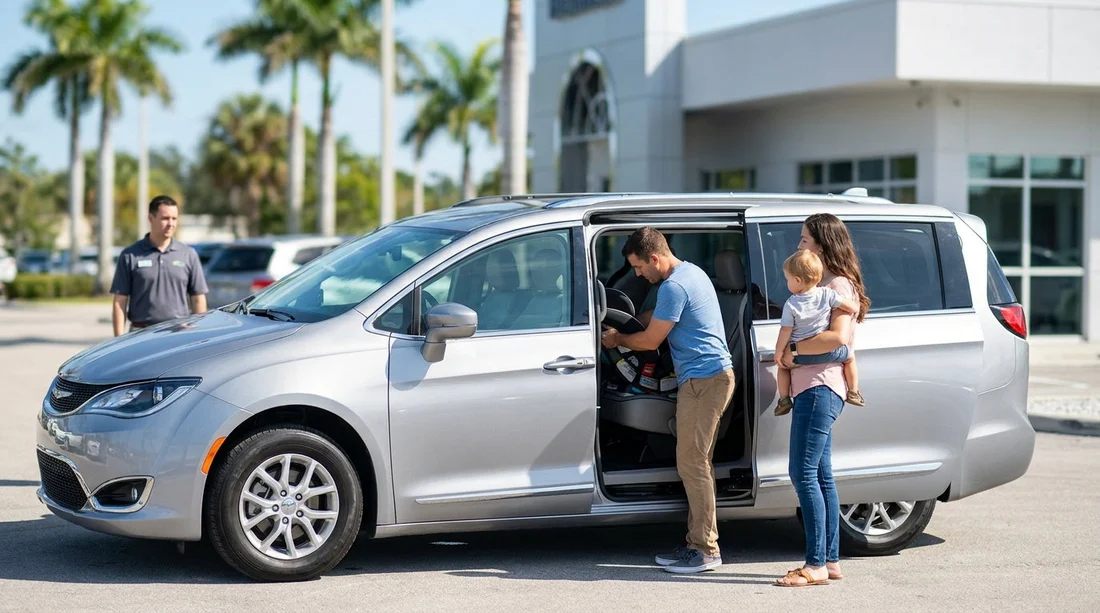
- In Florida, you normally install the hired child seat yourself at pick-up.
- Check seat type, labels, and all parts are present before leaving.
- Do belt routing, tightness, and harness checks before driving off-site.
- Arrive early, request seats in advance, and know your child’s measurements.
Picking up a car hire in Florida with children can feel time sensitive, especially after a long flight or a busy terminal transfer. The key question most parents ask is simple: do you have to fit a hired child seat yourself at collection? In most Florida car hire locations, the practical answer is yes, the driver or accompanying adult usually installs the child seat in the car. Staff may provide the seat and basic guidance, but they often cannot physically fit it for you due to liability policies, staffing constraints, and the fact that the correct fit depends on the exact child and seating position.
That does not mean you are on your own. You can still reduce risk and avoid delays by checking the seat at the counter, confirming you have the right size, and doing a quick installation checklist before you drive away.
Who installs the child seat at Florida car hire pick-up?
At many Florida car hire desks, the seat is issued as an accessory, sometimes handed over at the counter and sometimes collected from the vehicle bay or booth. It is common for the renter to install it, even when the seat has been pre-staged in the boot. Some locations may offer assistance, but it is typically limited to showing you where the seat is and pointing out the instruction labels.
If you are collecting from a high-volume location such as Orlando car rental near Disney or Tampa Airport car hire, assume queues and time pressure. Plan on installing the seat yourself, and build in an extra 15 to 25 minutes for fitting and checks, especially if you have not used that model before.
What to confirm at the counter before you accept the seat
Delays often happen because the seat provided does not match what you expected, or important parts are missing. Before you leave the counter area, confirm these points clearly.
Seat type and child fit: Ask whether it is rear-facing, forward-facing, or a booster, and confirm the minimum and maximum weight and height limits on the label. In Florida, requirements vary by age and size, so your focus should be a correct fit for your child rather than relying on age alone.
Included components: Check that you have all parts that are meant to be in the box, such as the base (if it is an infant seat system), inserts, chest clip, and any belt positioning guides for boosters. Missing parts can make a safe install impossible.
Condition and cleanliness: Look for cracks in the shell, fraying straps, stiff buckles, or missing padding. A child seat should not be damaged. If anything looks wrong, request a different unit.
Instructions: Many seats have routing diagrams on stickers, but not all are obvious. Ask staff if a paper leaflet is available, and check for a manufacturer label with model name so you can follow the on-seat diagrams accurately.
Safety checks to do in the car before you drive away
Once you reach the vehicle, do not pull out of the bay until you have done a few quick checks. These checks are simple, but they catch the most common errors.
1) Choose the safest seating position: The rear seat is generally preferred, and the centre position can be good if the seat can be installed tightly there. If the centre position does not allow a secure fit, use the outboard rear seat that gives the best belt geometry and stability. Avoid placing a rear-facing seat in front of an active airbag.
2) Confirm the belt path: Many installation problems come from using the wrong belt path. Use the seat’s routing labels for rear-facing versus forward-facing. Ensure the belt is flat and not twisted, then lock it according to the vehicle’s belt system.
3) Tightness test at the correct point: Grip the seat at the belt path and try to move it side-to-side and front-to-back. It should not move more than about 2.5 cm. Test only at the belt path, not at the headrest, where movement is normal.
4) Harness and chest clip check: For harnessed seats, straps should lie flat with no twists and be snug enough that you cannot pinch extra webbing at the shoulder. The chest clip should sit at armpit level.
5) Recline angle and head support: Rear-facing seats need the correct recline so your child’s head does not flop forward. Check the indicator on the seat if present. For boosters, ensure the lap belt sits low on hips, not on the stomach, and the shoulder belt crosses the collarbone, not the neck.
If you are unsure about any step, pause and ask for basic guidance from the bay team. Even if they cannot install it for you, they can often help you understand which belt locking method the vehicle uses, or whether a different car model would make fitting easier.
How to avoid delays at pick-up, especially at busy Florida locations
Most hold-ups are preventable with a little preparation. Here is what makes the biggest difference for Florida car hire collections.
Know your child’s current measurements: Bring your child’s approximate weight and height. Seats are issued by category, and being specific helps you avoid swapping at the desk.
Allow time for a swap: If the first seat does not fit your child or the vehicle properly, you may need to exchange it. That is more likely during peak periods at places like Fort Lauderdale Airport car hire, where stock can move quickly between returns and new rentals.
Choose a vehicle that suits car seats: Small saloons can have tricky belt geometry or limited rear space. If you have multiple children or large seats, consider a larger vehicle class. For example, an SUV can make access and installation easier, and you can compare options on pages such as SUV hire at Tampa TPA.
Inspect before leaving the car park: It is much easier to resolve problems while you are still on-site. Once you have driven off, returning for a swap can mean repeating entry procedures and re-queuing.
What if you need an infant seat or have more than one child?
Infant seats often involve a base and a carrier. At car hire pick-up, check whether you are receiving the base, and whether it is designed for seat belt installation. If the base is missing, ask for a complete set. For multiple children, consider where each seat will go and whether you can access buckles easily. It is common to find that three across does not work in many vehicles, even if there are three rear belts.
If you are collecting in South Florida and expect heavy traffic after pick-up, such as around Doral, it can be worth taking the extra time to secure every seat correctly before you set off. If you are arranging a collection point near the city, car rental in Doral can be useful for planning timings and avoiding a rushed fit immediately after a flight.
Common mistakes to avoid
Assuming staff will install it: Plan to fit it yourself, and treat any help as a bonus.
Rushing the belt lock step: A seat can feel tight at first, then loosen when the belt feeds back out. Ensure the belt is truly locked according to the car’s system.
Using the wrong belt path: Rear-facing and forward-facing routing differs. Follow the seat’s labels precisely.
Not checking the harness: Even a perfectly installed seat is unsafe if the harness is loose, twisted, or positioned incorrectly.
FAQ
Do Florida car hire companies legally have to fit the child seat for you? No. Most car hire companies provide the seat as equipment, but policies typically leave installation to the renter for liability and practicality reasons.
Can I ask staff to check my installation before I leave? You can ask for basic guidance, such as confirming belt locking methods or reading the seat’s routing labels. However, many locations will not sign off an installation as approved.
What should I do if the hired child seat looks damaged or incomplete? Do not use it. Return to the counter or bay booth immediately and request a different seat, making sure all required parts and labels are present.
How much extra time should I allow at pick-up for fitting a child seat? Allow 15 to 25 minutes per seat, longer if you have multiple children or an unfamiliar model, and more during peak travel periods.
Is it better to bring my own car seat instead of hiring one? Bringing your own can give you familiarity and confidence, but it adds luggage and handling. Hiring can be convenient, provided you inspect the seat and install it carefully before driving.































































































