


Quick Summary:
- Read the rental terms for off-road, unpaved, and undercarriage exclusions.
- Photograph road-entry signs, surface changes, and your odometer before proceeding.
- Confirm whether damage waiver applies on graded dirt roads, not trails.
- Turn back at deep ruts, water crossings, or “high clearance” warnings.
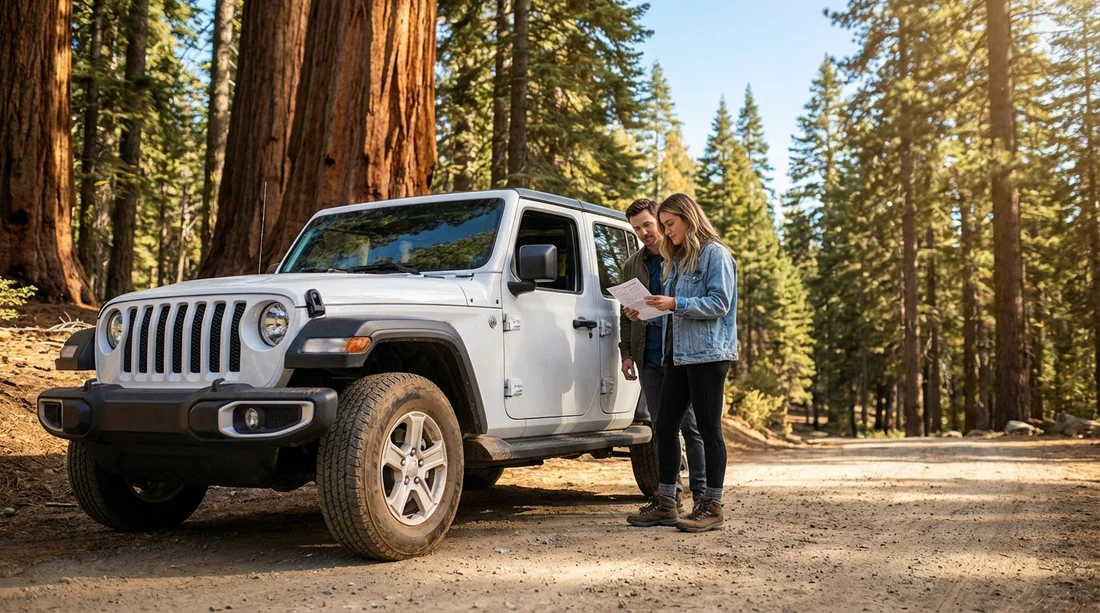
Unsealed forest roads in California can be tempting, they lead to trailheads, viewpoints, and quieter campsites. But with car hire, the big question is not whether the car can physically manage a dirt road, it is whether your rental agreement and damage cover will protect you if something goes wrong. A single sharp rock can crack an oil pan or slice a tyre, and many rental policies treat that as a driver-responsibility loss, even if you never intended to go “off-road”.
This guide explains how to decide, before you leave the paved highway, whether an unsealed forest road is allowed under your rental terms. It also covers what signs and photos help demonstrate the road’s status and condition, and the practical point at which it is wise to turn back to avoid damage liability.
Why “unpaved” is a grey area in California car hire
In California, many legitimate public roads are unsealed, especially in national forests and some state recreation areas. They might be county-maintained, Forest Service maintained, or temporarily unpaved due to construction. Rental agreements, however, often use broader language such as “off-road”, “unimproved roads”, or “unpaved surfaces”, and those terms can be interpreted strictly when a claim is made.
The key is to separate three categories:
1) Unsealed but maintained public roads, typically graded dirt or gravel, often passable by standard cars in dry weather.
2) “High clearance” or 4x4 routes, where rocks, ruts, steep grades, or washouts are expected.
3) True off-road travel, such as driving on trails, beaches where prohibited, meadows, or anywhere not a designated road.
Most disputes happen when drivers assume category 1 is fine, but the contract treats any unpaved surface as excluded for certain damage types (especially tyres, wheels, glass, roof, and underbody).
Check your rental terms before you reach the forest road
Start with the documents that govern your agreement, not the general marketing language. Look for these sections:
Permitted use and prohibited use: Search for “unpaved”, “unsealed”, “gravel”, “dirt”, “off-road”, “unimproved”, “forest service roads”, “4x4”, and “high clearance”. Some agreements allow unpaved public roads but prohibit “off-road”, others prohibit any unpaved surface.
Damage waiver and exclusions: Even if the road is allowed, damage waiver may exclude specific losses common on dirt roads. Pay special attention to tyres, wheels, undercarriage, suspension, oil pan, bumper, and towing or recovery charges. It is possible for the contract to allow the road, but still make you pay for a puncture, a bent wheel, or an underbody strike.
“Use of vehicle” and negligence language: Clauses about “reasonable care” and “inappropriate use” matter. If the road is deeply rutted, flooded, or signed as requiring high clearance, driving on it can be framed as unreasonable even if “unpaved roads” are not banned outright.
Geographic restrictions: These are more about crossing borders, but sometimes include restricted areas or seasonal closures. If a forest road is closed and you drive past a closure sign, liability risks escalate sharply.
If you are arranging California car hire around major airports, keep the paperwork easy to access on your phone. For pick-ups around Orange County, check the details on the relevant location page such as car hire at Santa Ana Airport (SNA). If you are collecting in the Bay Area, it can help to have your confirmation and terms saved alongside your trip plan, for example for car hire in San Francisco (SFO).
Ask the right “cover” questions, and avoid vague answers
When people say “Is it covered?”, they often mean three different things. Clarify which one you are checking:
Is the road permitted under the rental agreement? This is about contract compliance. If the contract prohibits unpaved roads, driving on one can void protections and create a breach.
Does the damage waiver apply on that surface? Some waivers exclude certain damage regardless of where it happens. Tyres and underbody are the common pitfalls on unsealed roads.
Would roadside assistance or towing be covered? Even if a repair is covered, recovery from a remote forest road can be billed to you. If a tow truck needs special equipment or a long call-out, costs can rise fast.
Useful phrasing is specific: “Is a graded, maintained Forest Service road considered permitted use?” and “Are tyre, wheel, and undercarriage impacts excluded even with the damage waiver?” If you are comparing providers for the same trip, look at brand-specific terms that may differ, for example Hertz car rental in San Francisco versus other options.
Road signs that matter, and what to photograph
If you ever need to show that you acted reasonably, contemporaneous evidence helps. You are not trying to build a legal case at the roadside, you are making it easier to explain what you encountered.
Photograph these before you proceed:
Entrance signs: Many forest roads have an initial signboard with the road number, managing agency, and allowed vehicle types. A sign that clearly identifies it as a road (not a trail) can be helpful.
Surface transition: Take a shot where pavement ends and dirt begins, including any “Pavement Ends” warning. This shows you did not leave a marked public road onto a random track.
Condition warnings: Signs such as “High Clearance Recommended”, “4x4 Only”, “Road Not Maintained”, “Impassable When Wet”, “No Trailers”, or “Narrow Road” are decision points. Photograph them. If you continue past them and damage occurs, those signs can also be used against you, so treat them as turn-back prompts unless you are fully confident your agreement and vehicle are suitable.
Closure notices: “Road Closed” or gates across the road are non-negotiable. Photograph and turn back.
Odometer and time: A quick photo of the odometer at the entrance can anchor where you were in case you later need to explain distances or timing.
The road ahead: Take one photo looking down the road showing its width and grading. If it looks like a maintained road, that supports your judgement. If it looks like a boulder field, it is a signal to stop.
Do not stop in unsafe places, and do not block traffic. Pull into a turnout if available.
How to judge the road surface in practice
“Unsealed” covers everything from smooth hard-packed dirt to loose gravel with embedded rocks. Use a simple checklist before committing:
Depth of loose material: Deep loose gravel increases puncture risk and reduces braking. If your tyres start digging in, reconsider.
Rock size and frequency: Fist-sized rocks are undercarriage hazards for many sedans. Scattered sharp rock is tyre trouble.
Ruts and washboarding: Ruts can scrape the underbody, washboarding can loosen components and make you lose control. If you cannot maintain a slow, steady line without bouncing, it is not worth it.
Water and mud: A shallow puddle can hide a deep hole. “Impassable when wet” means exactly that. If rain is forecast, treat a marginal road as a no-go.
Turnaround options: If there is nowhere to safely turn around, do not go in “just to see”. Many people get trapped not by the road, but by the inability to reverse a long, narrow track.
When to turn back to avoid damage liability
Turning back early is usually the cheapest choice. These are common “stop” signals for rented vehicles on forest roads:
Any sign requiring high clearance or 4x4: Even if you see other cars, your agreement may still treat it as inappropriate use. It also increases underbody strike risk.
Visible underbody threats: Exposed rocks in the centre line, ledges, deep ruts, or steep breakover points at dips.
Water crossings: Do not cross. Water ingestion can destroy an engine, and flood damage is often excluded.
Soft sand or deep mud: Getting stuck triggers recovery charges, and “self-inflicted” immobilisation is rarely protected.
Nightfall or poor visibility: Headlights can flatten contrast, making holes and rocks hard to spot. If you cannot read the surface clearly, turn back.
Your passenger is spotting hazards: If someone needs to get out to guide you over obstacles, the road is beyond a sensible threshold for car hire.
If your trip plan involves forest access near cities, choosing a vehicle with suitable clearance and tyres can help, but it does not override the contract. People collecting for family trips sometimes prefer larger vehicles, and you can compare options like minivan rental in Sacramento (SMF), but you still need to verify permitted use and exclusions.
Damage types most often disputed on unsealed roads
Understanding what typically goes wrong helps you evaluate risk realistically:
Tyre punctures and sidewall cuts: Often excluded from damage waiver, especially on rough gravel.
Wheel damage: Bends and cracks from potholes or rocks can be treated similarly to tyre damage.
Undercarriage impact: Oil pan, exhaust, transmission housing, and plastic undertrays are vulnerable. Undercarriage claims are frequently excluded or scrutinised.
Dust ingestion and filters: Long dusty stretches can clog filters, and driving through dust plumes at speed increases wear.
Paint chips and windshield chips: Gravel flicked up by other vehicles can chip paint or glass.
Towing and recovery: Even without damage, a tow from a remote area can be costly, and charges may be yours.
Practical steps before, during, and after the unsealed section
Before: Screenshot the relevant rental terms and your selected cover. Confirm whether your personal travel insurance or credit card cover has exclusions for unpaved roads, many do. Plan a route that includes an easy alternative if you decide to turn back.
At the start: Reduce speed immediately. Engage a calm driving style, slow inputs, longer following distances. Take the key photos of signs and conditions if safe.
On the road: Avoid the road edge where rocks accumulate. Do not straddle deep ruts if it risks scraping the centre. If you meet oncoming vehicles, yield at wide points rather than pulling into soft shoulders.
After: Check tyres for embedded stones, and look under the car for hanging panels or leaks when you reach a safe paved area. If you suspect you hit the underbody, do not continue driving long distances without checking for fluid loss.
If you are travelling across California and picking up from a different hub, keep your documentation consistent across locations, for example car rental in San Diego may involve different vehicle availability than inland airports, which can affect your practical suitability for rougher roads.
Bottom line for California forest roads with car hire
You can sometimes use unsealed forest roads in California with a hired car, but only when three things align: the road is a permitted public road, your agreement does not prohibit unpaved use, and your damage cover does not leave you exposed to the most likely losses. Your best protection is preparation, clear evidence of what the road was, and the discipline to turn back when signage or conditions move beyond “graded road” into “high clearance territory”.
FAQ
Can I drive any rental car on a dirt forest road in California? Not automatically. Some agreements prohibit unpaved roads, and others allow them but exclude common damage like tyres or underbody impacts.
What wording should I search for in my rental terms? Look for “unpaved”, “unsealed”, “gravel”, “dirt”, “off-road”, “unimproved roads”, “high clearance”, and exclusions for tyres, wheels, and undercarriage.
What photos are most helpful if there is a dispute later? Photograph the road-entry sign, any warnings, the pavement-to-dirt transition, the road condition ahead, and an odometer photo at the entrance.
If the road is public, does that mean damage waiver will cover me? Not necessarily. Damage waiver can still exclude specific items, and recovery or towing from remote roads may be chargeable even if the road is public.
What is the clearest sign I should turn back? A “4x4 only” or “high clearance recommended” sign, deep ruts, water crossings, or conditions where you need a spotter are strong reasons to stop.































































































