


Quick Summary:
- Use Regular 87 octane unless the fuel door or manual states otherwise.
- Plus 89 is rarely necessary, choose it only if required.
- Premium 91 or 93 suits specific engines, not most rental cars.
- Check pump labels and pick the lowest recommended octane to save.
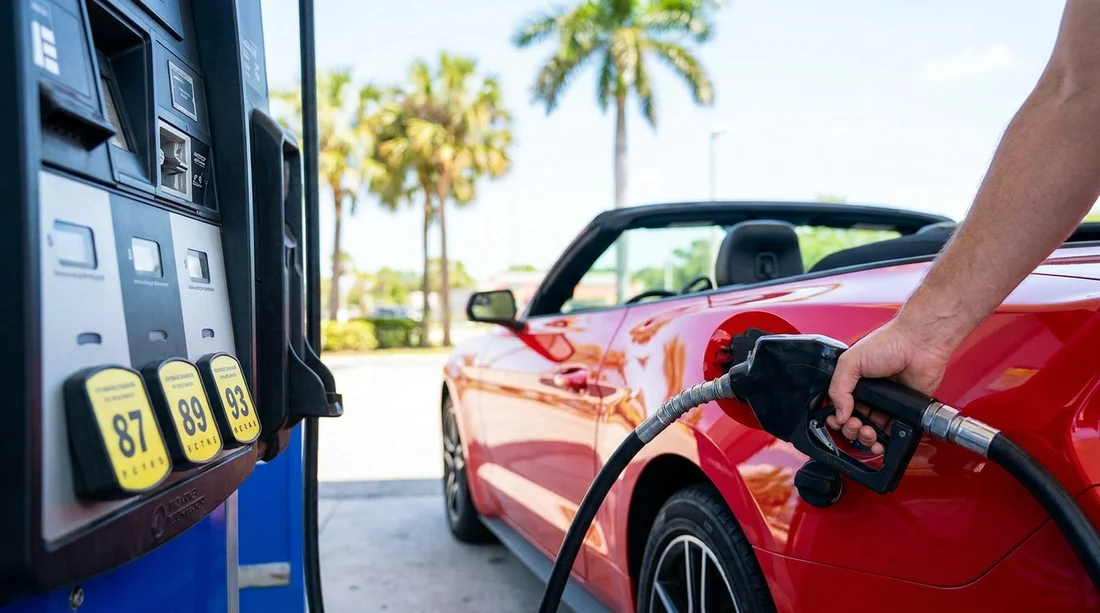
Petrol grades in the US can feel confusing if you are used to UK labelling, especially when you are sorting out car hire in Florida and want to refuel correctly. At most Florida forecourts you will see buttons marked 87, 89, and 91 or 93, commonly labelled Regular, Plus, and Premium. The key point is simple, choose the lowest octane that your rental car is designed to run on. Anything higher is usually wasted money, and it will not make the car faster or noticeably more economical.
Octane rating is a measure of a fuel’s resistance to knocking, which is uncontrolled combustion that can occur in some engines under load. Higher octane fuel can help prevent knock in engines built for it, such as turbocharged or high compression engines. However, an engine that is designed for regular fuel generally cannot take advantage of premium fuel, because the engine management is not asking for it. That is why choosing the correct grade matters, but overbuying rarely helps.
In Florida, most standard rental cars, think compact, saloon, and many midsize options, are built to run on 87 octane regular unleaded. If you are collecting near South Florida, you might compare options and pick-up points such as car rental Miami Beach for city driving, or car rental Fort Lauderdale for a wider range of routes. In both areas, the fuel advice is the same, match the car’s requirement, not the fanciest pump button.
What 87, 89, and 91 mean in the US
US petrol is labelled using the Anti Knock Index, often shown as (R+M)/2. This number is not directly the same as the Research Octane Number that many UK drivers are familiar with. So, it is best not to convert in your head or assume US 87 is equivalent to a UK “super unleaded” grade. Instead, treat 87, 89, and 91 or 93 as a straightforward ladder, higher number means higher knock resistance.
In practical terms, 87 Regular is the default grade for most everyday cars. 89 Plus sits in the middle and is less common as a requirement. 91 or 93 Premium is aimed at engines that specify premium fuel. Some stations in Florida offer 93 instead of 91, and either can count as premium depending on what is available.
What most rental cars in Florida actually require
For typical car hire in Florida, most vehicles will be fine on 87 octane. This covers the majority of economy models, standard family cars, and many crossovers. Rental fleets prioritise fuel compatibility and running costs, so they often select models designed for regular fuel.
Where you may see premium recommended or required is with certain upgraded models, performance trims, or particular SUVs. If you are hiring a larger vehicle, check the requirement carefully rather than guessing based on size. For instance, someone arranging an SUV rental in Miami might be offered several different models across brands, and the fuel requirement can vary between them. The only reliable answer is what the vehicle itself states.
Two phrases matter on the car’s sticker or manual. “Regular unleaded recommended” means 87 is fine, and premium might offer no meaningful benefit. “Premium required” means use 91 or 93 to avoid knocking and potential long term issues. If the car says premium is required, treat that as non negotiable.
How to check the correct grade quickly at pick-up
You do not need to read the full handbook. Look for the fuel label inside the fuel door, on the fuel filler cap, or on a sticker near the driver’s door jamb. Many cars state something like “Unleaded fuel only, 87 octane minimum”. If you see a minimum number, treat it as a minimum, not a target. So if it says 87 minimum, choose 87. If it says 91 minimum, choose premium.
If you are collecting in a busy location, such as near theme parks, it helps to check this before you leave the lot. Locations like Hertz car hire Disney Orlando typically have a steady flow of arrivals, and it is easier to confirm fuel requirements while you are still parked than at your first petrol stop.
How to read Florida petrol pump labels without confusion
At the pump, you will usually see three grade buttons. The grade name, Regular, Plus, Premium, can be more prominent than the octane number. Focus on the number. If your car needs 87, press the button that says 87 even if Premium sounds appealing.
Also check for ethanol content. Many Florida stations sell E10, which is petrol with up to 10 percent ethanol, and it is widely accepted for modern vehicles. Unless your rental car is clearly marked to avoid ethanol blends, E10 is normally fine. E15 is less common but exists, and it is not suitable for some vehicles. Most pumps display an “up to 10% ethanol” label, which is the usual, safe default for modern cars.
If you are paying inside, the cashier may ask “Regular?” to confirm. If your car takes 87, say yes. If you are unsure, check the fuel door and decide before answering.
Will premium fuel improve performance or mpg in a rental?
In a car that is designed for 87, premium generally will not improve fuel economy enough to offset the higher price, and you are unlikely to feel a performance difference in normal driving. Modern engines adjust ignition timing, but they cannot create extra compression or fundamentally different operating conditions just because you bought higher octane.
If premium is recommended but not required, you may see a small benefit in specific situations, such as sustained high load driving in hot weather. Even then, it is usually marginal. For most Florida driving, including motorway stretches between Miami, Fort Lauderdale, and Orlando, 87 in an 87 recommended car is the sensible choice.
Common scenarios where drivers overpay for fuel
The most frequent reason people buy premium unnecessarily is uncertainty at the pump. When you are tired after a flight, it is easy to think “premium must be safer”. Another common issue is mixing up octane with quality, assuming 91 is “cleaner”. In the US, all major brands must meet detergent standards, and many regular fuels are perfectly suitable for modern engines.
A third scenario is upgrading your car category and assuming it must take premium. Some larger engines do, but many do not. If you are picking up from a city location such as Alamo car rental Orlando, check the vehicle label rather than relying on category assumptions.
Tips to avoid extra charges when returning your car
Fuel grade and fuel level are separate issues. The rental agreement usually focuses on returning the car with the same fuel level, commonly full to full. To avoid extra charges, fill up close to the return location, keep the receipt, and make sure the pump shuts off cleanly when full.
Do not top up with a different octane just because it is the last fill. Mixing grades is usually not harmful, but if the car requires premium, adding regular right before return can be unhelpful for the next driver and may cause rough running. Likewise, if the car only needs regular, there is no advantage in “treating it” with premium at the end.
If you are ever unsure, take a quick photo of the fuel requirement sticker and the pump receipt. It is a simple record if questions arise.
FAQ
Do most car hire vehicles in Florida take regular 87 petrol? Yes, most standard rental cars are designed for 87 octane regular unleaded. Always confirm on the fuel door label for your specific vehicle.
What if my rental car says “premium recommended” rather than “required”? If it is recommended, you can usually use 87 without issues, though the car may produce slightly less power under heavy load. If it is required, use 91 or 93.
Is 93 octane the same as 91 octane in Florida? Both are premium grades, with 93 having higher knock resistance. If your car requires premium, either 91 or 93 is typically acceptable if it meets the minimum.
Will using premium fuel make my rental more fuel efficient? Not in a car that is designed for regular fuel. Any efficiency change is usually too small to justify the higher price per gallon.
Can I use E10 petrol in Florida rental cars? In most modern rental cars, yes. E10 is common in Florida and is generally compatible, but avoid higher ethanol blends unless the vehicle specifically allows them.






























































































