


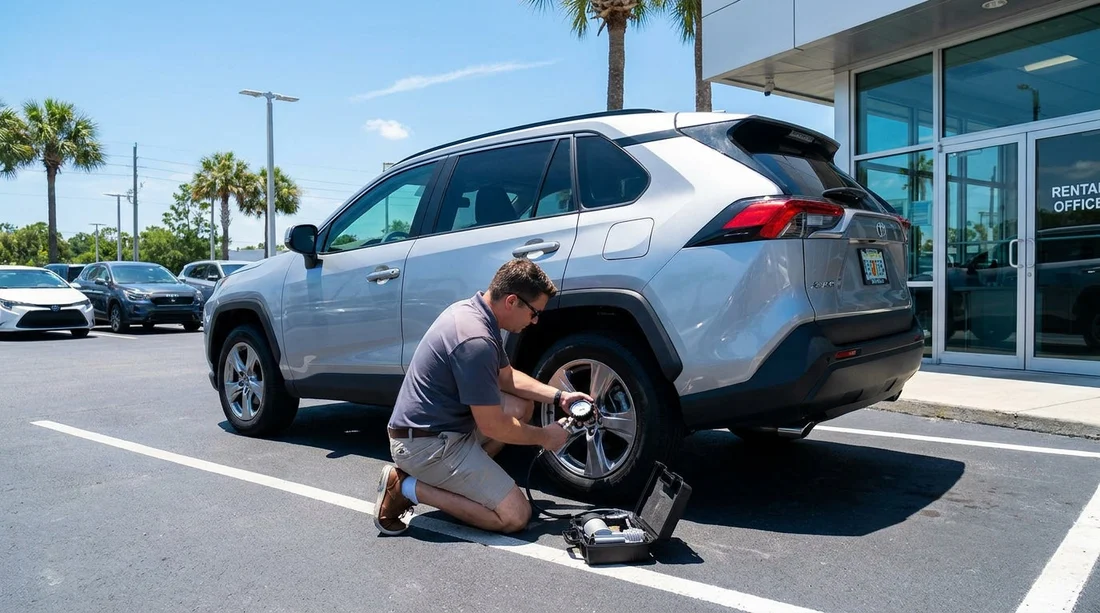
Quick Summary:
- Walk around and inspect each tyre for cuts, bulges, and debris.
- Check tread looks even across all tyres, with no bald edges.
- Start the car and confirm no tyre-pressure warning light stays on.
- Locate the spare or inflator kit and confirm tools are present.
In Florida, a lot of driving starts in a busy airport or hotel car park, often in heat and sudden rain. Tyres are the part of your car hire that you rely on most, yet they are easy to overlook when you are focused on luggage, sat nav, and exit signs. A two minute check before you leave can help you avoid a slow puncture on I 95, unexpected aquaplaning in a storm, or discovering too late that your vehicle has no spare wheel.
The aim is not to do a mechanic’s inspection. It is to spot obvious issues, confirm the warning systems look normal, and understand what support equipment you have if a tyre goes down. If you are collecting at Orlando or Miami, build this into your pickup routine, whether you arranged car hire at Orlando MCO or you are heading out after car rental in Miami.
1) Start with a slow walk-around, one tyre at a time
Stand back and look at the car from each corner. A tyre that is clearly lower than the others is your biggest red flag. You do not need a gauge to spot a tyre that is visibly underinflated, especially when the sidewall looks squashed where it meets the ground.
Then check each tyre face and sidewall:
Cuts, bulges, and cracks: Any bulge on the sidewall can indicate internal damage, often from a kerb impact. In Florida’s heat, a weakened tyre is more likely to fail. If you see a bulge, ask for a different vehicle.
Objects in the tread: Look for nails, screws, glass, or stones. If something is embedded, do not pull it out in the car park, it can turn a slow leak into a fast one. Flag it to the desk or attendant.
Scuffs and kerb rash: Light scuffing can be cosmetic, but heavy abrasion on the sidewall is more serious than a mark on the wheel rim. Sidewall damage is not repairable in most cases.
Valve stems and caps: Make sure each valve stem is straight and has a cap. Missing caps are common and not a disaster, but a damaged valve stem can leak. If you see one bent sharply, mention it immediately.
2) Check tread depth and uneven wear quickly
You are looking for confidence in wet conditions. Florida rain can arrive suddenly, and standing water can build fast on motorways. Even if the tyre has legal tread, uneven wear can reduce grip and make the car feel unstable.
Use these quick visual checks:
Look across the tyre: The tread should appear reasonably even from inner edge to outer edge. If one edge looks much smoother, it may indicate alignment issues or low pressure.
Compare tyres front to back: A big mismatch in tread depth across the set can affect handling and braking. Rental fleets rotate tyres, so they will not always match perfectly, but one almost bald tyre is not acceptable.
Look for wear bars: Most tyres have small raised bars in the grooves. If the tread is close to level with those bars, grip in heavy rain will be compromised. Ask to swap cars rather than hoping it will be fine.
If you are starting your trip from central Miami rather than the airport, the same approach applies when collecting from a city branch such as car hire downtown Miami. City driving can mean more kerb strikes and potholes, so the sidewall and tread check matters.
3) Pay attention to the tyre-pressure warning light (TPMS)
Most modern US rental cars have a tyre pressure monitoring system. When you turn the ignition on, a tyre symbol may light up briefly, then go out. That is normal. What you do not want is a warning that stays on or flashes.
If the TPMS light stays on: It may mean one tyre is low, or the system needs a reset after inflation. Either way, do not drive off assuming it will sort itself out. Ask the staff to check pressures or provide another car.
If the TPMS light flashes: This often indicates a system fault, not necessarily low pressure. A fault can stop the system warning you later if a tyre begins to leak. It is reasonable to request a different vehicle.
Also glance at any message on the dash that shows individual pressures. If one is significantly lower than the others, it suggests a leak or a tyre that was not set correctly after maintenance.
4) Confirm what puncture support you actually have
Many drivers still expect a full size spare wheel. In reality, a lot of car hire vehicles now come with a tyre inflator kit and sealant, or sometimes no spare at all. You want to know which situation you are in before you are on a Florida toll road with limited shoulder space.
Open the boot and look under the floor panel:
Spare wheel present: If there is a spare, check it is properly inflated by feel. A flat spare is surprisingly common. Also check you have a jack and wheel wrench, and that the locking wheel nut key is included if the car has locking nuts.
Space saver spare: This is a narrow temporary wheel. It is usually speed limited and not intended for long distances. If you find one, look for the speed limit label and any distance guidance so you can plan sensibly if you need it.
Inflator and sealant kit: Confirm both the compressor and the sealant bottle are present, and that the sealant is in date if visible. Some kits are designed only for small tread punctures, not sidewall damage. If the tyre is cut or has a bulge, the kit will not help, you would need roadside assistance.
If you are travelling with family and luggage, you might be using a larger vehicle option such as minivan rental in Miami. On bigger vehicles, confirm the jack and tools are rated and included, and that the spare is accessible without unloading the entire boot.
7) Document what you see, and report issues immediately
If you spot damage, photograph it clearly before leaving the bay, and make sure it is noted on the rental agreement or in the provider’s check out system. Take photos of each wheel and tyre, plus any warning lights on the dashboard. This is quick, and it can help avoid disputes later about whether damage was pre-existing.
For trips starting around Orlando, some travellers choose a recognised provider option such as Thrifty car hire at Orlando MCO. Regardless of provider, the key is the same: if anything looks questionable, raise it while you are still on site and the car can be swapped easily.
FAQ
Q: What is the fastest tyre check I can do in a Florida car park? A: Walk around the car, look for one tyre sitting lower, scan for sidewall bulges or cuts, then confirm the tyre-pressure warning light goes out after startup.
Q: If the tyre-pressure light is on, can I just add air later? A: It is better to resolve it before leaving. The light can indicate a puncture or a sensor issue, and a low tyre can overheat quickly on Florida highways.
Q: Do rental cars in Florida usually come with a spare wheel? A: Not always. Many now provide an inflator and sealant kit instead of a spare. Check under the boot floor and confirm you have the tools and instructions.
Q: What tyre damage means I should request a different car? A: Any sidewall bulge, deep cut, exposed cords, or a tyre that looks significantly underinflated. Also request help if the TPMS light stays on or flashes.
Q: How can I tell if tread is too low for heavy rain? A: If the tread looks close to the wear bars, or the grooves appear shallow across large areas, wet grip will be reduced. Ask to change vehicles before you set off.






























































































