


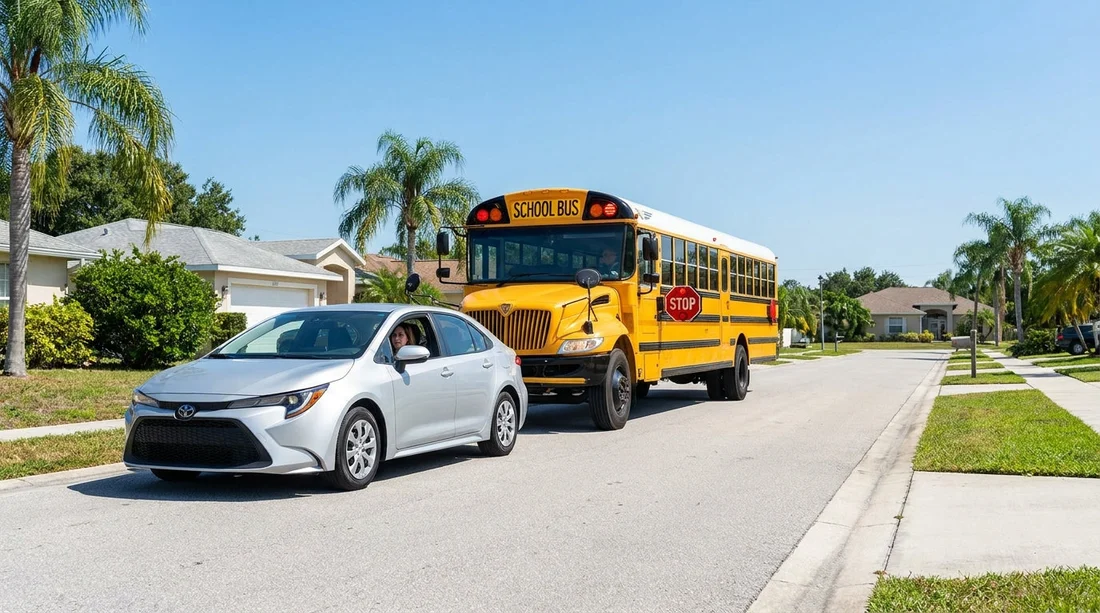
Quick Summary:
- Stop for any bus showing red lights with an extended stop arm.
- On undivided roads, both directions must stop behind the bus.
- On divided highways with a physical median, opposite traffic usually continues.
- Wait until lights stop, arm retracts, and children clear the roadway.
If you are visiting Florida from the UK, driving a US rental car can feel familiar at first, roads are wide, signage is clear, and automatics are common. The surprise comes from school-bus rules. In many parts of the US, school buses have special legal protection, and drivers are expected to stop in situations that would not require stopping at home. Misjudging it in Florida can lead to a serious fine, points, and in some cases a criminal charge if children are put at risk.
This guide explains what Florida’s school-bus stop laws mean in practice, how to spot the key signals, and how to handle common road layouts you will meet on holiday. It is written for UK travellers arranging car hire and planning to drive around Orlando, Miami, Fort Lauderdale, and beyond.
Why Florida takes school-bus stopping so seriously
Florida school buses load and unload children directly from the carriageway in many neighbourhoods. The law is designed to create a protected space around the bus, because children can cross unexpectedly or step into traffic from between parked cars. From a visitor’s perspective, the key point is this, when the bus is in stop mode you are expected to treat it like a moving red signal with strong enforcement.
Unlike many UK situations where a stopped bus is mainly a courtesy slow-down, in Florida you are legally required to stop in many cases, even if you are travelling in the opposite direction on the same road.
Know the signals, amber, red, and the stop arm
Florida school buses use a sequence of lights to warn drivers. Amber flashing lights typically mean the bus is preparing to stop. This is your cue to slow down, cover the brake, and be ready to stop. Red flashing lights mean the bus has stopped to load or unload, and the stop arm will usually swing out on the driver’s side of the bus with the word STOP.
As a car hire driver, treat the extended stop arm and red lights as the definitive instruction, stop and stay stopped. Children may be crossing in front of the bus where you cannot see them. Do not edge forward to get a look, because you may be moving into the crossing path.
When you must stop, the simple rule, and the big exception
The simplest way to remember Florida’s rule is, if you are on the same road as the bus and there is no physical median separating directions, both directions must stop for red lights and the stop arm. That includes when you are behind the bus and when you are approaching from the opposite direction.
The main exception is a divided highway where the opposing lanes are separated by a raised median, unpaved median, or other physical barrier. On that kind of road, vehicles travelling in the opposite direction usually do not have to stop. However, vehicles travelling behind the bus in the same direction must still stop.
Because road design varies, focus on whether there is a real median or barrier. A centre turn lane or painted double yellow lines do not count as a dividing median for this purpose. If in doubt, stop.
How far back should you stop?
Florida expects you to stop a safe distance from the bus, so you are not crowding it or blocking children’s space. In practice, stop well behind the bus, remain in your lane, and do not attempt to pass on the shoulder.
If you are approaching from the opposite direction on an undivided road, stop before you reach the bus, and do not proceed until it is clearly safe and legal to do so.
When can you move again?
You can move when the bus driver turns off the red flashing lights and retracts the stop arm, and the children have cleared the roadway. Do not rely on a child’s wave or a driver behind you honking. The bus may pause briefly even after some children have boarded, and a late runner can appear.
Also note that buses can stop at railway crossings and some intersections without using the red school-bus lights. In those cases, you follow normal traffic rules and do not pass unless it is safe and legal, but the mandatory everyone stops rule is tied to the red lights and stop arm.
Common Florida scenarios UK drivers often misread
Two-lane residential road. This is the most common trap for visitors. If there is one lane each way with no median, you stop in both directions when the bus displays red lights.
Multi-lane road with a centre turning lane. Even if it feels like a larger road, a centre lane is not a median. If the bus is stopped with red lights on your side or the opposite side, you must stop unless a physical median separates directions.
Divided boulevard with a raised or grass median. If you are on the opposite side of a proper median, you usually continue, but slow and stay alert. If you are behind the bus on the same side, you stop.
Right turn at a junction near the bus. If the bus is stopped with red lights and you would pass it while turning, you still must stop. Wait until the stop arm retracts, then complete your turn when safe.
Penalties, enforcement, and why rental drivers should be careful
Passing a stopped school bus in Florida can be expensive. Fines are substantial and can increase depending on circumstances. Beyond money, it can add points to a licence, and if you are driving as a visitor the situation is stressful to resolve from abroad. Some areas also use camera enforcement on buses, which can capture number plates and trigger a citation.
With car hire, any ticket or toll-related notice may be routed through the rental company, and administrative fees can apply.
Practical driving tips for Florida car hire routes
Many visitors collect vehicles at major hubs and drive straight into busy roads. If you are picking up near Orlando International, you will likely meet school zones and bus routes within minutes of leaving suburban areas. When comparing options for car hire at Orlando MCO, factor in a calmer first drive time, such as outside school start and finish times.
In South Florida, complex multi-lane roads can make it harder to judge whether a median is physical. This is relevant whether you choose downtown Miami car rental pickup or base yourself around Brickell with SUV hire in Brickell.
If your trip starts at the airport and you are heading north to the beaches, note that Fort Lauderdale has a mix of divided and undivided roads. It can help to familiarise yourself with the pick-up area before setting off from Fort Lauderdale FLL car rental.
FAQ
Do I have to stop for a school bus on the other side of the road in Florida?
Yes, if the road is undivided and the bus has red flashing lights and an extended stop arm. If there is a physical median or barrier, opposite-direction traffic usually does not stop.
What if there is a centre turning lane between directions?
A painted centre turning lane is not a median for school-bus stopping. Treat it as an undivided road and stop for the bus’s red lights and stop arm.
Can I pass a school bus showing amber flashing lights?
Amber means the bus is preparing to stop. You should slow down and be ready to stop, because it may switch to red at any moment. Passing at this point is risky and can lead to an unsafe overtake.
How do I know when it is legal to move again?
Wait until the red lights stop flashing, the stop arm retracts, and children have cleared the roadway. Do not move simply because other drivers start rolling.
Are school-bus violations handled differently when driving a rental car?
The legal duty is the same, but citations may be sent via the rental company, sometimes with administrative fees. The safest approach is to treat every red-light stop as non-negotiable.






























































































