


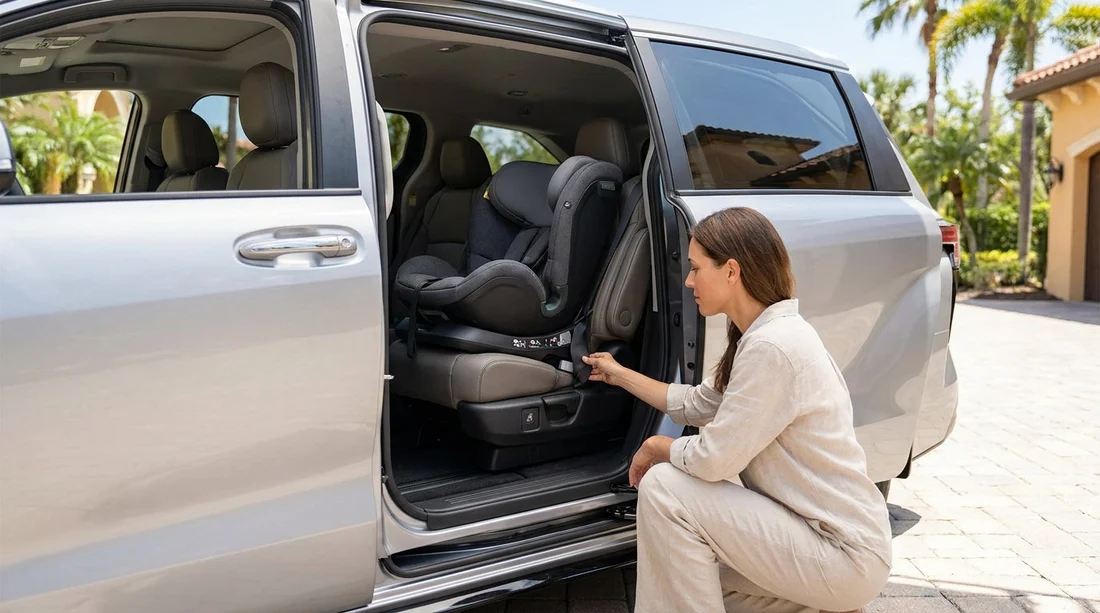
Quick Summary:
- A UK ECE-marked seat is not automatically certified for US use.
- Look for the FMVSS 213 compliance statement label on your seat.
- Match Florida restraint rules to your child’s age and size.
- Test a secure install with belts or LATCH before driving.
If you are travelling from the UK and arranging car hire in Florida, it is natural to assume your child seat is fine everywhere, especially if it is in-date and in good condition. In practice, US rules focus on different approval labels than the UK and Europe, and that is the key point to understand before deciding whether to bring your own seat or use a supplied option.
This guide explains how US and UK child-seat approvals differ, what labels to look for, and how to judge compatibility with a typical US rental car. It is written for families collecting a car in Florida, including busy arrival points such as Orlando Airport (MCO) or the Miami area served by Miami Beach locations.
Is a UK child seat “legal” in the US?
In the UK, child seats are approved under UN ECE standards (such as ECE R44/04) or the newer UN R129 (i-Size). You will typically see an orange ECE label (often with an “E” in a circle) or an i-Size marking. In the US, child restraints are certified to a federal standard called FMVSS 213.
Because the certification systems are different, a UK seat that is perfectly legal in Britain is not automatically certified for US use. Some US states are strict about requiring a seat that meets FMVSS 213, and Florida’s laws require appropriate child restraints. Practically, enforcement varies, but if you want to minimise risk, you should assume that a UK-only ECE label does not equal US certification.
US vs UK approval labels: what to look for
The fastest way to decide whether a seat is US-approved is to find the label on the seat shell. You are looking for a US compliance label that states the restraint conforms to all applicable Federal Motor Vehicle Safety Standards. It usually references FMVSS 213 explicitly, and may include manufacturer details and a date of manufacture.
By contrast, a UK or EU seat generally shows an orange approval label with ECE R44/04 or UN R129 information, plus weight or height ranges, and an approval number. An i-Size seat may show the i-Size logo and height limits.
Florida child restraint basics you should check
Florida law requires children to be restrained appropriately, and the type of restraint depends on age. Many families also follow best practice guidance based on height and weight, because children can outgrow one stage earlier than expected on a long holiday.
Before you fly, check that your planned restraint matches the child’s age and size, and that you can install it properly in a US vehicle. In day-to-day terms, that means knowing whether you need a rear-facing seat, forward-facing harness seat, or booster, and whether your child can safely use the vehicle belt without a booster.
Even if you bring a seat from the UK, Florida rules still apply regarding using a suitable restraint. So the decision is not only about approval labels, it is also about choosing the correct stage for your child and being able to fit it securely in the rental car you collect, whether that is a compact in Miami or a larger vehicle such as an SUV in Fort Lauderdale.
Will a UK seat fit a US rental car?
Compatibility is the second big issue after labels. US cars have seat belts and a lower-anchor system called LATCH (Lower Anchors and Tethers for Children). In the UK you may be more familiar with ISOFIX. LATCH and ISOFIX are related concepts, but the hardware, spacing assumptions, and top tether arrangements can differ by market and vehicle.
1) Installation method. If your UK seat installs with the vehicle belt, confirm that it can be installed tightly with a US belt. US belts may lock differently, and some require switching the retractor into a locking mode. Practise before your trip, and be prepared to use a locking clip if your seat requires it and allows it.
2) Top tether requirements. Many forward-facing seats require a top tether for best performance, and sometimes for compliance. Check whether your seat expects a tether, and whether the US rental car has a reachable tether anchor in the correct position. In many US vehicles, tether anchors are on the rear shelf, seat back, or boot area, and can be less obvious.
3) Booster fit and belt geometry. A booster that works well in your UK car can behave differently in a US model if the shoulder belt sits too close to the neck or fails to retract smoothly. Confirm the shoulder belt fits across the centre of the shoulder and chest, and that the lap belt sits low on the hips.
4) Width and rear-seat layout. Some UK seats are bulky. If you plan to fit multiple seats, check the rear-seat width of your expected vehicle category. This can be especially relevant in busy urban collections such as downtown Miami, where you may be offered a similar model within the same class rather than the exact car you pictured.
Common misconceptions worth avoiding
“ISOFIX and LATCH are identical.” They are similar ideas, but details matter, including where anchors are and how tethers are routed. Check your seat’s instructions and the car’s anchor locations.
“If it is legal in the UK, it must be legal in Florida.” The safety intention is similar, but the approval system is different. Labels are the deciding factor for certification.
“Any booster is fine once a child is older.” Booster suitability depends heavily on belt fit. A poor belt fit is a safety problem even if the child meets a minimum age.
“A quick install is good enough for a short drive.” Most holiday driving includes unfamiliar junctions and high-speed roads. Taking time to install correctly is part of travelling safely.
If you are collecting near Disney and planning lots of short trips, convenience may weigh more heavily than it would for a one-off airport transfer. Travellers arranging car hire around Disney in Orlando often find that planning the seat setup in advance helps the first day go smoothly.
FAQ
Can I use a UK i-Size (R129) seat in a US rental car in Florida? A UK i-Size label indicates UN R129 approval, not US FMVSS 213 certification. Unless the seat also carries the US compliance label, it is not certified to the US standard, even if it can be installed securely.
Where exactly is the US FMVSS 213 label on a child seat? It is usually a sticker on the side or back of the plastic shell, sometimes underneath fabric. Look for wording that the restraint conforms to all applicable Federal Motor Vehicle Safety Standards, often referencing FMVSS 213.
If my seat only has a UK ECE label, will I definitely get fined in Florida? Not necessarily, enforcement varies and roadside checks are unpredictable. However, relying on a non-US-certified seat can create avoidable uncertainty, so it is worth checking certification and considering alternatives.
Will my UK seat belt installation work with US seat belts? Often yes, but you must confirm you can achieve a tight install with the US belt’s locking method. Some US belts lock at the retractor, and you may need to switch to locking mode for a secure fit.
Should I choose a bigger rental car for easier child seat fitting? A larger car can make it easier to achieve correct belt routing, tether access, and comfortable seating positions, especially with multiple children. It is still essential to install according to the seat manual and the vehicle’s anchor points.






























































































