


Quick Summary:
- Toll-by-plate uses cameras to match plates, no cash or E‑ZPass needed.
- Your car hire company is billed, then recharges you plus admin fees.
- Charges can arrive weeks later, keep your agreement and travel dates.
- At pick-up, confirm toll programme, fee caps, and dispute process.
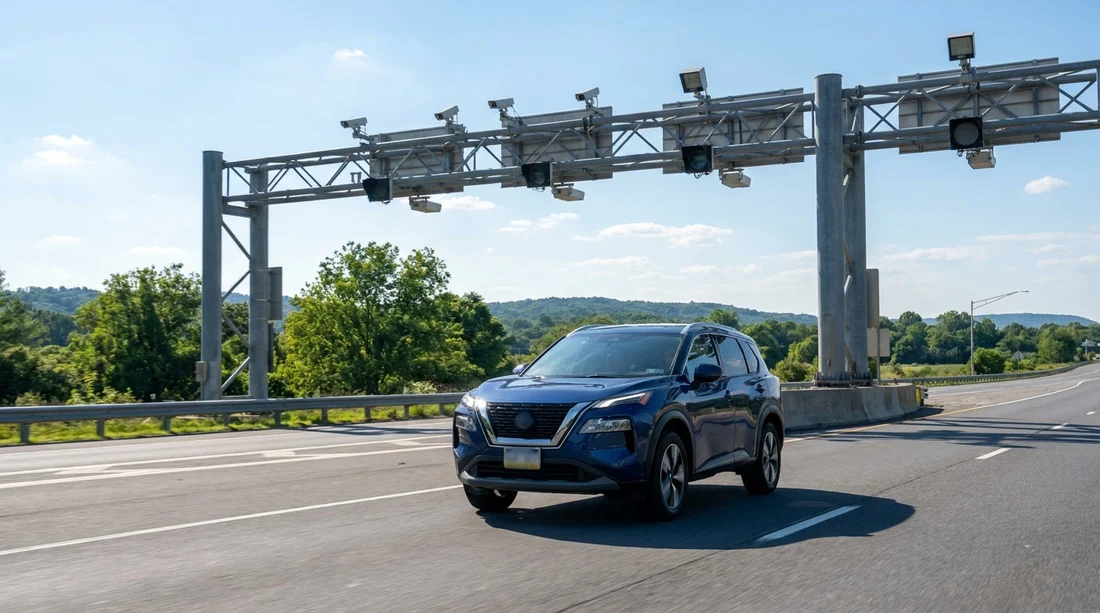
In Pennsylvania, many major toll facilities no longer require you to stop and pay cash. Instead, they use gantries with cameras and sensors to identify the vehicle and bill the trip electronically. If you are driving a car hire vehicle without an E‑ZPass transponder, you are typically using toll-by-plate, sometimes also described as video tolling or toll-by-plate invoicing. The key point is that the bill follows the vehicle’s registration, not the driver, and that is where rental billing can feel confusing.
This guide explains how toll-by-plate works in practice on hire cars in Pennsylvania, how rental companies usually recharge the tolls, what admin fees are common, and what to check at the counter so you do not get unexpected post-trip charges.
What “toll-by-plate” means on Pennsylvania roads
Toll-by-plate is a system where cameras photograph the number plate as you pass under toll points. The toll operator, such as the Pennsylvania Turnpike Commission, uses the plate data to identify the registered owner and issues a bill. On a privately owned car, that bill goes to the address on the vehicle registration. On a car hire vehicle, the registered owner is the rental company, so the initial invoice usually goes to them.
In Pennsylvania, tolling may occur on the Pennsylvania Turnpike (I‑76 and related extensions) and on certain bridges or tunnels depending on your route. Some locations are fully electronic, meaning there is no cash lane at all. Even where toll booths exist, you can still be captured by cameras and billed later if you pass through without paying in an attended lane.
How toll-by-plate gets billed on a car hire
The typical billing chain has four steps. First, you drive through a toll point and the camera captures the plate. Second, the toll operator creates a toll record and invoices the registered owner, which is the car hire company. Third, the rental company matches that toll record to your rental agreement, using the dates and times you had the vehicle. Fourth, the rental company charges your payment method for the toll amount plus any associated administrative fees under the terms you accepted at pick-up.
This is why tolls can appear after you return the vehicle. The toll operator’s invoice processing and the rental firm’s matching process are not instant. It is normal to see toll charges post to your card days or even weeks after the trip, especially if there are multiple journeys or if plate images need manual review.
If you are arranging a vehicle in the Philadelphia area, Hola Car Rentals listings such as car rental at Philadelphia Airport (PHL) and car rental in Philadelphia are useful starting points for comparing providers, then you can focus your questions on toll programmes and fee structures at the counter.
Admin fees, service fees, and “toll programmes” explained
On a car hire, you are rarely charged only the toll itself. Most rental companies add a service charge for handling the toll transaction, because they receive the invoice, identify the renter, and process the payment. The name varies by company, but it is often described as an administrative fee, convenience fee, toll processing fee, or a daily toll programme fee.
There are two common models.
1) Pay-per-use plus admin fee: You pay the tolls you incur, and a fixed admin fee is added for each toll event or each day you used toll roads. Some companies cap the maximum admin fees per rental, while others cap per day. This model can be cost-effective if you use toll roads rarely, but it can add up if you pass through many toll points in one day.
2) Optional toll pass programme: Some rental companies offer an optional programme where you pay a daily fee to use their transponder or toll service, and then you still pay the tolls themselves. The advantage is that you may be billed at the lower transponder rate where applicable, and your tolls may post more quickly and cleanly. The disadvantage is that a daily fee can exceed the savings if you only expect a small number of tolls.
When comparing offers, focus on three details: whether fees are charged per toll or per day, whether there is a cap, and whether the programme activates automatically when you use a toll road. If you are selecting a supplier through Hola Car Rentals, pages like car hire in Philadelphia can help you compare options, then you can confirm the exact fee rules in the rental agreement you sign.
What to confirm at pick-up, before you drive
Most toll disputes come from misunderstandings at pick-up. Take two minutes at the counter and ask direct questions, then check the answers against the paperwork.
Ask which toll system applies: Is the vehicle equipped with a transponder, and will it be active for your rental? If there is no transponder, confirm you will be billed via toll-by-plate and how that will be passed on to you.
Ask how the admin fees are calculated: Confirm whether the fee is per toll, per day of toll usage, or per rental, and whether there is a cap. Also confirm whether there is an extra fee if the toll operator charges the rental company a penalty due to late payment.
Ask when you will be charged: Some companies charge shortly after they receive toll data, others post charges in batches. Knowing the timeline helps you spot legitimate charges and reduces the chance you cancel a card that is still needed for post-rental items.
Ask about disputes: If a toll charge looks wrong, you want a clear route for getting the transaction details, including date, time, toll location, and plate reference. Confirm whether the rental company can provide an image or a transaction record from their toll provider.
If you are choosing among providers, seeing what is available through supplier-specific pages can help you prepare questions. For instance, Budget car hire Philadelphia and Alamo car rental Philadelphia listings can guide you to review each supplier’s terms closely, since toll and admin fees vary across companies.
How to avoid unexpected toll-by-plate costs
You cannot always avoid toll roads in Pennsylvania, but you can reduce surprises.
Plan your route with toll awareness: Navigation apps can usually avoid tolls, but the detours may add significant time. Decide in advance whether the time saved is worth the tolls and associated processing fees on a hire car.
Keep your rental agreement and receipts: Save the agreement number, pick-up and drop-off times, and the vehicle plate details if provided. If a toll appears outside your rental period, those details make it easier to challenge.
Use the same payment card throughout: If you change cards or cancel a card soon after travel, toll charges may fail and trigger collection processes. Keeping the card active for a few weeks after returning the car reduces hassle.
Understand that toll-by-plate can cost more: Some toll roads price toll-by-plate higher than transponder rates. On a car hire without a transponder, you could pay the higher rate plus admin fees. If you expect heavy toll usage, ask whether a transponder-based option is available and how the daily fee compares with likely toll spend.
FAQ
Q: Will I receive a paper bill in the post for toll-by-plate on a hire car?
A: Usually not. The toll authority bills the car hire company, then the rental company charges your payment method on file.
Q: How long after my trip can Pennsylvania toll charges appear?
A: It varies, but it is common for charges to appear days or weeks later, depending on toll processing and the rental company’s batching.
Q: Are admin fees avoidable if I do not have E‑ZPass?
A: Not always. Many rental companies apply a processing or programme fee whenever tolls are incurred, even on toll-by-plate.
Q: If I avoid toll roads in Pennsylvania, can I still be charged?
A: You should not be, but mistakes happen. Keep your rental dates and ask for toll record details if a charge appears unexpectedly.
Q: Can I use my own E‑ZPass in a rental car?
A: Often yes, but you must follow both your E‑ZPass rules and the rental company’s policy, and ensure the rental car is added correctly to avoid double billing.






























































































