Quick Summary:
- Set seat distance so your knees stay bent when braking firmly.
- Adjust seat height for clear view, headroom, and full pedal control.
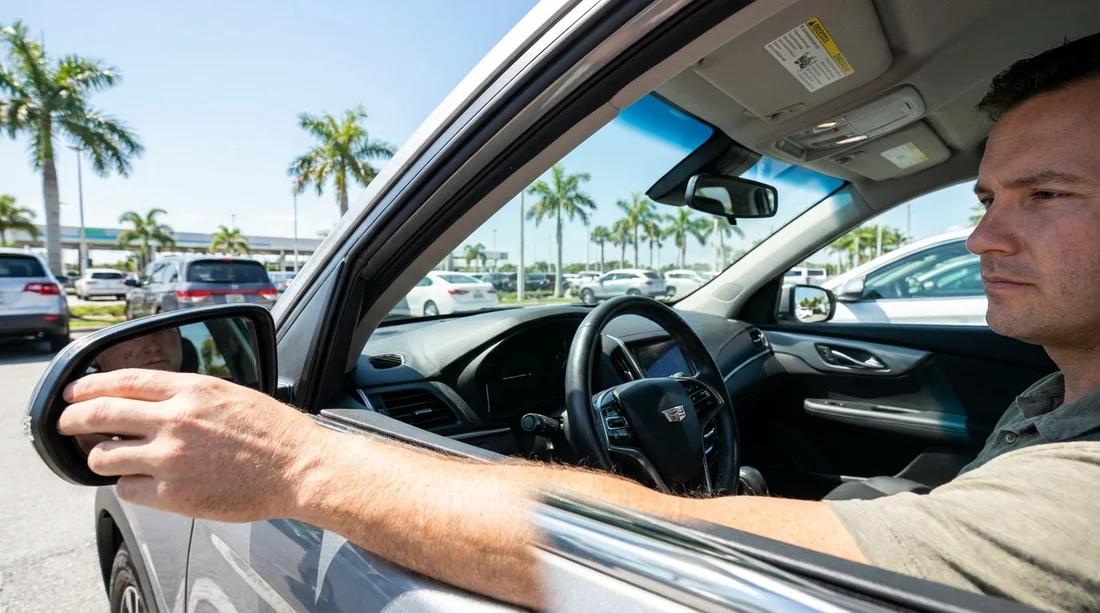
- Angle door mirrors outward to reduce overlap and shrink blind spots.
- Practise mirror, signal, shoulder check at walking pace before exiting.
Picking up car hire in Florida as a UK driver can feel unfamiliar for the first few minutes, not because the roads are difficult, but because your seating position and mirror habits were built around driving on the left. Before you leave the rental lot, take five calm minutes to set your seat, steering wheel and mirrors for left-hand drive. You are aiming for three outcomes, comfort, full vehicle control, and the smallest possible blind spots.
If you are collecting at a busy hub like Orlando Airport (MCO) or heading straight into city traffic from downtown Miami, these adjustments matter even more. You will make better lane choices, you will spot faster-moving traffic earlier, and you will feel less mentally overloaded.
1) Park first, then set your driving position
Do all adjustments while stationary, in Park, with the parking brake applied if available. In Florida, the first hazard after pickup is often not the motorway, it is the rental exit, pedestrians, and tightly spaced lanes. Your body position should let you steer smoothly with shoulders relaxed and elbows slightly bent.
Start by sliding the seat forward or back. With your back against the seat, press the brake pedal firmly with your right foot. Your knee should remain slightly bent at full pressure, not locked straight. This gives better control in sudden stops and avoids stretching, which can reduce braking force.
Next, set seat height. You want a clear view of the road ahead and the instrument cluster, but also enough headroom so you are not hunched. A simple check, you should be able to see the front edges of the bonnet area and judge your position in the lane without lifting your body off the seat. If the car has a tilt function at the front of the seat base, set it so your thighs are supported without cutting off circulation behind the knees.
Then set seatback angle. Too upright makes steering jerky and tiring, too reclined makes your arms overreach and weakens your ability to turn the wheel quickly. Aim for a comfortable upright position where your shoulder blades remain in contact with the seat during normal steering.
2) Adjust steering wheel reach and height
Many Florida car hire vehicles have a steering wheel that adjusts for reach and height. Unlock the lever, then bring the wheel towards you until you can place your wrists on the top of the steering wheel rim while keeping your arms straight. When you then grip the wheel at roughly the 9 and 3 o’clock positions, your elbows should be slightly bent. This helps you steer precisely without lifting your shoulders.
Set the wheel height so the airbag area is pointing towards your chest, not your face, and so you can see all key dials and warning lights. Make sure the wheel does not block your view of indicators or wiper controls, which can feel reversed when you first swap sides.
3) Head restraint, seat belt, and pedal check
Set the head restraint so the centre of the restraint aligns with the back of your head, not your neck. The gap between your head and the restraint should be small. This reduces whiplash risk in a rear-end impact.
Fasten the seat belt and make sure it sits across the shoulder and chest without rubbing your neck. If the vehicle has belt height adjustment, lower it slightly if it cuts into the side of your neck, raise it if it rides off your shoulder.
Before you move, do a quick pedal rehearsal. With the engine on, foot on the brake, shift through the gears to confirm where Reverse and Drive sit. In an automatic, keep your left foot relaxed and away from the pedals. Many UK drivers’ first mistake in the US is instinctively braking with the left foot, which can cause a harsh stop.
4) Rear-view mirror first, then door mirrors
Set mirrors in a deliberate order so they work together rather than duplicating the same view. Start with the interior rear-view mirror. Adjust it to frame the entire rear window with minimal head movement. You should not need to duck or lean to see vehicles behind you.
Next, set the left door mirror. Lean your head slightly towards the driver window, then adjust the mirror outward until you can just barely see the side of your own car at the inner edge. Return to normal seating position. This method reduces overlap with the rear-view mirror and pushes your coverage into the next lane.
Now set the right door mirror. Lean your head towards the centre of the car, then adjust the mirror outward until you can just see the side of the car. Again, return to normal seating. The goal is to cover what the rear-view mirror cannot, especially important on multi-lane Florida highways.
If your car hire vehicle has blind-spot monitoring, treat it as backup, not as a substitute for correct mirror angles and shoulder checks.
5) Blind-spot routine that works for left-hand drive
In the UK, you may be used to judging the right side differently because your seating position is closer to the kerb. In Florida, your lane position will feel shifted, and your biggest initial risk is the lane to your left, where faster traffic may undertake or where you may drift while you settle in.
Use a consistent routine every time you change lanes, mirror, signal, mirror again, shoulder check, then move smoothly. Your shoulder check should be quick and targeted. For a left lane change, glance over your left shoulder to confirm the area your left door mirror cannot show. For a right lane change, do the same over your right shoulder.
Before leaving the rental facility, practise this at walking pace in a quiet part of the car park. Keep both hands on the wheel, use gentle steering inputs, and check that your mirrors show vehicles transitioning from rear-view mirror to door mirror without disappearing for long.
6) Quick control scan for indicators, wipers, and lights
Left-hand drive cars often place the indicator stalk on the left side of the steering column, which can lead UK drivers to accidentally trigger the wipers when trying to signal. Before you drive off, locate indicators, wipers, headlights, and the hazard light switch.
If you are planning longer drives across the state, it can help to familiarise yourself with the vehicle category you have, for example a standard car from Florida car rental options in Miami may feel different to a larger people carrier.
7) Final pre-departure checklist at the exit barrier
Just before you leave the rental area, do one last posture and mirror confirmation. Can you press brake firmly without stretching? Can you rest your right heel and modulate speed smoothly? Are you sitting far enough back that your elbows are bent, but close enough to steer without leaning forward?
If you need extra space for passengers, consider how mirror settings might change in a wider vehicle, such as those discussed on van rental in Miami Beach. Whatever you drive, correct adjustment makes the car feel smaller and more predictable.
Finally, remember your lane positioning. You sit on the left side of the car, so you should align yourself with the left lane line rather than trying to centre the bonnet. A helpful mental cue, keep your body closer to the centre line of the road than you are used to in the UK, while still staying fully within your lane.
FAQ
How far should I sit from the steering wheel in a left-hand drive rental? Sit so you can rest your wrists on the top of the wheel with straight arms, and grip at 9 and 3 with elbows slightly bent. Keep enough distance that the airbag can deploy safely.
Should my door mirrors show the side of the car? Only a small sliver at the inner edge. If you can see lots of your own car, the mirrors are usually too far inward and you are increasing blind spots.
What is the safest way to check blind spots when changing lanes in Florida? Use mirror, signal, mirror again, then a quick shoulder check towards the lane you are entering. Do the move smoothly without drifting, and avoid lingering alongside other vehicles.
Why do I keep hitting the wipers instead of indicating? Many left-hand drive cars place the indicator stalk on the left. Take a moment in Park to practise signalling left and right, and build the habit before you reach busy junctions.
Do I need to adjust mirrors differently if the car has blind-spot monitoring? No, set mirrors correctly first, then treat alerts as extra information. Good mirror angles reduce reliance on sensors and help you judge closing speeds.