


Quick Summary:
- Check both mirrors for BSM icons and indicator windows before starting.
- Turn ignition on and confirm both mirror lights briefly self-test.
- Open driver-assist settings and ensure Blind Spot Monitor is enabled.
- Do a slow on-lot pass and watch for mirror warnings.
When you pick up a car hire in California, the vehicle class on your booking rarely guarantees the exact driver-assist package on the specific car you are handed. Blind-spot monitoring (BSM) is common, but it is not universal, and it may be disabled or configured differently between trims and model years. The fastest way to avoid surprises is to run a repeatable counter check, then a two-minute walkaround, then a quick on-lot confirmation before you merge onto busy freeways.
This guide focuses on verifying the feature on the actual vehicle, not on the listing. It also helps you distinguish between true BSM (rear radar sensing with mirror indicators) and lookalike systems such as lane-departure warning or camera side views that only appear when you indicate. If you are collecting at a busy hub like Los Angeles LAX, doing these checks before you leave the lot can save a return trip through terminal traffic.
Know what you are looking for: BSM vs similar features
Blind-spot monitoring typically uses radar sensors mounted behind the rear bumper corners. When a vehicle sits in your blind spot, a small warning light illuminates in or near the side mirror. If you signal toward that side while a vehicle is detected, most systems add a stronger warning, such as a brighter flash, a chime, or steering resistance.
Do not confuse BSM with lane-departure warning, lane-keeping assist, rear cross-traffic alert, or camera side view. Those systems can be useful, but they do not always detect vehicles beside you in the same way.
Counter check: confirm what is supposed to be on the keys you receive
Before you walk to the car, take 30 seconds at the counter. Ask whether the specific vehicle on your contract includes blind-spot monitoring and whether it is standard on that model and trim. If the agent can see the VIN-linked equipment list, ask them to confirm BSM is listed. This is especially useful when you are picking up from locations with mixed fleets, for example Sacramento SMF where the same intermediate class can include multiple makes.
Walkaround checklist: hardware and cabin clues in two minutes
Once you reach the vehicle, do not start loading bags yet. First, confirm you are at the correct car, then run this quick visual checklist.
1) Side mirrors: look for icons or indicator windows
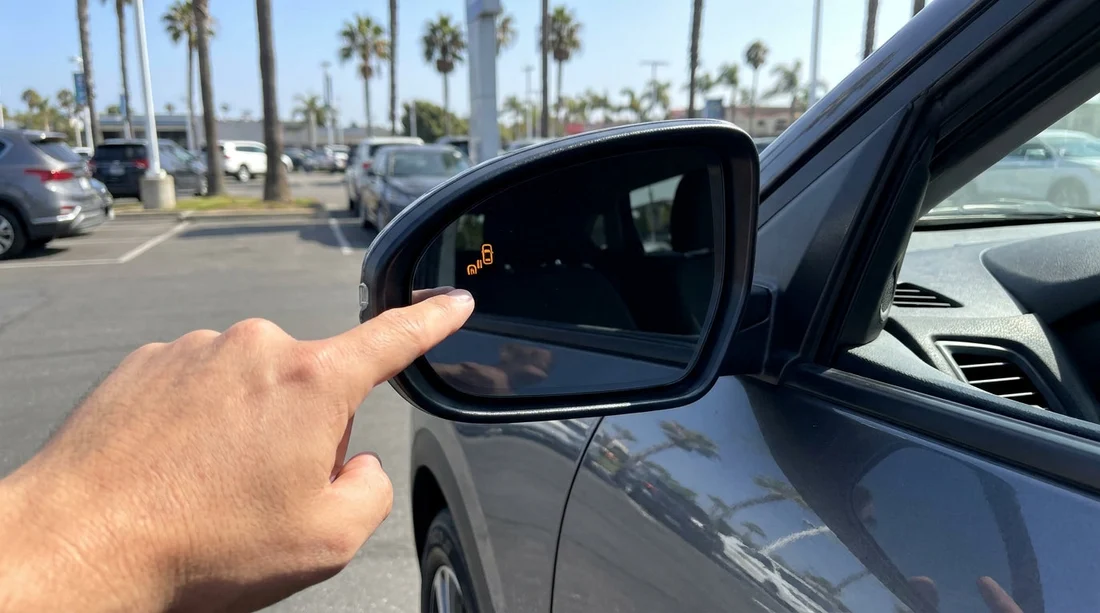
Most BSM-equipped cars have a small etched icon, a tiny translucent window, or a marked area in each mirror where the warning light illuminates. If the mirrors have no visible indicator area at all, true BSM is less likely. Some designs place the light on the mirror housing rather than in the glass, so look carefully from the driver’s door.
2) Start-up self-test: the most reliable quick clue
With the car in Park and your foot on the brake, turn the ignition on. Many BSM mirror indicators briefly illuminate as part of the bulb check. If both sides light momentarily, that is a strong sign the car has the system and the indicator lights are functioning.
Menu verification: confirm it is enabled and not restricted
Even if the car has BSM hardware, it can be turned off in software if a previous driver changed settings. Use the infotainment screen or driver display to find the driver-assist menu, then look for entries such as Blind Spot Monitor, Blind Spot Alert, Side Assist, or Blind Spot Warning. Confirm the option exists, it is enabled, and it is not greyed out with a warning.
If you are collecting in Southern California and expect lots of lane changes, it is worth doing this properly before leaving the garage at Dollar at California LAX, because pulling over to fix settings in airport traffic is stressful and sometimes unsafe.
On-lot confirmation: a safe, quick functional test
After the walkaround and menu check, do a short functional test in a low-speed area of the lot. Keep it safe and legal, and do not rely on the system to prevent a collision. You are simply confirming that the indicators respond.
Step 1: set mirrors correctly
Adjust your mirrors to minimise blind spots, because BSM is a supplement, not a substitute.
Step 2: watch for the steady mirror light
When a vehicle is alongside and slightly behind, the mirror indicator on that side should illuminate steadily. If it does not, the system may be off, unavailable at that speed, or not equipped.
What to do if the car does not have BSM
If blind-spot monitoring is important for your trip, return to the booth before you exit the facility and ask whether an alternative vehicle with BSM is available within your category. Be ready to explain what you checked: no mirror indicators, no menu option, and no start-up self-test.
Fleet availability varies by day and location. A larger pickup point, such as San Jose SJC, may have more model variety, while smaller sites may have fewer swaps possible. If you are considering a larger vehicle, remember that vans and people carriers can have different trim mixes, so you still need to verify the exact vehicle. For instance, feature packages can differ between a standard car and a minivan hire at Los Angeles LAX.
FAQ
How can I tell in ten seconds if a rental car has blind-spot monitoring?
Look for a small warning light area on both side mirrors, then turn the ignition on and watch for a brief self-test illumination.
Is blind-spot monitoring guaranteed when I choose a certain car class?
No. Car class usually groups size and luggage space, not exact driver-assist packages, so you must verify on the vehicle.
What if the menu shows Blind Spot Monitor but it is greyed out?
That can indicate a fault, blocked sensor, or system limitation. Re-check settings, then report it before leaving.
Does rear cross-traffic alert mean I also have blind-spot monitoring?
Often they are bundled, but not always. Confirm the mirror indicators and the specific Blind Spot Monitor setting.
Can I rely on BSM for lane changes in California traffic?
Use it as a supplement only. Always check mirrors and do a shoulder check, especially for fast-approaching motorcycles.






























































































