


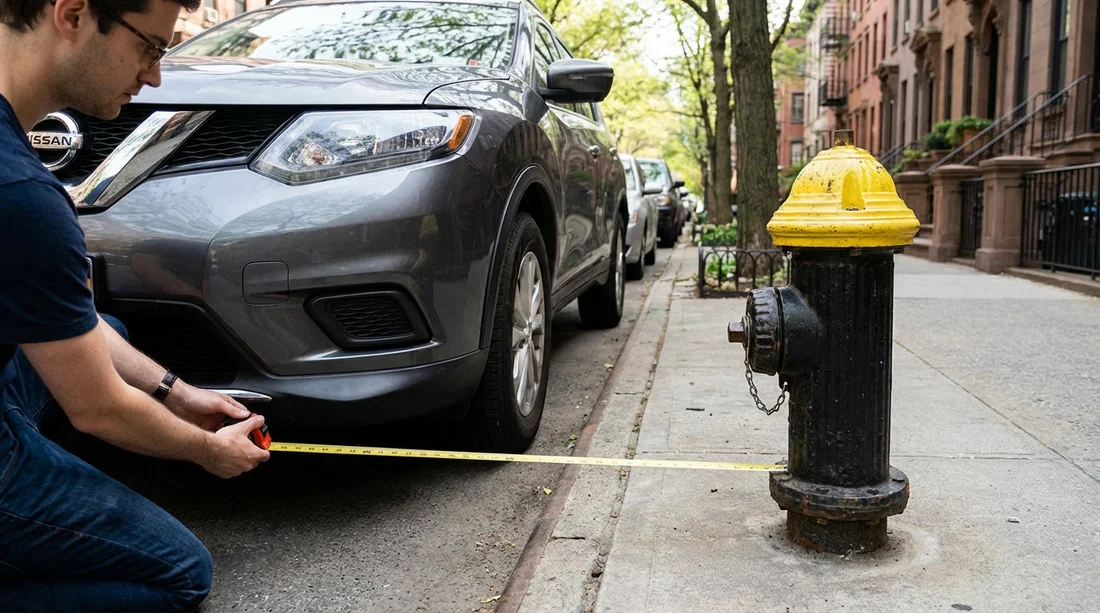
Quick Summary:
- In New York, keep at least 15 feet from any fire hydrant.
- Measure quickly using five adult paces, or your car’s length as reference.
- Always measure from the hydrant itself to the nearest part of your vehicle.
- Ignore painted kerbs alone, tickets apply even without markings.
If you are driving in New York, the fire hydrant rule is one of the easiest to misunderstand and one of the quickest to earn you a ticket or tow. Visitors used to different UK or European kerb markings can get caught out because New York does not rely on consistent painted cues, and enforcement is strict in busy neighbourhoods.
The simple part is the legal minimum distance. The practical part is measuring it fast, especially on narrow streets, at night, or when other parked cars obscure the kerb. This guide explains the rule, how to measure it in seconds, and the common sign and street cues that lead people astray.
The legal rule in New York: 15 feet from a fire hydrant
In New York, you must not park within 15 feet of a fire hydrant. That is the baseline rule drivers need to follow in the city and across the state. The purpose is to leave firefighters a clear working space for hoses and access.
Two details matter for real-world parking:
1) It is distance, not visibility. Even if the hydrant is “not really blocking anything” or there is plenty of road width, the 15-foot buffer still applies.
2) It is measured to your vehicle. The distance is effectively the gap between the hydrant and the nearest part of your car. In practice, that means your bumper corner or front end is what counts, not your tyres or the middle of your vehicle.
If you are visiting New York with car hire, assume enforcement will not give you the benefit of the doubt. Officers can ticket based on their judgement of distance, and you do not want to be measuring after you have walked away.
How to measure 15 feet quickly, without a tape measure
Fifteen feet sounds specific, but you can estimate it accurately enough with a couple of quick hacks. The key is to use consistent references, then check the gap from the hydrant to the closest point of your vehicle.
Quick measuring hacks that work on New York streets
Use five normal walking paces. For many adults, a normal pace is roughly 2.5 to 3 feet. Five paces gets you to about 12.5 to 15 feet. If you are not sure, take six paces and give yourself extra room. This is the fastest method when you are alone.
Use your vehicle length as a rough ruler. Many common saloons are around 14 to 16 feet long. If the front bumper of the car you are parking behind is about one car length away from the hydrant, you are close to the legal buffer. Because models vary, add a bit of extra space and avoid “just one car length” if you are unsure.
Use kerb slabs and street features. In some areas, kerb stone sections and sidewalk expansion joints create repeating lengths. These vary, so do not treat them as an exact ruler, but they are helpful for confirming your pace count. If you count joints and they suggest you are short of the buffer, move back.
Use a phone measuring tool carefully. Some phones have measuring apps that use the camera. They can be good for a quick check, but accuracy depends on lighting, angles, and whether you can clearly see the hydrant base and your bumper. Treat it as a secondary check, not your only method.
When in doubt, add margin. The best hack is simply to leave more than 15 feet. New York parking spaces are often tight, but shifting back even another half-metre can make the difference between a safe park and a fine.
If your trip starts around Newark, you may notice street rules change quickly as you cross areas and boroughs. Having a consistent measuring habit helps no matter whether you are heading into Manhattan for the day or navigating residential streets after picking up from car hire at Newark Airport.
Where do you measure from, exactly?
Drivers often mis-measure because they pick the wrong start or end point. Use this simple method:
Start point: the fire hydrant itself. Stand next to the hydrant and look at the nearest part of your car.
End point: the closest part of your vehicle, usually a bumper corner. Do not measure to your wheel or to the centre of your car.
Measure along the kerb line: think of the distance as the “no-parking zone” length alongside the kerb. If you are angled out, the closest point might not be aligned with your wheel, so check the protruding corner.
Consider overhangs: if your bumper sticks out past your tyres, that bumper is what can violate the distance.
A quick habit that helps is to park, then step out and do the pace count from the hydrant to your nearest bumper corner. It takes ten seconds and saves hassle later.
Common sign and kerb cues that catch visitors out
In some countries, kerb paint or explicit signs are the main signal. In New York, you will see painted kerbs sometimes, but they are not consistent enough to rely on. Here are the traps that often catch visitors:
Assuming “no paint means it is fine”. Many streets have no special paint around hydrants. The rule still applies, and enforcement still happens.
Assuming a painted kerb gives the correct length. Even when there is paint, do not assume it represents exactly 15 feet. Paint can be faded, extended, or repainted inconsistently after roadworks.
Confusing parking regulation signs with hydrant rules. A sign might say parking is allowed at certain times, but hydrant clearance is separate. A “parking permitted” window does not permit parking in the hydrant buffer.
Thinking “I am not blocking the hydrant”. Firefighters need space to connect hoses quickly. Your car does not need to be directly in front of the hydrant to interfere.
Misjudging distance on short blocks. Some New York blocks are crowded with multiple driveways, hydrants, and loading rules. It is easy to squeeze in where the gap looks big enough, but it is actually 10 to 12 feet.
If you are using car hire near Newark EWR as your starting point, build these checks into your routine early, before you reach the densest parts of the city where the margins are smallest.
What about being “double-parked” briefly, or stopping with hazards on?
People often treat hydrants as “okay for a minute” zones, especially for loading or dropping someone off. In practice, stopping in the hydrant buffer can still create a problem, and it can still attract enforcement if you are unattended or obstructing access. If you need to stop, choose a legal loading zone or a metered area where stopping is permitted, and keep clear of hydrants regardless.
Hydrants near corners, crosswalks, and driveways: how to decide fast
New York streets often combine multiple restrictions. A hydrant can sit near a corner or beside a driveway, which can make the “best” space illegal for more than one reason. Use a quick decision sequence:
Step 1: spot the hydrant first and mark the 15-foot buffer in your mind.
Step 2: check for any nearby corner or crosswalk restrictions that may also apply.
Step 3: check signs for time-based rules, meters, and loading limits.
Step 4: if you are forced to choose between a tight fit and moving on, move on.
This sequence keeps you from making a “legal on signs, illegal by hydrant” mistake.
Practical parking workflow for visitors with car hire
When you are unfamiliar with local street design, it helps to use a repeatable workflow each time you park:
1) Scan the kerb line. Before committing, look for hydrants, driveways, and any painted warnings.
2) Park with extra buffer. Aim for clearly more than 15 feet from the hydrant, not exactly 15.
3) Exit and verify. Do the five-to-six pace check from the hydrant to your closest bumper corner.
4) Photograph your position. A quick photo showing the hydrant and your car can help if you need to recall the scene later. Do this without blocking the pavement or standing in the road.
5) Re-check after parallel parking adjustments. If you move to align with the kerb, you might shift closer than you realise. Re-check before walking away.
This matters whether you are in a small hatchback or a larger people carrier. If your itinerary includes group travel or luggage, van hire from Newark EWR can change your judgement of overhang and turning space, so be especially cautious around hydrants on narrow streets.
What happens if you park too close?
Outcomes vary, but common consequences include a parking ticket and, in some cases, towing if your vehicle is considered obstructive. Even without a tow, returning to a ticket can disrupt your schedule and add unexpected cost to your trip.
Because hydrant clearance is a safety issue, it is not treated as a minor technicality. If you are travelling on a budget, it is worth being conservative with distance rather than trying to “make it fit”. That approach pairs well with planning tools like budget car hire options in New Jersey, where keeping extra room can help avoid the most avoidable fines.
How to handle tricky situations: blocked hydrants, snow, or poor visibility
Hydrant partially hidden by another vehicle: if you cannot clearly see the hydrant, assume it is there and choose a different space. Hydrants can sit between cars and only be visible from one angle.
Snowbanks and ploughed kerbs: snow can hide both hydrants and the true kerb line. Measure to the hydrant as best you can, but add extra margin because your car may end up closer once the snow shifts or melts.
Night parking: poor lighting makes camera-based measuring less reliable. Use paces, and leave extra space.
Unfamiliar vehicle dimensions: if you have just collected keys and are still judging length and bumper overhang, take an extra moment. It can help to note the approximate length class of your vehicle and remember that the bumper corner is what matters.
FAQ
How close can you legally park to a fire hydrant in New York? You must stay at least 15 feet away from a fire hydrant. Give yourself extra space if you are unsure of the measurement.
How do I measure 15 feet quickly without tools? Use five to six normal walking paces from the hydrant to your nearest bumper corner. If your stride is short, take six paces to stay safely outside the buffer.
Do I still need to keep 15 feet away if there is no painted kerb? Yes. The hydrant clearance rule applies even when there are no markings, and paint can be inconsistent or faded.
Where exactly is the distance measured from? Measure from the hydrant itself to the closest part of your vehicle, typically a bumper corner. Check for any protruding overhang after you finish parking.
Can I stop briefly near a hydrant for loading or drop-off? It is risky. Stopping in the hydrant buffer can still lead to enforcement and may obstruct emergency access, so choose a legal loading area instead.






























































































